Which Hull Record Label Killed The Pop Career Of A 70s TV Tough Guy?

A cautionary tale of ambition, ineptitude and fraud featuring a current Emmerdale star. Uncovered by our singing detective correspondent Angus Young.
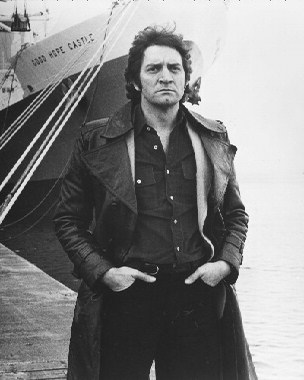
Patrick Mower, just after stepping off a trawler.

From The Sex Pistols’ God Save The Queen to Donna Summer’s I Feel Love, 1977 was a year to remember for music fans. It also marked a high point for singing TV detectives with David Soul taking time off from Starsky and Hutch to reach Number One with Silver Lady. Two years earlier, Telly Savalas had also topped the charts with a cover of the Bread song ‘If’ while playing the lollipop-loving New York cop Kojak. Surely the time was right for one of Britain’s best-known TV tough guys to follow in their footsteps?

In the 1970s, Patrick Mower was never off the telly. He followed up his breakthrough role as a ruthless assassin in the spy series Callan to star as a detective in the hard-hitting police drama Special Branch before playing the main no-nonsense detective in Target, the BBC’s answer to The Sweeney. In addition, he was also a regular face on celebrity panel shows, adverts and films such as Black Beauty.

Then, in 1977, the actor who once auditioned to play James Bond revealed he was launching a pop career. In a newspaper interview he revealed he had been waiting for the right song to come along and now it had – a love ballad called My Imagination. Not only that, he said he hadn’t just leapt at the first offers to come his way from record companies keen to cash in on its popularity on the box. Instead, he’d signed up with an obscure label in Hull called Koala Records.

It seemed a strange choice, The Beverley Road-based label didn’t exactly have a roster of big name artists on its books. Instead, its less than extensive back catalogue included debut albums by two never-to-be-heard-of-again folk groups and a LP of Christmas carols sung by the York Philharmonic Male Voice Choir and pupils from a primary school in Bradford. The signing of Mower seemed to mark a shift in direction for the label. As well as his debut single, Koala also scheduled a new single release by New Faces finalist Eve Adam at the same time.
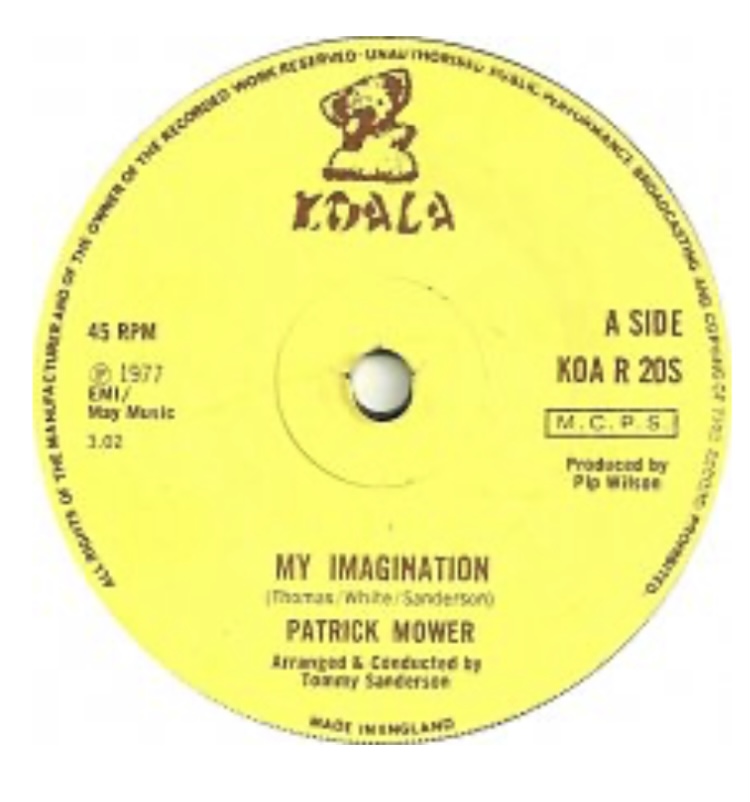
The only evidence we could find of Patrick Mower’s pop career.

However, things didn’t go quite as planned as revealed in a subsequent story in The People under the headline: Patrick Singing The Blues. “The record was never released and I haven’t received a penny from it,” said Mower. Producer Tommy Sanderson wasn’t a happy man either, blaming a lack of promotion by Koala “It was a lovely song and Patrick has a nice, gentle voice – not like his tough TV image,” he added.

Mower wasn’t the only star let down by the label. The People also discovered magician Paul Daniels had suffered a similar experience having recorded a song for Koala. “I made a sad ballad called Do A Little Magic For Me with a send-up of Perry Como’s Magic Moments on the flip side but the record was never released. It was a pity because it wasn’t bad at all,” said Daniels.

According to the story, “real-life detectives” were now looking into the company’s affairs. Owner and managing director Richard Mackenzie said: “We found financial irregularities and immediately called in the fraud squad. The matter is still under investigation.” He claimed the label’s problems had surfaced at the same time as Mower’s debut single was due to be released. “The books are still being sorted out but Patrick won’t be getting much because fewer than 1,000 discs were sold. We were quite happy to persevere and wait for another suitable song but he appeared to lose interest.”

Four years later Mackenzie was jailed for six months at the end of four-week trial at Doncaster Crown Court after being found guilty of four dishonesty charges relating to Koala and other business ventures. During the trial, the jury heard Koala’s creditors were owed around £6,000 when it eventually ceased trading. A former Conservative councillor in Hull, he was also disqualified from being a company director for five years. Passing sentence, Judge John Henham said Mackezie had used his undoubted talents to deceive others.

Today ‘70s TV tough guy Mower is still on the box playing ageing lothario Rodney Blackstock in the hit soap Emmerdale. The last time I saw Mackenzie a couple of years ago he was representing a convenience store owner at a city council licensing committee hearing into allegations of illegal cigarettes being sold under the counter. As for My Imagination, it’s now a rare collectible slice of vinyl with original copies currently being advertised on Ebay with a £25.23 price tag.

Angus Young

How Did A Witch Knock Hull City Out Of The Cup?

Our sporting necromancy correspondent Phil Ascough recounts a 50-year old tale of sorcery, spells and spoiled seasons.

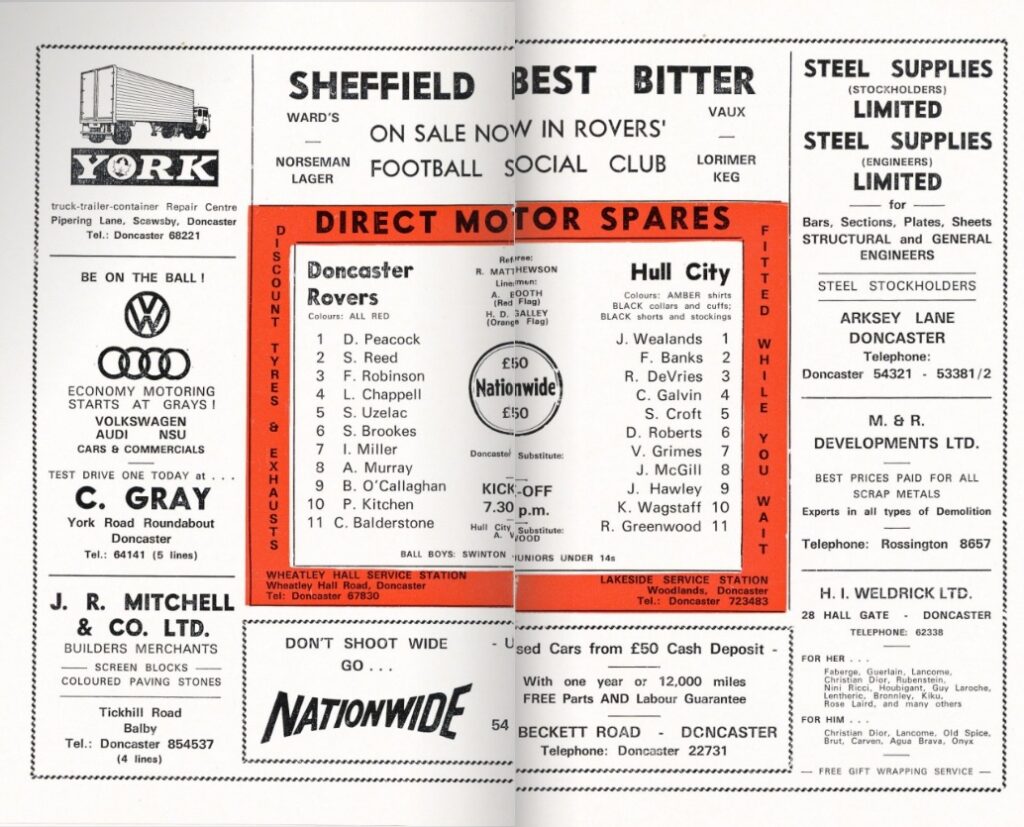
The programme from the bewitched day.

It’s quarter finals week in the Carabao Cup, just two games from a showpiece Wembley final, and this season’s competition marks a bizarre anniversary for Hull City. Fifty years ago they really should have taken their place in the last eight of the competition – then known simply as the League Cup. As a Second Division team they should have been heading to play the mighty Spurs, then managed by former City boss Terry Neill, at White Hart Lane.

But they had lost 2-1 in the fourth round at Doncaster Rovers  on 11 November 1975, despite dominating a match against a team two divisions below the Tigers. Defeat was entirely beyond their control. Not the result of a dubious penalty, the ball deflecting off an unseasonal beachball, a sudden gust of wind or the keeper missing a shot after being dazzled by the floodlights. No, Hull City lost the match because a witch put a good luck spell on Donny.

Rovers sat sixth in the Fourth Division table and the attendance of 20,476 was evidence that home fans sensed an upset. Their manager, genial and wily north easterner Stan Anderson, seemed a little apprehensive in his match programme notes – or maybe it was mind games. He wrote that City’s attendances were “among the poorest in the second division” and victory would give them a chance of “a big tie and a packed house at Boothferry Park”. He added: “One of the game’s top strikers is on view tonight in Ken Wagstaff. With a top club there’s little doubt that Ken would have been in the England set-up. Injuries over the last three seasons may have taken their toll but he’s still a player to be reckoned with. Let’s hope for a cracker tonight!”

City boss John Kaye and his team must have been fancying their chances as they headed west to Donny’s old Belle Vue ground. A Tigers line-up which included Ken Wagstaff, Alf Wood, John Hawley and Roy Greenwood should have had enough firepower to see them through, with Jeff Wealands a safe pair of hands in goal. But City couldn’t have imagined having to overcome the talents of my mum’s friend Connie, who worked as a secretary in Doncaster Rovers’ office and counted white witchcraft among her hobbies.

The team never stood a chance against the powers of Witch Connie.

Connie told me her story when we met a couple of years after the match. I had just started a career in journalism. My mum was a district nurse in Doncaster and said I should go and see Connie, who worked 30 hours a week for the health authority, lived just a couple of villages away, and made great pizza.

Connie revealed she had been interested in the occult for as long as she could remember and her interest ranged from simple herbal remedies to actual experiments in witchcraft. She had cast spells over the years to help her friends move house, get married and become pregnant. A woman from Thorne told me that Connie hit the post with one pregnancy attempt involving a few stones and bits of a tree from Glastonbury. “I didn’t get pregnant,” the woman said. “But a lot of my neighbours did, and all the gardens bloomed!”

I was at the match at Belle Vue and remember Greenwood tormenting Donny’s defence. Wood scored for the Tigers but Connie’s witchcraft kept Waggy at bay. Goals from Peter Kitchen and Ray Ternent won the match for Rovers. Connie told me she had spent the early evening of the match touring the area near her home and collecting laurel leaves which she used to prepare a spell to give the team good luck.

Three weeks later hordes of Rovers fans decamped to White Hart Lane. I watched again as Donny turned on the style, took the lead, fell behind at the interval but equalised early in the second half. Rovers were rampant and would surely have won the game but for the wizardry of Pat Jennings in the Spurs goal. But just a minute after Kitchen’s equaliser, Donny’s captain Les Chappell rolled a back pass to the keeper, who missed it. 3-2, and the match ended 7-2 as the magic unravelled – or did it?

Phil’s account of the game hits the newsagent’s shelves.

Connie told me she had only ever done one “dirty deed” and felt it was time for another: “By then I had had enough. The players began to think it was all down to them, so I gave up.” She didn’t stop there, for good measure adding a curse to stop Rovers from winning promotion for at least four seasons.

After beating the Tigers, Rovers won their next game but then embarked on a disastrous run of eight defeats in ten league games and dropped to 12th in the table. A run of form took them up to eighth, just three points off a promotion place, before, mysteriously, they fell away again. Rovers won only one of their final ten games and finished 10th. They spent four more seasons in Division Four before winning promotion.

After meeting Connie I rang Stan Anderson to ask him if he remembered her. He said: “Remember her? How could I ever forget her?”

Phil Ascough