

Eyes down for a tale of fraud, full houses and fat ladies as our illegal gaming correspondent Angus Young gets his card marked.

Fraud cases come in all shapes and sizes. Perhaps the most notorious recent example is John Darwin, who faked his own death in 2002 in a canoeing accident to allow his wife Anne to collect his life insurance. Unknown to the insurance company, he was alive and well and secretly living in the house next door in Seaton Carew.
Hull’s most famous fraud case stayed very much on dry land but left hundreds of bingo fans across the city up the creek without a paddle, cheated out of thousands of pounds in cash prizes. It actually involved two scams – one lasting a few weeks and the other spanning the best part of 18 months – and both centred on one of Hull’s top venues at the time – the Phoenix social club in Hessle Road.
The first fraud was relatively crude. It involved the club’s owner Michael Brown calling out the numbers in bingo games and manager Albert Penhallurick checking the card when a win was called out. Unknown to those playing, the punter who called a win hadn’t won fairly at all. Instead, along with the club’s card checker, he was in on the scam with a predetermined set of numbers already agreed and shared by the four men. The resulting cash prize was then split between them.
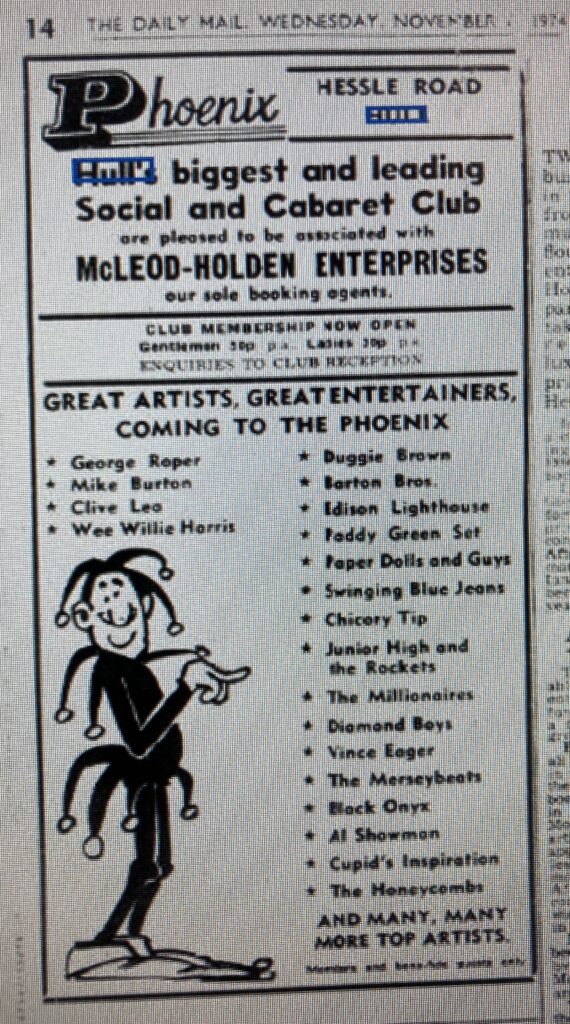
The second con featured the same routine but much bigger cash prizes. This was because it involved a series of so-called ‘link bingo’ games played simultaneously in 19 social clubs across Hull. The group of clubs operated under the New Allied Bingo Club banner, with the Phoenix acting as a nerve centre where the balls would be drawn, their numbers called and relayed to each venue via a radio system. Brown was also New Allied’s treasurer. Under link bingo, tickets were sold at each club up to a predetermined time, usually before mid-evening interval. This was intended to allow the numbers of tickets sold at each club to be telephoned through to the Phoenix to allow the prize money to be calculated before each game. A small CCTV camera was set up to film the balls as they appeared from the machine in a move designed to convince players at the other clubs everything was above board.
However, when some games were underway the camera would helpfully not work properly while the interval was used by those involved in the fraud to get into their positions. With Brown once again directing operations, 88 games were fixed in the same way as the initial fraud. In many cases, so-called ‘runners’ sitting next to ‘winners’ would use the interval to race to the Phoenix control room to double check the agreed numbers would be announced later in the evening. Some of the runners at outlying clubs would phone in to make similar checks. Overall, the gang shared prize money totalling £14,314.
Inevitably, suspicions were eventually raised and the police were called in. The subsequent investigation led to charges being brought against 23 men who all eventually admitted their part in the swindle.
When they all appeared for sentencing at York Crown Court in March 1977 the place was packed. The men were represented by 15 barristers and it took half an hour to read out all the 32 charges against them. Mastermind Brown, who pleaded guilty to 26 offences, was given a 12-month jail sentence suspended for two years. His brother-in-law Stephen Evans was handed a nine-month sentence suspended for two years. Most of the others were given fines ranging from £10 to £500. All of the men were connected to the Phoenix while none of the other club proprietors were implicated in the racket. In passing sentence, Judge Stanley Price said: “There could not be a case which more clearly underlines that dishonesty does not pay.”
The scandal cast a shadow over the Phoenix’s reputation but the venue was already living on borrowed time. By the end of the decade it had been demolished to make way for the new roundabout under the Daltry Street flyover as part of the construction of the new Clive Sullivan Way dual carriageway.