

Our Victorian socialite correspondent Angus Young profiles a well-known shipping magnate’s daughter while introducing us to the words automobilist and faiseurs.
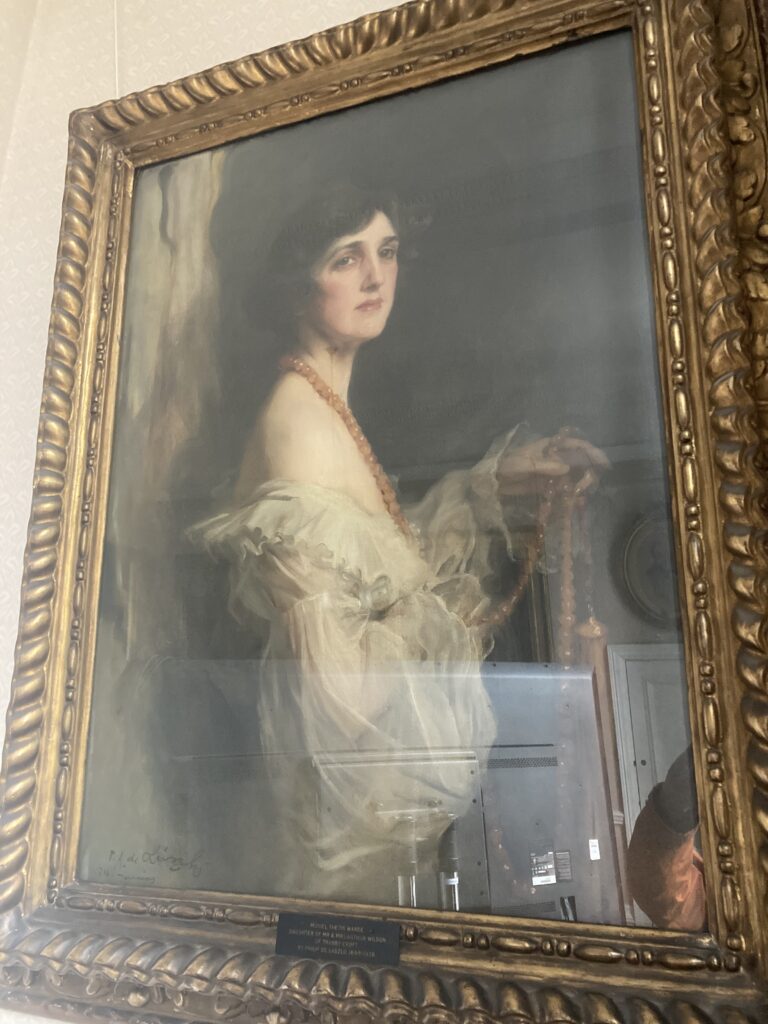
She was once known as the most beautiful woman in Britain. However, there was far more to Muriel Wilson than her striking looks. The youngest daughter of Hull shipping tycoon Arthur Wilson also had a strong mind of her own. So much so that when a young Winston Churchill asked her to marry him, she famously turned him down. Indeed, her unwillingness to tie the knot with a number of British and European aristocrats who also sought her hand in marriage earned her the nickname ‘Dear Lady Rejection’.
Born in 1875, her childhood was divided between the Wilson family home at Tranby Croft in Anlaby and her father’s London residence in fashionable Grosvenor Square. Her family’s fortune obviously gave her a head start in life and she mixed with high society from an early age. By the time she was a teenager she was representing the family at various events. At the time, the Wilsons were Hull’s equivalent of the Royal family and Muriel became an increasing focus of attention.
Displaying a talent for both acting and dancing, she also had a keen eye for fashion and was a regular client at Madame Clapham’s famous dress-making salon in Kingston Square. Newspaper and magazine reports on her emergence as a young socialite suggest she enjoyed making bold fashion statements with her choice of designs and colours.
An 1885 Vanity Fair feature on lady cyclists noted a new trend of ladies riding bicycles without touching the handlebars and namechecked a certain young woman from Hull. “Miss Muriel Wilson always makes a sensation when she rides into Hull with her hands behind her, or holding up a crimson parasol,” it said.
Four years later the New York Times reported on her eye-catching arrival in the city ahead of a tour of America, describing her as “one of the most beautiful and accomplished as well as one of the most eccentric girls in British high society.” It added: “Miss Wilson is beautiful and is obviously conscious of the fact. Her face is small and oval with no colour to speak of but a complexion so dark as to verge on olive. She has large, dark, lustrous and very expressive eyes. Her mouth is small, as is also her nose which is shapely. Her admirers are legion and her engagement to several well-known members of the British aristocracy has, at various times, been reported and contradicted. At present, she is understood to be fancy-free.”
She combined her whirlwind social life with charity work in Hull, mostly involving the poor. She also began to be known as a leading figure among a group of unmarried wealthy women who operated outside the traditional norms of a male-dominated high society.
In another Vanity Fair article in 1908, the magazine’s columnist Candida penned an open letter to Muriel praising her as a “leading light” in this new movement, highlighting her skills as a linguist (she spoke fluent French and Italian), her bravery as an “automobilist” and her “admirable recklessness”at the casinos in Monte Carlo. Candida also touches on Muriel’s Hull roots. “There is much to admire in the loyal way in which you deal with Hull and its tradespeople. Many women in the smart set with less ample resources would have every rag they wore from the best dressmakers in London and Paris but you employ local faiseurs who, indeed, seem to turn you out in first-rate style and in a most becoming manner. Even your court gowns often hail from Hull and your smartest hats are put together by the hands of homegrown modiste. This line of action shows a keen sense of justice and one supposes a certain grain of self-sacrifice.”
Muriel would eventually marry in 1917 in Anlaby after meeting her future husband, Lieutenant Richard Waude, while working as a nurse caring for wounded officers at her sister’s townhouse in London. The couple would spend most of their married life in the capital and in the South of France at another Wilson family residence. After her husband’s premature death in 1932 Muriel never remarried. Instead, she returned to a house in London where much of the impressive Wilson-owned art collection covered the walls.
On her own death, she bequeathed most of the collection, including Canaletto’s “A View Of The Grand Canal”, to the Ferens Art Gallery, stating: “I owe everything to Hull.” Two striking portraits of Muriel can also be found in a small committee room in the Guildhall along with other Wilson-related artworks.
Angus Young