How Many Air Raid Warnings Were Sounded In Hull During WW2?

The remarkable story of diarist Winifred Essen and her exceptional and essential note-taking is relayed by our siren chronicling correspondent Angus Young.

Queen Victoria Square, the morning after an air raid.

Sometime on 4th September 1939 Winifred Essen picked up a pencil and carefully detailed the events of the night before on the first page of a small notebook. “Warning: 2.40am. All clear: 3.30am. Sirens: 1. Date: Sep 4th. Description: First night of the war. Length: 50 min.”

Thanks to the 25-year-old grocery shop assistant’s diligent record-keeping we now know just how many times air raid sirens were activated in Hull during the Second World War, giving a new and sometimes terrifying insight into what life must have been like in the city at the time. For Winifred continued making hand-written notes about each warning siren for the duration of the war, recording the length of each episode to the exact minute. She also added brief details about certain air raids including the numbers of people known to have been killed or injured, some of the types of bombs involved, the places and buildings damaged and even the weather at the time as well as snippets of national and international  news about the war.  

Overall, she counted sirens being sounded in Hull on no fewer than 823 occasions during the war. The shortest siren lasted just eight minutes. The longest on 18th March 1941 continued for eight hours and 50 minutes. On some days, there were multiple siren bursts. On 7th March 1941, the first siren sounded at 11.41am and was followed by three more ending at 5.46pm.
Bomb damage on Ella Street.

Not every warning siren was followed by bombs being dropped on Hull or the surrounding area. In her notes, Winifred records some sirens going off as Luftwaffe bombers flew high over Hull thought to be heading for targets such as Sheffield and Liverpool. On some nights, she simply states: “Nothing to report”

However, other descriptions capture the sheer terror of warfare arriving on Hull’s doorstep. “Warning: 11.30pm. All clear: 4.25am. Siren: 1.Date Aug 24th. Hull’s biggest raid to date. Dropped high explosive and screaming bombs. Heavy gunfire. A lot of planes over. Dropped flaming onions and tracer bullets. One of our planes hit and caught fire, pilot jumped in parachute. 8 killed, 62 injured. 2 shelters hit. 3 children of one family killed.

It’s thought she filled two notebooks (only one survives) before transferring her records at a later date into a single handwritten chronology which she kept until her death in 1996. Having never married and with no immediate family, she left no will. As a result, it’s believed that her belongings – including her chronology and notebook – were eventually sent for auction.

A page of Winifred’s notes.

After being bought by an antique dealer as a job lot, they remained untouched in a box of items until 2023 when the Nottingham-based dealer returned to Hull and offered them to bookbinder Stephen Ingram, who is based at the Carnegie Heritage Centre in Anlaby Road. Once the sale was agreed, the chronology was found but without featuring the author’s name. However, the items also included Winifred’s National Identity Card so volunteers at the Carnegie began piecing together both her story and the remarkable document she had created during the war.

Their combined efforts, which ranged from tracing Winifred’s surviving family to identifying some of the words and abbreviations she used in her handwritten notes, have helped turn the forgotten chronology into a new book – Hull, World War Two’s Forgotten City, published by the Carnegie Heritage Centre. The book also attempts to answer the question of why a young grocery shop assistant living above the family shop in Clough Road embarked on such a personal and detailed diary of the air raids.

Editor Christine Pinder, who also researched Winifred’s life, discovered she enrolled as a fire guard in 1943 and may well have carried out an undocumented voluntary role in air raid operational work before then. As such, she would have been privy to much detail about the bombing raids on Hull and the timings of when the warning sirens were turned on and off. Christine said: “The level of detail in Winifred’s chronology is considerable and how she accumulated this has been the subject of much discussion among the Carnegie volunteers and others who have seen it. We will probably never know  for certain.”

Angus Young

Who Cheated Who In The Great 1970s Hull Bingo Scandal?

Eyes down for a tale of fraud, full houses and fat ladies as our illegal gaming correspondent Angus Young gets his card marked.

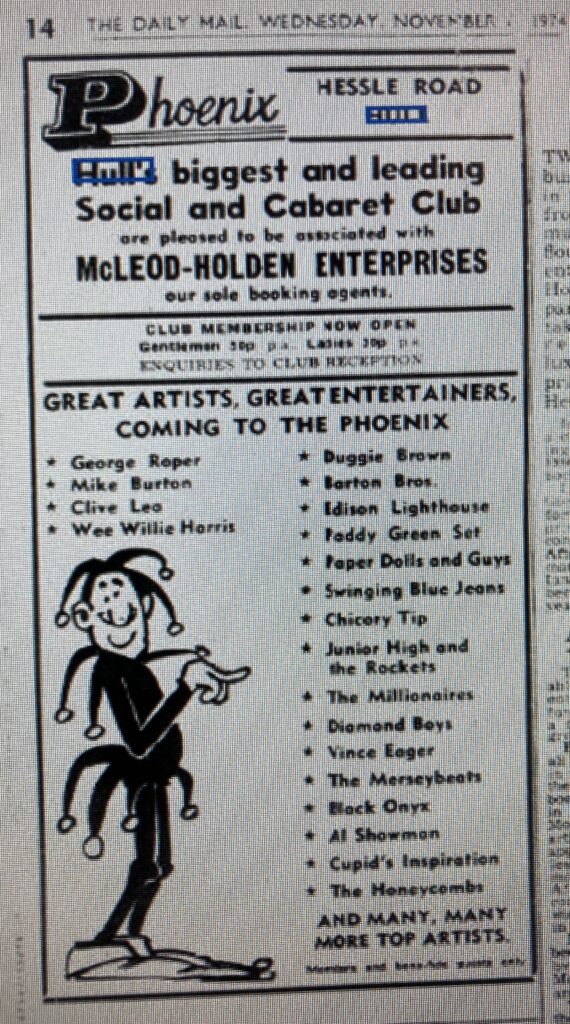
The Phoenix Club, sometime in the seventies.

Fraud cases come in all shapes and sizes. Perhaps the most notorious recent example is John Darwin, who faked his own death in 2002 in a canoeing accident to allow his wife Anne to collect his life insurance. Unknown to the insurance company, he was alive and well and secretly living in the house next door in Seaton Carew.

Hull’s most famous fraud case stayed very much on dry land but left hundreds of bingo fans across the city up the creek without a paddle, cheated out of thousands of pounds in cash prizes. It actually involved two scams – one lasting a few weeks and the other spanning the best part of 18 months – and both centred on one of Hull’s top venues at the time – the Phoenix social club in Hessle Road.

The first fraud was relatively crude. It involved the club’s owner Michael Brown calling out the numbers in bingo games and manager Albert Penhallurick checking the card when a win was called out. Unknown to those playing, the punter who called a win hadn’t won fairly at all. Instead, along with the club’s card checker, he was in on the scam with a predetermined set of numbers already agreed and shared by the four men. The resulting cash prize was then split between them.

A mid-seventies newspaper ad for the Phoenix Club.

The second con featured the same routine but much bigger cash prizes. This was because it involved a series of so-called ‘link bingo’ games played simultaneously in 19 social clubs across Hull. The group of clubs operated under the New Allied Bingo Club banner, with the Phoenix acting as a nerve centre where the balls would be drawn, their numbers called and relayed to each venue via a radio system. Brown was also New Allied’s treasurer. Under link bingo, tickets were sold at each club up to a predetermined time, usually before  mid-evening  interval. This was intended to allow the numbers of tickets sold at each club to be telephoned through to the Phoenix to allow the prize money to be calculated before each game. A small CCTV camera was set up to film the balls as they appeared from the machine in a move designed to convince players at the other clubs everything was above board.

However, when some games were underway the camera would helpfully not work properly while the interval was used by those involved in the fraud to get into their positions. With Brown once again directing operations, 88 games were fixed in the same way as the initial fraud. In many cases, so-called ‘runners’ sitting next to ‘winners’ would use the interval to race to the Phoenix control room to double check the agreed numbers would be announced later in the evening. Some of the runners at outlying clubs would phone in to make similar checks. Overall, the gang shared  prize money totalling £14,314.

Inevitably, suspicions were eventually raised and the police were called in. The subsequent investigation led to charges being brought against 23 men who all eventually admitted their part in the swindle.

When they all appeared for sentencing at York Crown Court in March 1977 the place was packed. The men were represented  by 15 barristers and it took half an hour to read out all the 32 charges against them. Mastermind Brown, who pleaded guilty to 26 offences, was given a 12-month jail sentence suspended for two years. His brother-in-law Stephen Evans was handed a nine-month sentence suspended for two years. Most of the others were given fines ranging from £10 to £500. All of the men were connected to the Phoenix while none of the other club proprietors were implicated in the racket. In passing sentence, Judge Stanley Price said: “There could not be a case which more clearly underlines that dishonesty does not pay.”

The scandal cast a shadow over the Phoenix’s reputation but the venue was already living on borrowed time. By the end of the decade it had been demolished to make way for the new roundabout under the Daltry Street flyover as part of the construction of the new Clive Sullivan Way dual carriageway.

Angus Young

Where Is Hull’s Other Garden Village?

Another interesting tale for the ‘Well I Never Knew That’ file from our unrealised suburbs correspondent Angus Young.

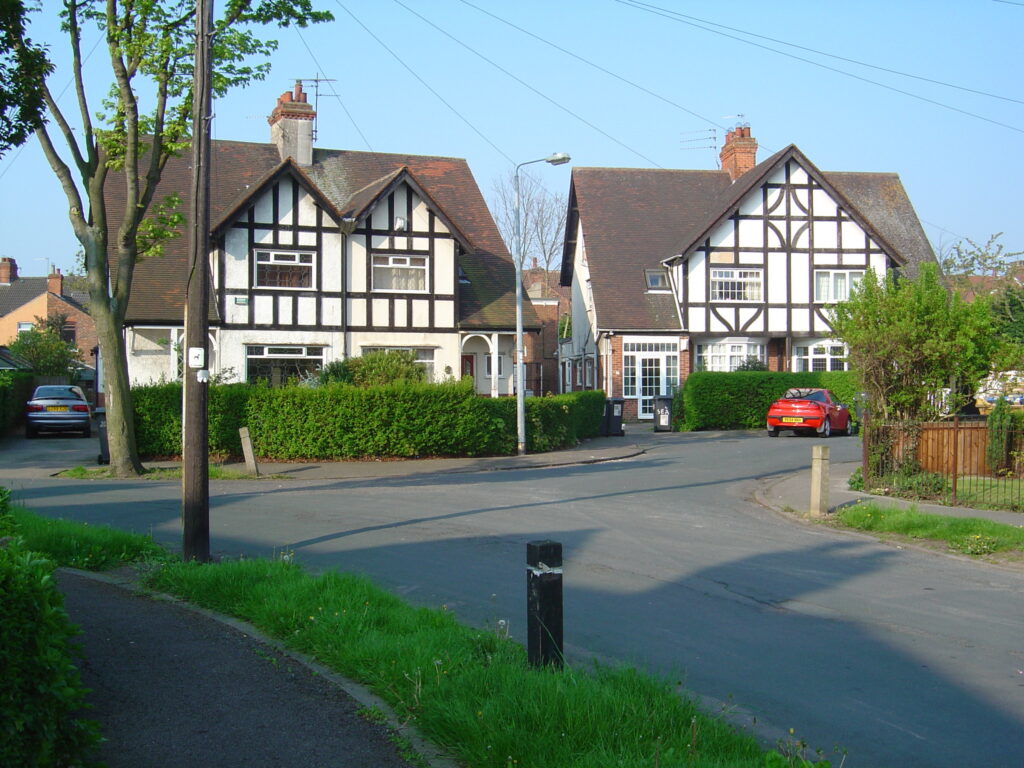
Garden Village – or is it, yesterday.

Sir James Reckitt’s Garden Village is rightly regarded as one of the gems of East Hull. Constructed between 1907 and 1913, the village featured 600 houses built on 140 acres of land with most of the new homes being occupied by employees of the famous company bearing the philanthropist’s name. Today the neighbourhood retains much of its original charm and is still a popular place to live.

However, relatively few people know about another similar but much smaller historic model village on the other side of Holderness Road.

Just after the First World War, the British Oil and Cake Mills Ltd. (BOCM) bought 42 acres of land to build facilities and services for its employees. The plans included up to 500 houses along with a library, concert hall, social club, tennis courts and a pavilion, cricket and football pitches and even a 15-foot wide cinder running track. The first phase of the BOCM garden village was opened in 1921 featuring 56 houses on the south side of The Broadway and one fully completed street – Seafield Avenue.

To avoid uniformity, there were 11 different house types of four different sizes laid out as either semi-detached pairs or short terraces. The aptly-named Sunshine Houses were built in terraces of just four properties, each one with large living rooms positioned to get the sun throughout most of the day.

Further house-building was slow but Maybury Road was developed to the east as part of the original BOCM plan to form a boundary to the village. Intended residential development on the land in between halted when the Second World War began.

The war also saw the sports pitches and cinder track being used for anti-aircraft units while the construction of post-war prefabs on the remainder of the land originally purchased by BOCM effectively ended the stylish garden village project before it had really properly got underway.

Altogether, only 74 BOCM houses were built but thanks to original tree-planting, the intentionally wide spaced-out streets and a healthy amount of mock-Tudor panelling, there’s still a pleasing 1920s urban village feel to the place. As such, it’s officially recognised as a Conservation Area, The designation provides a degree of protection under city council planning policy when it comes to any new planning applications being considered.

Another BOCM legacy can also be found in Cleveland Street in the shape of the  company’s former social club which stands on the corner of Mulgrave Street. Built in 1904 for company employees, it was known as both the New Cleveland Club and the Pearson Club over the years. The landmark building is currently being converted into a residential home for adults with mental health issues.

Angus Young