
Back to Ours enthusiast Mark tells us what he loves about their North Hull chat shop.

Back to Ours enthusiast Mark tells us what he loves about their North Hull chat shop.

With the reunited Gallagher brothers returning to stadiums tonight, Nick Quantrill recalls the time they played somewhere much smaller.

It’s little more than an underground box, so this is a fair question for our subterranean immersion correspondent Angus Young to address.
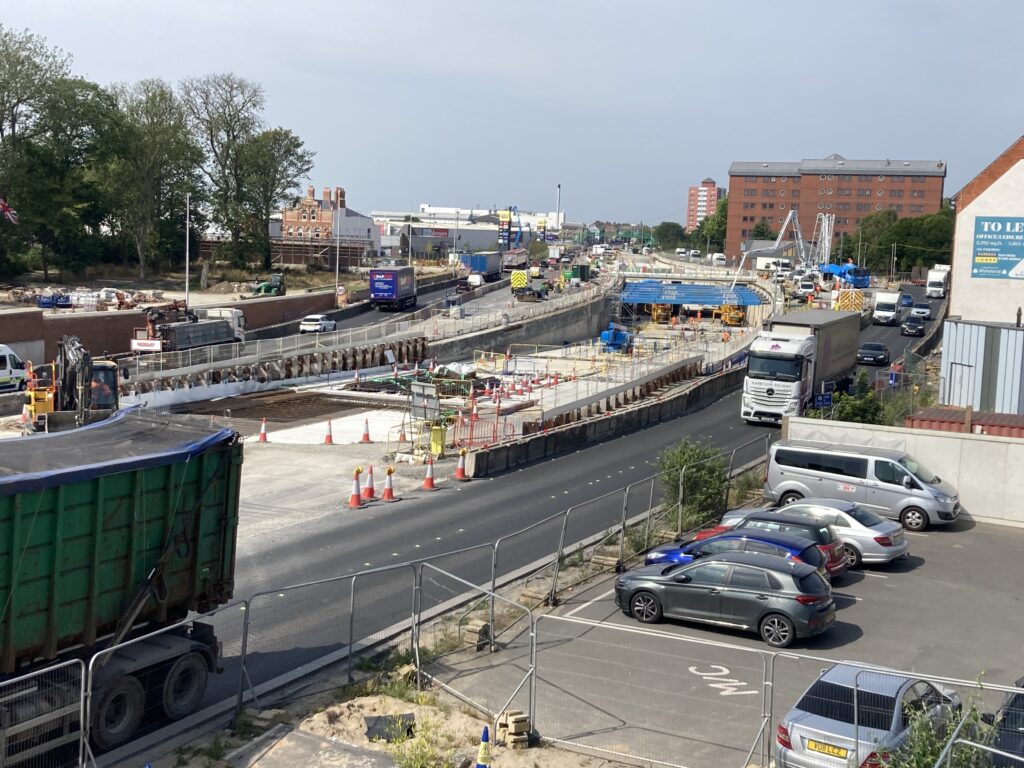
When you sink a road several metres underground in Hull it’s the obvious question to ask. As anyone who has driven under the section of Chanterlands Avenue which dips under a railway bridge will know, heavy rainfall usually creates a big puddle pretty quickly. So will the same thing happen on a much bigger scale in the underpass currently being built on the A63 at Castle Street in the city centre?
According to National Highways’ senior project director Fran Oliver, the answer is no.
Speaking at a recent city council scrutiny meeting, she gave details of the a new pumping station being constructed next the junction with Commercial Road which has been designed to keep traffic flowing once the new-look dual carriageway is finally finished in Spring next year, She said: “The pumping equipment in the building will serve the underpass in times when there is excess water from run-off from the road. It will have a huge capacity and it’s a really significant part of the overall scheme. Just to be clear, as well as dealing with normal run-off it is also designed for a flooding-type incident on the road. We are conscious it’s a big dip in the road and we know what water is like so we don’t want it to collect there. The pumping station is designed to deal with flooding although it’s more than likely to be triggered by excess rainfall on a more regular basis”
She said sensors inside the underpass will pass on real-time information on the build-up of any water. If large volumes need pumping out, water will initially be held in storage tanks before being gradually released into the city’s main drainage system.
“The pumping station will be connected to our regional control centre so they will know when to switch it on in the event of a problem if they need to override the automatic systems,” said Ms Oliver. “There’s a full emergency plan in place and National Highways also has mobile pumps which, in exceptional circumstances, can be brought here pretty quickly. Inside the station itself, there is a pump and a back-up pump as well as a power back-up.”
She said she had no worries about the underpass itself being able to withstand extra pressure from any flooding, however small. “The structure is incredibly robust. The concrete walls are capable of bearing an enormous amount of pressure and they go 27 metres deep into the ground. They are absolutely huge concrete walls and, together with the base slab, they are why it has taken us a little longer to install. We have tried to ensure that all the elements work together. For example, when we finish the base slab and take the props out, we won’t do anything for a week or so because we have got so much monitoring instrumentation to make sure everything is absolutely belt and braces.”
Because of the high water table in the immediate area, she said National Highways had opted to use concrete for the walls of the underpass instead of sheet piling which is more commonly used in similar construction projects elsewhere. “A lot of the design was influenced by the high water table. Huge volumes of steel and concrete have been put in, essentially to weigh it down because the water pressure is so great. Other underpasses might be constructed with sheet piles but they just wouldn’t be appropriate here because they wouldn’t be able to stand up to the strength of the water.”
When completed and fully open, the new underpass has been designed to have a 120-year lifespan.

When, where, why? Only Hull Tour Guide Paul Schofield can ferry us across the questions to the facts.

Artist Pippa Hale tells how the humble banana went from musa to muse. (Bonus points to anyone who gets that reference.)

Hull poet and legend Dean Wilson cropped up unexpectedly on Countryfile so our surprise TV correspondent Angus Young asked him about it.

Countryfile is one of BBC1’s most popular programmes and last night it featured one of our own local treasures. Self-styled Fourth Best Poet in Hull and Second Best Poet in Withernsea Dean Wilson appeared in an episode devoted to the beautiful natural wilderness of Spurn Point.
The beloved Curiosity contributor recently spent a day filming at Spurn with a three-man Countryfile crew. The results were screened on Sunday night as part of the latest programme in the long-running show which covers rural, agricultural and environmental issues.
Dean said: “I got a call from a researcher asking if I’d be interested in being featured in a programme they were planning to do about Spurn Point. It came a bit out of the blue but I couldn’t say ‘no’.”

On the day in question, Dean donned his trademark woolly hat and spent six hours being filmed on the peninsula. “It was a really great day because it was just like going for a day out at Spurn,” he said. “The crew were really nice, the weather was lovely too and I just talked about pebbles, poetry and what’s it like living in Withernsea.
“They filmed me talking about the pebbles I pick up along the coast, reading three of my poems and going up the lighthouse at Spurn to enjoy the view. I also talked about going to Spurn as a kid. It’s always been a magical place for me. Even though we were there all day, I was told they would only probably end up showing three or minutes of me but I don’t mind. Hopefully when people see the programme it will help shift a few of my books and allow a few more people to discover my secret genius!”
Dean watched the show on his settee at home in With, although he admits to not being Countryfile’s biggest fan. “I don’t really watch it very much,” he said. Was he nervous about the potential of suddenly becoming a national treasure after appearing on one of the BBC’s top-rated shows? “It’s either going to end up be the best thing I’ve ever done or I’ll never be able to leave the house again,” he said.
The Spurn episode on Countryfile is now available to watch on the iPlayer.

We’ll give you a clue – it’s posh and minty. Full answer revealed by our extinct games correspondent Angus Young.

It was enthusiastically described in one newspaper as “a red-letter day in the history of local sport.” The day in question was Saturday, 9th May 1896, the occasion was the first ever competitive polo match in Hull and the venue was a new ground complete with stables off Westbourne Avenue.
The game of polo originated in Persia in the 6th Century before spreading into the Middle East, China and India where it was enthusiastically taken up by British tea planters and Army officers in the mid-19th Century. The first competitive game in England was played in Aldershot in 1870 between two cavalry regiments and the new sport spread quickly among Royalty and the nobility. It took another 26 years for the game to reach Hull.
“The picture formed by the gay appearance of the members’ stand and enclosure will no doubt linger long in the memories of those who assisted at the first appearance of the game of Polo in our midst,” continued the newspaper report. The two sides in the first match were simply titled ‘Married’ and ‘Single’. Among the former was George Houlton, founder of the construction company which still bears his name today.

It seems Hull’s high society turned out in force to witness the Single team record 6-5 victory with as much attention being paid to the fashionable dresses of the ladies present. However, the lack of any effective policing of the estimated 6,000 crowd led to complaints from those who had paid an admission fee only to end up rubbing shoulders with those who had gained entry without paying anything. According to one report, paying spectators in the enclosure had their views spoiled by the “assemblage of un-privileged in front of the rails”. Barriers were installed at the next match while screens were erected to prevent people standing outside the open ground having a free if distant view of the action.
The ground had been laid out on open land between Westbourne Avenue and Chanterlands Avenue which, at the time, only ran between Spring Bank West and Perth Street. It became home to the Holderness Polo Club, although the playing team was simply known as Hull.

Early matches against visiting teams did not go well with Hull losing 8-1 to York and then 10-0 to Leeds. Although results did improve and matches continued to attract Hull’s wealthiest figures in regular social gatherings, the last polo game at the ground took place in August 1907. The club’s demise seems to have coincided with a serious injury experienced by its best player Joss Stephenson in a fall from his horse a month earlier.
Another possible reason for its end was that most of the players who had started 11 years earlier were still in the saddle. Had they lost their enthusiasm for the game? Perhaps the expanding nature of Hull itself also forced them out.

In November 1908 city councillors were mapping out plans to extend Chanterlands Avenue to the high-level Hull and Barnsley railway line and connect the new route with extensions to Marlborough, Westbourne and Park Avenues. Within two years, these western extensions to the Avenues had been completed along with a new street called Perth Street West connecting to National Avenue and the new National Radiator Company factory.
A small terrace off Perth Street West was named Polo Villas to reflect the immediate previous history of the area. As for the rest of the ground, it was redeveloped with new housing.

Matt, of Humber Street Gallery, finally gets the the heart of the question we all really, really, really wanna zig-a-zig-answer to.

Chair of VHEY Chris Blacksell revisits a street that has played a huge part in his life.

Sarah, a senior producer for Middle Child, outlines what her job entails and how vital it is.