What The Heck Has Gregory Peck Got To Do With Hull?

Call me Ishmael! He’s at it again! Our cub reporter Angus Young just can’t help digging up obscure tales of random connections to the city.

There was a special reason for film fans to flock to Hull’s cinemas in November 1956 to see the latest Hollywood blockbuster Moby Dick. Starring alongside Gregory Peck as the obsessed Captain Ahab in the adaptation of Herman Melville’s famous novel was a very familiar ship. Two years earlier companies at St Andrew’s Dock normally engaged in maintaining Hull’s distant-water steam trawling fleet had been chosen by the film’s director and producer John Huston to help convert a three-masted schooner into Ahab’s whaling ship Pequod. Huston himself would later visit Hull to check on the progress of the work.

Gregory Peck (complete with wooden leg) on the deck of the ship

Originally built in 1866 in Lancaster and named the Ryelands, the vessel spent most of her working life transporting cargo around the British coast. However, in 1948 she was sold to film company RKO Pictures to be used as Long John Silver’s pirate ship Hispaniola in the Walt Disney adventure film Treasure Island. Treasure Island was a box office hit and Scarborough Council cashed in by purchasing the ship and mooring it at the harbour, converting the lower decks into an aquarium full of tropical fish.

By then, the council had also commissioned a quarter scale replica of the galleon to sail on Scarborough Mere as another visitor attraction. This mini Hispaniola was built in Hull by engineering firm Charles Pearson Ltd. and made its maiden voyage on the Mere in the summer of 1949. In its first summer season, it carried nearly 46,000 passengers to an island in the middle of the Mere where buried plastic doubloons were waiting to be discovered.

A few years later with Huston’s Moby Dick on its production schedule, Elstree Studios bought the Hispanioloa and hired the expertise of the company behind its replica to oversee its conversion from an 18th century English pirate ship into a 19th century American whaler. The resulting refit was extensive and involved a number of specialist firms based at the fish dock and in Hull.

The refitted ‘Pequod’ passing the Bullnose in Hull

The sails were made by ship chandlers and sail makers E.E. Sharp & Sons whose former premises in High Street is now part of the Sailmaker’s Arms pub. The rigging was made and fitted by Hall’s Barton Ropery which had a factory on St Andrew’s Dock while a team of carpenters and skilled craftsmen from engineering firm Humber-St Andrews not only created an entirely new cork deck for the ship but also designed and made numerous period features. They included the type of small boats used in close-quarters whale-hunting and the ship’s large wooden figurehead reputedly based on a real-life female chief of a 17th century Native American tribe although not the same tribe that gave the ship its name.

Peck’s performance as the Pequod’s captain divided opinion at the time of the Moby Dick’s release but is now regarded, along with the film itself as being the definitive big screen adaption of Melville’s novel.

The ship later appeared as the Sultana in the 1956 TV series The Buccaneers starring Robert Shaw as the captain of a swashbuckling crew of pirates. Four years later the ship was back in the same dock in Lancaster where it had been built after being bought by businessman Peter Latham. It was moved her to Morecambe to operate as a museum.

In 1972 the ship was sadly destroyed by a fire but the story doesn’t quite end there. Back in Scarborough, the Hull-built mini Hispaniola is still taking tourists for pleasure trips having relocated from the Mere to the town’s seafront.

Angus Young

Did Hull Have A Town Wall?

You’d think everyone would know this by now, but apparently not. Hull Tour Guide Paul Schofield gets to the truth of the matter.

What Is Hull Noir?

Murder! Death! Intrigue! Libraries! We go behind the monthly crime fiction events Null Noir and find out from the key players just whodunnit and why.

What Is A Chunk Of York Minster Doing Down Spring Bank?

Our cub reporter Angus Young earns his spurs with this wonderful piece of research that takes in churches and zoos and all manner of architectural secrets.

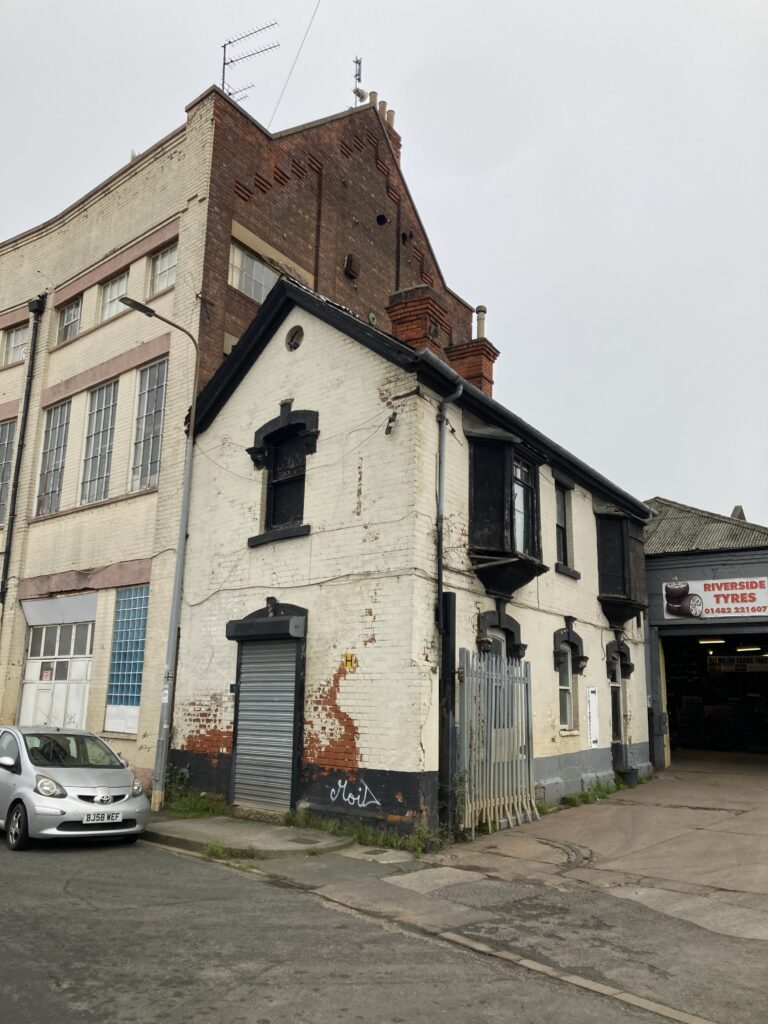
Take a stroll down Hutt Street and eventually you come across a rather curious house. Unlike the uniform red-brick terraced properties surrounding it, this one features a very different design with a large door, oblong windows and protruding front gable roof. There’s also a side archway entrance with a window above.

In old photographs the house looks like it’s clad in dull-coloured pebble dash. Today it stands out because it’s painted white and criss-crossed with mock Tudor beams painted black while the door and windows are bright red. The current look dates from the 1960s but what is also striking is an original layer of stones clad around its base.

Luckily, master stonemason Andrew Gomersall’s workshop and yard lies directly opposite and he can read old stone like some people read books. He’s also done a lot of research on the history of the neighbourhood and, in particular, the former Hull Zoological Gardens which once stood nearby. “I’m almost certain the stone is from York Minster. There’s nothing remotely like it around here in Hull,” he says. If Andrew is correct (and we think he is), his theory certainly fits the story of the Zoological Gardens.

Opened off Spring Bank in 1840, the zoo and pleasure gardens operated until 1861. Entry was one shilling for adults and sixpence for children and, for a while, it attracted visitors from all over Yorkshire who took special excursions to travel to Hull to marvel at the sight of elephants, tigers, camels and polar bears.

As well as housing exotic animals and staging live entertainment, the grounds also featured  architectural attractions added each season including a Swiss chalet for the goats, a Moorish temple for the elephants and what was described as a ‘Heathen Temple’ displaying various curiosities associated with Buddhism.

Alongside these was an area known as The Ruins, a carefully-assembled folly of unwanted decorative masonry from several churches to capitalise on the then fashionable study antiquities. The bulk of the stonework came from York Minster, having been sold off at auction in 1844 following a devastating fire there four years earlier. Most of it was damaged but that didn’t deter Thomas Hammond, a Hull chemist and honorary secretary of the Zoological Society, who snapped up 27 lots at the auction.

Transported to Hull and re-built at the zoo, The Ruins would eventually go under the hammer again in 1862 along with the zoo’s ornamental buildings after its closure. Advertised as ‘Ancient Church Architecture’, some of it was bought by Hull Corporation for £45 and re-erected in the newly-opened Pearson Park where once more they became known as The Ruins.

Apart from being marked on maps of the zoo, there is no actual image of them being there. However, the Pearson Park version features on several surviving early 20th century postcards. They were eventually removed in the 1950s.

There’s also no record of where other items from the zoo went but it is known that “A Unique Swiss Entrance Lodge” was sold at the auction held in April 1862 along with the elephant house, a monkey house and a bear pit. It seems this lodge was then taken down and rebuilt in nearby Hutt Street where it briefly became the home of the zoo’s former superintendent Simpson Seaman, who had also been responsible for the attraction’s regular fireworks displays.

In addition to his role at the zoo, Seaman also ran a private museum in what is now the Polar Bear pub featuring the work of his taxidermist father as well as his own acquisitions, including the skeleton of an elephant. He also sold fireworks there but a disastrous fire in 1865 not only nearly killed him but also destroyed his entire collection. He recovered from his injuries and ran it as a pub without the museum until 1871 when he moved to Sussex where he died a year later.

His old lodge house in Hutt Street and its stones from York Minster are now all that physically remains of an extraordinary chapter in Hull’s Victorian history.

Angus Young