Which Local Trains Ran On Fresh Air?

Our wind-powered correspondent Angus Young looks at a time when Hull’s transport network was blowing in the breeze.
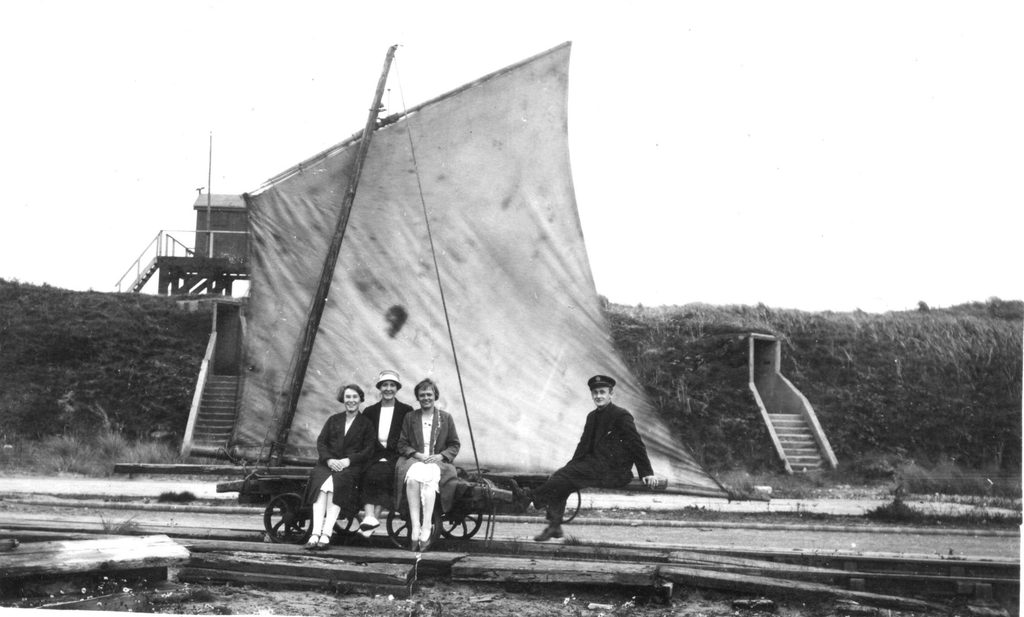
Windtrain Sail bogie on Spurn Point, c 1933

The long-running saga over the proposed electrification of the main rail line in and out of Hull appears to be inching towards a conclusion. For years the stumbling block seemed to be the cost of installing the necessary overhead cables between Hull and Selby. Now the development of battery-electric trains has changed the dynamic.

TransPennine Express recently announced a £1bn investment in a new fleet of battery-electric trains and Hull MPs Diana Johnson and Emma Hardy have now written to the bosses of Hull Trains and Northern Trains asking them to consider doing the same. The MPs said: “Operating without fossil fuels would offer future-proofed long-term benefits for all rail-users and for freight transportation.” If they were still around today, I’m sure Charles Hailes and Edwin Hodgson would agree with them
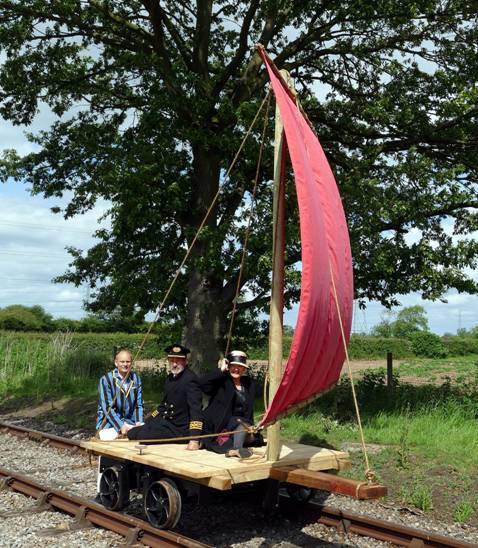
Back in 1922, the neighbours from Kilnsea invented their own fossil fuel-free train and started running it on East Yorkshire’s most remote railway. Seven years earlier a military line stretching for nearly four miles was opened by the Department of War to supply fortifications and gun batteries between Kilnsea and Spurn Point. Goods and materials would be landed by boat at a jetty on Spurn before being loaded onto small steam locomotives.

After the war its use as a railway declined and Charles and Edwin spotted an opportunity. Taking advantage of Spurn’s gusty nature and using an old rail bogie, a wooden pole and a sheet previously used as a makeshift cinema screen for a sail, they created their own wind-powered train. A contemporary newspaper report records the train reaching relatively high speeds but without any brakes, stopping was a bit of a problem and it also experienced several near-misses with the locomotives. In one early run in a gale-force wind, Charles was even forced to use his knife to cut the sail loose in a desperate bid to slow the train before it crashed.

Over the next few years several versions of the ‘Spurn bogie’ were built, some by military men still stationed nearby and others by local lifeboatmen and lighthouse keepers with old wheels and axles being acquired from redundant locomotives. Brakes were also fitted.
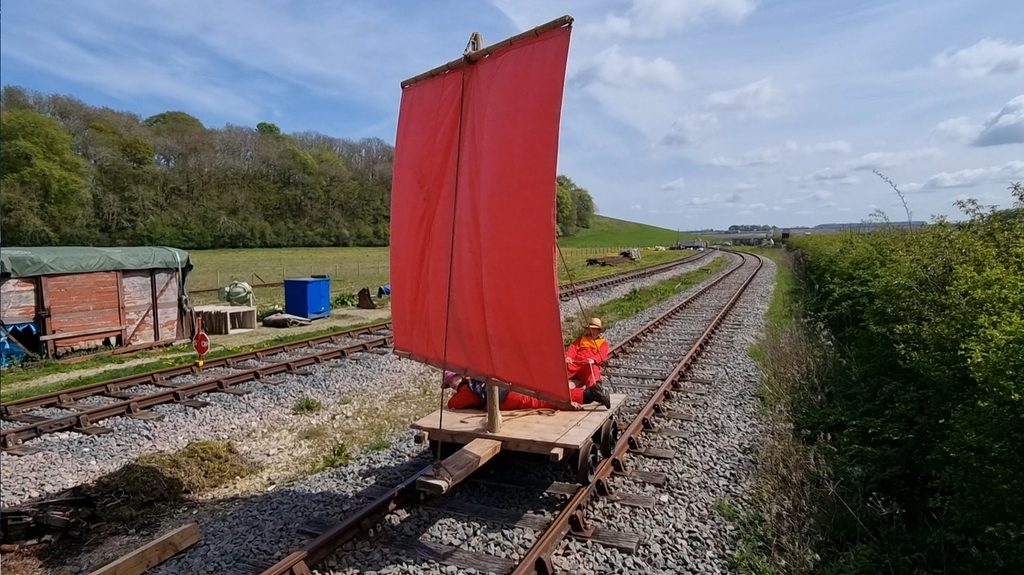
One model even featured an adapted racing car which had its wheels adapted to run on the rails and was said to reach 60mph on windy days. Ronald Kendall, who lived on the Point in the 1930s as son of a lifeboatman, shared his memories of growing up there with the Spurn Kilnsea Easington Local area Studies project. He said: “On one occasion a gang of us, without notifying anyone, lifted the bogie onto the line and began pushing it along, running and jumping on. As we came up to the bend and went down a slight incline we came face to face with the Kenyon (locomotive). It was a case of all jumping off and collecting a few bruises as the bogie crashed into the train. We were reported to our fathers who read us the riot act.”

When the first road was built along the Point in 1941, the use of the railway line decreased dramatically and it finally closed ten years later. Slowly but surely, it then got washed away.

In 2019 local historian and Spurn expert  Phil Mathieson turned the clock back with a small team of volunteers to build a replica of the original bogie train, taking some modern day inspiration from the nearby offshore wind farms. “With the Humber region being at the forefront of wind turbines and green energy, we felt it was appropriate,” he said.

With the old military railway at Spurn no longer intact, the bogie still gets an occasional run-out elsewhere. Most recently, it was one of the star attractions at an event at the Yorkshire Wolds Railway at Fimber Halt.

Angus Young

Why Did A Tank Of Fish Feature In A Suffragette Rally In Hull?

The question is a bit of a red herring, as our piscine prop correspondent Angus Young reports on a remarkable, pioneering militant heroine.

Selina ‘Sepia’ Cooper.

As a working-class woman Selina Cooper was a rarity. Most of the prominent figures in the women’s suffrage movement of the early 20th century were from the middle or even upper classes of British society. Selina, on the other hand, had left school at 13 to work full-time in a Lancashire cotton mill to help support her widowed mother who was raising six other children. She soon became involved in trade unionism and in 1896 she founded a local branch of the Women’s Cooperative Guild in her home town of Nelson. Four years later became involved with the North of England Society for Women’s Suffrage.

Selina’s organisational and speaking skills soon attracted attention and before long she was campaigning alongside the likes of Emmeline and Christabel Pankhurst and presenting petitions to Parliament. In 1907 she became a full-time organiser for the National Union of Women’s Suffrage Societies, touring the country as an in-demand public speaker. In November that year she came to Hull in a visit recalled by her daughter Mary in a series of interviews given to author Jill Liddington for a 1984 biography called The Life and Times of a Respectable Rebel.

It seems Selina was not only an impressive speaker but also knew how to cope with regular heckling and rough treatment. Mary recalled her mother setting off for Hull early that morning to make sure she had plenty of time to advertise her meeting later that day, writing the details in chalk on pavements in the city centre.

“As she chalked the flags, all these men met her. She usually got antagonism and she was alarmed by them. There was a fish auction on and these men escorted her to the dock where they kept the live fish in tanks for hotels. They took my mother and they said: ‘We’ve got a platform ready for you Mrs Cooper’. They knew her name because it was on all of the publicity. My mother was a strong woman, five foot seven and broad built. They took her on and she thought: ‘There’s something funny about this’.

“She started speaking and the lid started coming up. She put her legs astride to sort of hold it and there were live bass in it, live fish, Anyhow, she stood it and they clapped her like mad when she finished because she stuck at it.”  

Selina’s experience at Albert Dock didn’t put her off. She continued to campaign for women to have the right to vote. Three years later she was one of four women chosen to present the case for women’s suffrage to Prime Minister Herbert Asquith.

She remained politically active for the rest of her life; opposing the First World War, developing the first ever maternity centre in Nelson, becoming a magistrate in 1924 and joining a small delegation to visit four women prisoners held in Nazi Germany in 1934. She later resigned from the Labour Party because she believed the party was not taking a strong enough stand against fascism.

In her own words, Selina Cooper once summed up what kept her campaigning. “One reason why I am a convinced suffragist is that the mothers (even as wage earners) take the greater share of responsibility in the upbringing of their children; therefore, they ought to have the greater means, not the less, to enable them to do justice to the rising generation.”

Angus Young

Where in Hull did Les Dawson’s career take off?

The famous ‘bad piano playing’ part of the great comic’s act started in our city. But – asks our comedy legend correspondent Angus Young – which one?

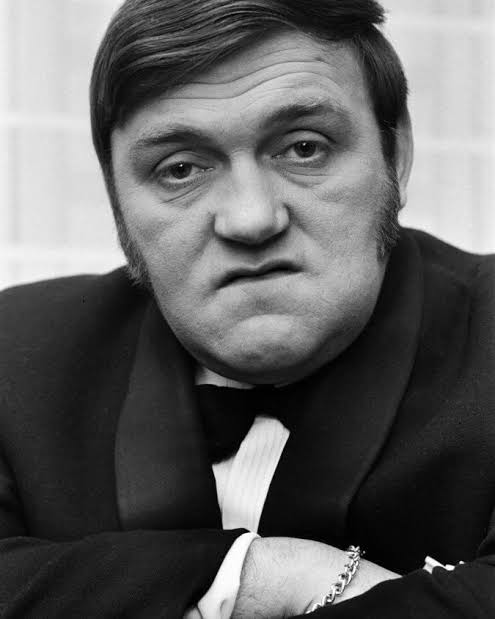
Lesley Dawson, posing with his famously lugubrious face.

Like most legends, there are a few versions of the story of how Les Dawson started on his journey to become one of Britain’s best-known comedians. The man himself told it to Michael Parkinson on the latter’s hugely-popular chat show in 1974. Still available to watch on YouTube, Dawson recalls a booking in Hull when he was still performing as a struggling pianist and singer in the late 1950s. “I was having a terrible time. I was dying everywhere. It was that bad they were calling me the Fourth Prophet. I got this booking in Hull. It was a fishermen’ s club. They came straight from the trawlers with barb and salt caked on their faces and with a sock full of money. They sat there and drank themselves into oblivion. An act was superfluous, they didn’t need an act and I was there, dying a death, night after night.

“One terrible night they were letting bottles go and pennies were being thrown. They were shaking the bottles and letting the tops off, it was like an alcoholic El Alamein. It got to the Thursday and I couldn’t face it any more so I went to a pub in The Land of Green Ginger and got stoned. I went back and I couldn’t get off the piano. This makeshift curtain opened on this podium and I couldn’t get off. So I said: ‘It’s very nice in here, it’s a superbly decorated kipper factory’ and suddenly I was getting laughs.”

The more he ad-libbed and fired off deadpan jokes about his miserable life, the more the crowd loved it. Despite being drunk, Dawson had invented what became his trademark comedic style. But where did all this happen?

We’re talking about 1956 here so it’s a long time ago and there are few remaining eye-witnesses still around to confirm things. His trip to The Land of Green Ginger almost certainly involved a pint or three in The George Hotel. As for the club, debate continues to rage over which venue was actually involved.

One theory places the action in the old Stevedores and Dockers Club in Posterngate. However, this contradicts Dawson’s own story of performing in a fishermens’ club. Many point to the West Dock Club in West Dock Avenue or the Phoenix Club in Hessle Road. Both are sadly no longer with us. There are also a few votes for the old Humber St. Andrew’s Club in Anlaby Road.

Local author Mike Ullyatt was Hull comedian Norman Collier’s biographer. He said: “Norman was a big friend of Les and he told me that Les confirmed it was the West Dock Club where it all started for him. Myths have it that it was at practically every club down Hessle Road.”

However, the current consensus is that Dawson’s encounter with an audience of trawlermen took place in another former Hessle Road social club – The Empress. (A location confirmed by Dawson’s mate, Hull playwright Alan Plater – Ed.) If true, the venue is still there as a pub, albeit now operating as The New Empress having previously been known as The Bosun. All that’s missing is a blue plaque commemorating its rightful place in British comedy history.

Angus Young

Why Is An Anlaby Road Mini-Mart Part Of Pop Music History?

Our unlikely history correspondent Angus Young finds some of the biggest hits in pop began life on top of a local shop.

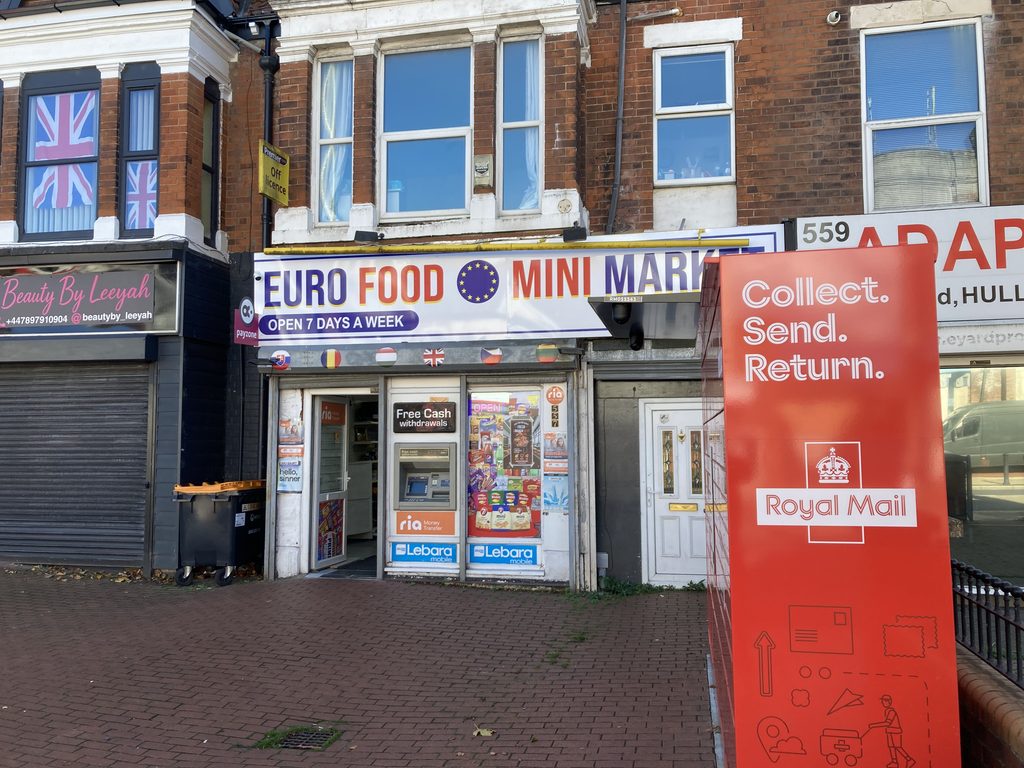
Euro Food Mini Market. Once home to a pop legend.

Search online for famous UK music scene locations and some familiar places pop up. There’s the zebra crossing in Abbey Road made famous by The Beatles, Salford Lads’ Club courtesy of The Smiths and London’s Berwick Street as featured on the cover of Oasis’ What’s The Story Morning Glory?

Here in Hull we also have our fair share of contenders. The Adelphi Club in De Grey Street needs no introduction, a giant sculpted guitar in East Park commemorates Mick Ronson’s days as a council gardener there while the shop which inspired Tracey Thorn and Ben Watt to call themselves Everything But The Girl still stands on Beverley Road although it’s now a home to the Hull & Humber Chamber of Commerce. However, one address in the city and its place in global pop history remains largely overlooked.

Today, the first-floor flat in Anlaby Road sits above the Euro Food Mini Market. There’s no blue plaque, just a recently-installed Royal Mail postal and collection locker. Back in the late 1960s the flat was home to an aspiring teenage musician who had moved from Grimsby to join a band called The Hammer. Rod Temperton had little in the way of belongings except for a Hammond organ nicknamed Betsy which he kept in the flat between gigs.

Hull entertainment agency boss Peter McLeod was the band’s manager. He recalled: “When Rod joined there was a big change in the music. They dropped all the soul stuff and although they still did pop, Rod was into more far out material like Hawkwind and Soft Machine and he brought that into the group. Rod could disappear for days in his flat with his songwriting and he was absolutely assiduous with it. He used to stay up all night writing through until the next day.”

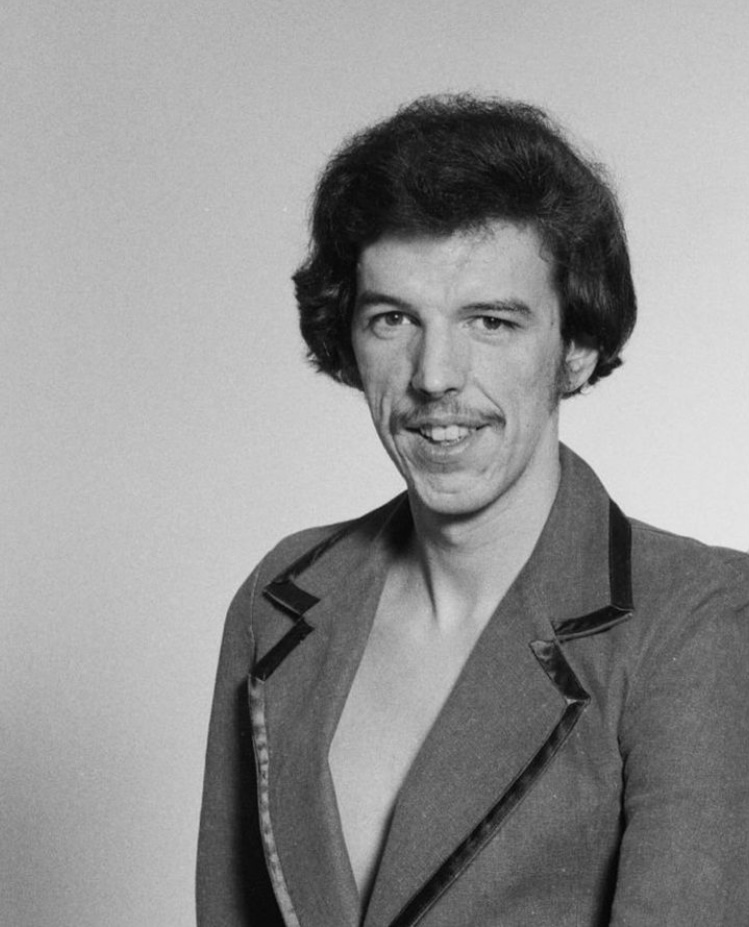
Rodney Lynn Temperton, when he was too poor to afford a vest.

The Hammer became more popular as a live act in Europe than the UK but were always struggling to make good money. The band relied on the generosity of the owner of a nearby Chinese takeaway on Anlaby Road for free meals while Rod worked a side hustle playing keyboards in the Flamingo Club, a notorious late-night coffee club in Londesborough Street. Hull musician Peter Green was a regular visitor at the flat. He said: “There was always a terrible smell, It wasn’t Rod’s fault because it came from a pet shop next door.”

The Hammer’s hopes of a big breakthrough eventually arrived with a trip to London to record an audition album for the DJM label and play a Friday night gig at The Marquee Club with the music press, agents and studio executives expected to be in the audience. The recording went well but DJM boss Dick James said he would only release an album if Rod relinquished his songwriting rights. The band refused and instead James signed another unknown act who had auditioned material at the same time in a neighbouring studio. The new signing was a keyboard player called Reg Dwight, later better known as Elton John.

The Marquee gig also went badly. The Hammer’s bass player Stan Saye later recalled: “It was the day Jimi Hendrix died. I think we played to an audience of three.” The band returned to Hull and continued touring but, according to Saye, “the spirit had gone”. The inevitable split followed and after four years living in Anlaby Road, Rod packed his bags and relocated to Germany where he joined a band called Sundown Carousel playing covers in a residency in Frankfurt.

In 1973 he answered an advert in Melody Maker magazine from a soul band looking for a keyboard player. Over the next three years Heatwave would adopt Hull as their second home as they rehearsed, recorded and played here before finally breaking through with UK and US chart success with Boogie Nights.

Rod’s musical style had evolved into slick disco and he was soon writing global hits for Michael Jackson, including Off The Wall, Rock With You and Thriller. Were early versions of those songs crafted in a flat in Anlaby Road ? Probably not but without it acting as a musical stepping stone they might never have seen the light of day.

Angus Young