Which Local Trains Ran On Fresh Air?

Our wind-powered correspondent Angus Young looks at a time when Hull’s transport network was blowing in the breeze.
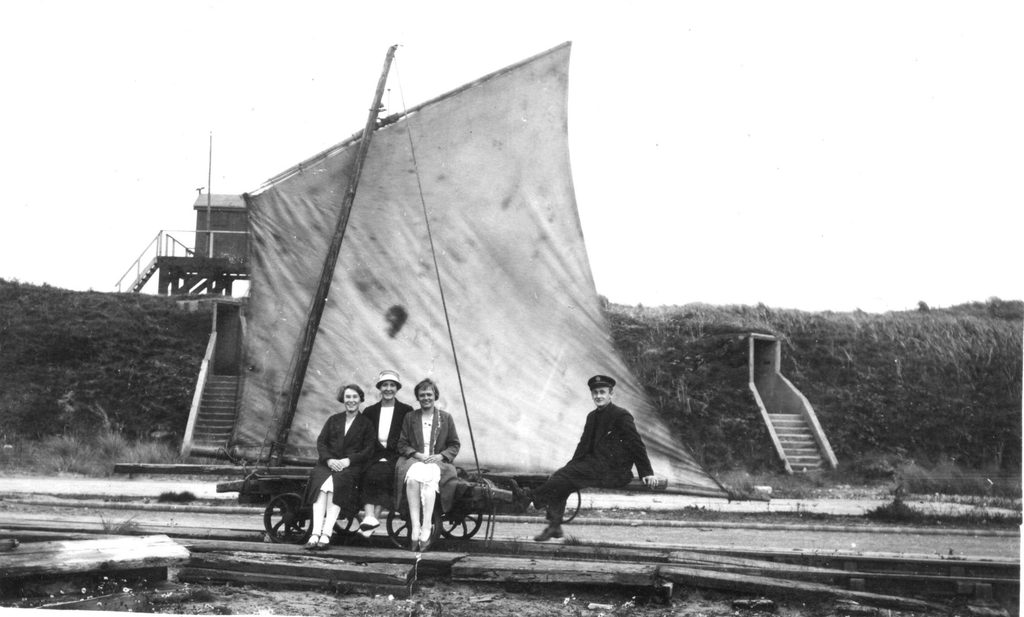
Windtrain Sail bogie on Spurn Point, c 1933

The long-running saga over the proposed electrification of the main rail line in and out of Hull appears to be inching towards a conclusion. For years the stumbling block seemed to be the cost of installing the necessary overhead cables between Hull and Selby. Now the development of battery-electric trains has changed the dynamic.

TransPennine Express recently announced a £1bn investment in a new fleet of battery-electric trains and Hull MPs Diana Johnson and Emma Hardy have now written to the bosses of Hull Trains and Northern Trains asking them to consider doing the same. The MPs said: “Operating without fossil fuels would offer future-proofed long-term benefits for all rail-users and for freight transportation.” If they were still around today, I’m sure Charles Hailes and Edwin Hodgson would agree with them
Back in 1922, the neighbours from Kilnsea invented their own fossil fuel-free train and started running it on East Yorkshire’s most remote railway. Seven years earlier a military line stretching for nearly four miles was opened by the Department of War to supply fortifications and gun batteries between Kilnsea and Spurn Point. Goods and materials would be landed by boat at a jetty on Spurn before being loaded onto small steam locomotives.

After the war its use as a railway declined and Charles and Edwin spotted an opportunity. Taking advantage of Spurn’s gusty nature and using an old rail bogie, a wooden pole and a sheet previously used as a makeshift cinema screen for a sail, they created their own wind-powered train. A contemporary newspaper report records the train reaching relatively high speeds but without any brakes, stopping was a bit of a problem and it also experienced several near-misses with the locomotives. In one early run in a gale-force wind, Charles was even forced to use his knife to cut the sail loose in a desperate bid to slow the train before it crashed.

Over the next few years several versions of the ‘Spurn bogie’ were built, some by military men still stationed nearby and others by local lifeboatmen and lighthouse keepers with old wheels and axles being acquired from redundant locomotives. Brakes were also fitted.
One model even featured an adapted racing car which had its wheels adapted to run on the rails and was said to reach 60mph on windy days. Ronald Kendall, who lived on the Point in the 1930s as son of a lifeboatman, shared his memories of growing up there with the Spurn Kilnsea Easington Local area Studies project. He said: “On one occasion a gang of us, without notifying anyone, lifted the bogie onto the line and began pushing it along, running and jumping on. As we came up to the bend and went down a slight incline we came face to face with the Kenyon (locomotive). It was a case of all jumping off and collecting a few bruises as the bogie crashed into the train. We were reported to our fathers who read us the riot act.”

When the first road was built along the Point in 1941, the use of the railway line decreased dramatically and it finally closed ten years later. Slowly but surely, it then got washed away.

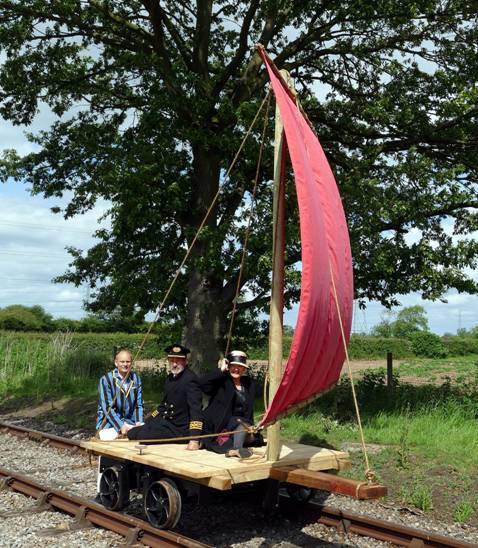
In 2019 local historian and Spurn expert  Phil Mathieson turned the clock back with a small team of volunteers to build a replica of the original bogie train, taking some modern day inspiration from the nearby offshore wind farms. “With the Humber region being at the forefront of wind turbines and green energy, we felt it was appropriate,” he said.

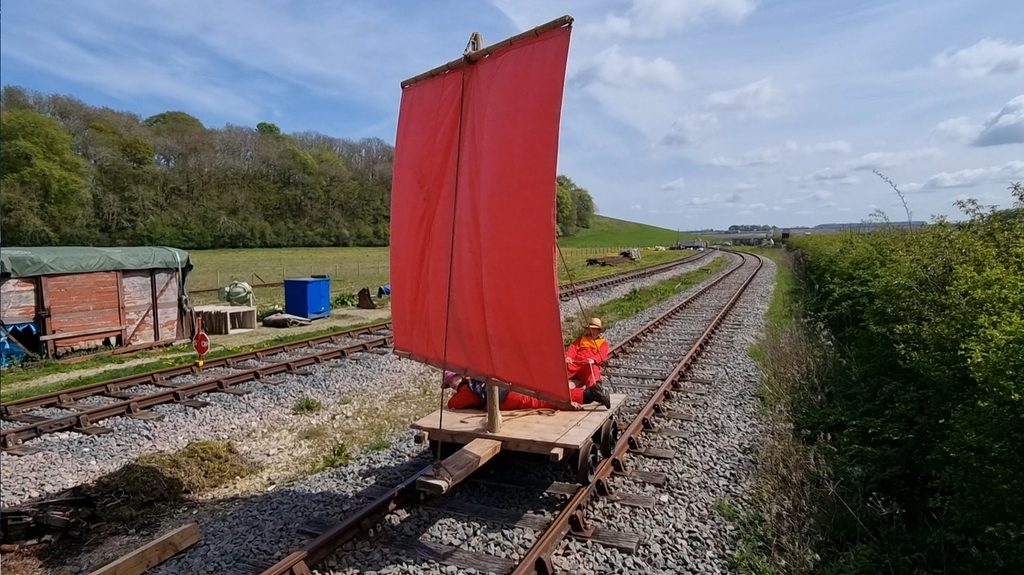
With the old military railway at Spurn no longer intact, the bogie still gets an occasional run-out elsewhere. Most recently, it was one of the star attractions at an event at the Yorkshire Wolds Railway at Fimber Halt.

Angus Young

Which Geordie Artist Is Being Celebrated At Two Pubs In Hull?

Our sober analysis correspondent Angus Young went to the pub (for research purposes) and began contemplating the walls.

You might not have heard the name John Gilroy. However, his most famous artwork is instantly recognisable and it’s currently enjoying a revival in Hull. Gilroy was born in 1898 in Whitley Bay and served with the Royal Field Artillery during the First World War. After the war he became an art teacher but in 1925 he changed career to become an artist and illustrator for London-based advertising agency SH Benson.

Three years later the agency secured a prestigious new account. Guinness didn’t use advertising during the first 170 years of its existence. Instead, the  Dublin-based brewery believed its famous dark Irish stout could speak for itself. That all changed with Gilroy and the agency he worked for being given the task for turning the drink into a brand.

As lead creative on the account, he came up with the Guinness for Strength campaign which featured a range of impressive feats of strength being carried out after downing a glass of the dark stuff. The most famous was the workman using one hand to steady a giant iron girder balanced on his head. The campaign was a huge success but Gilroy was already at work on a second one, having been inspired by a night out at the circus.

His idea was to incorporate exotic animals into his now trademark bold designs, starting with a poster of a cheeky sea-lion running away from a zookeeper with a Guinness perched on its nose. Turtles, ostriches and crocodiles followed but Gilroy’s most popular creature was the toucan, first introduced in late 1935, then revived in  a new series of posters in 1953 and again in the 1980s for a series of TV adverts.

Interviewed in 1952 about the secret of his Guinness campaigns, Gilroy said: “I love poster work and I am conscious of the poster artist’s responsibilities. The hoardings are the Museum of the Masses.. They hoard the art treasures of the man in the street. But the man in the street is usually in a hurry to catch a bus or to avoid being caught by a bus. He has no time for contemplation. My posters are, therefore, a kind of aesthetic-in-a-minute.”

Girlroy died in 1985 but his artwork for Guinness lives on. Recently it’s been incorporated into facelifts at two pubs in Hull by local artist Ezra.

At Molly Mangan’s, Gilroy’s famous toucan looms over Newland Avenue against a backdrop of the Humber Bridge, The Deep and the Maritime Museum. In the pub’s car park, a Gilroy crocodile adorns a wall while prints of some of Gilroy’s Guinness is Strength posters can be seen just inside the main entrance.

Meanwhile, at the St. George’s Hotel in St. George’s Road  the toucan and the crocodile both make an appearance along with a gentleman sporting a toucan-like beak. For purely research purposes, Curiosity can also confirm the Guinness at both establishments is reassuringly good.

Angus Young

What’s Going On At Hessle Station?

Following some subtle changes, our horticulture halt correspondent Angus Young finds intriguing transformation going on round the edges of Hull.

Victoria Tuthill on Hessle Station, yesterday.

At first glance, there’s not much to catch your attention at Hessle railway station. Two largely empty platforms lie either side of the main Hull to Doncaster line, there’s a rusting iron pedestrian bridge spanning the tracks, two perspex shelters and, er, that’s about it. The old ticket office closed in 1985 and is now a showroom for a kitchen design company.  Meanwhile, the station itself has remained unmanned, a bit drab and generally unloved until recently.

A second glance reveals colourful new signs saying ‘LOOK UP’ on the perspex shelters. If you do look up, you clap eyes on the Humber Bridge looming large in the near distance. There’s also a new poem about Hessle displayed on a sign adorning a wall next to the walkway leading down to the eastbound platform, new litter bins and a new row of seats on each platform.

Elsewhere, four recently-installed water butts await connection to a drain pipe currently taking rainwater off the roof of the station’s main surviving architectural feature – a decorative canopy propped up with impressive ironwork. Once connected, the water supply will allow the installation of a number of large planting boxes. All this recent activity is courtesy of the group of volunteers called Friends of Hessle Station.

They were formed earlier this year after Victoria Tuthill and Pam Locker were approached by Hessle Town Council and asked whether they would be interested in adopting a railway station. Known for rolling up their sleeves and getting stuck in, the pair had both been involved with the annual Hessle Open Gardens for years as well as the garden at Hessle Community Centre. After a meeting with the council, rail operator Northern and the Community Rail Partnership, they agreed to take the plunge.

Eight more local volunteers were recruited and a plan of action was hatched with a focus on community, creativity and wildlife. The plan was duly agreed by the relevant partners, unlocking modest funding from Northern and allowing the group to secure further grants from the town council, the rail partnership and telecoms group KCOM.

“We did the ‘Look Up’ signs first, taking inspiration from the same message used during the 2017 City of Culture programme in Hull,” said Victoria. “In our case, we’re encouraging people using the station to look about because of the view of the Humber Bridge.”

The imminent arrival of the planters is the group’s next big project. “We want to bring lots of interest and food for thought when people visit the station by growing things like beans, tomatoes and berries with information about how to grow them at home as well as inviting people to pick the produce. Unfortunately, there is no water supply so we are in the process of installing water butts but, because of the risk of people throwing things onto the tracks, everything has to be bolted to the floor or enclosed.

“One of our volunteers has used his neighbour’s old decking to create a big cupboard to enclose the water butts and we will soon be installing large planters repurposed from wooden tables and benches donated by a local pub. They are nearly ready to go on each platform and will contain an interesting range of drought-tolerant perennials, herbs and shrubs which benefit wildlife. One of the planters will be specifically aimed at younger children with prompts for starting conversations about what they can see, smell and feel. We will soon find out if we can collect enough water to maintain the plants we want to grow and will have to learn and adapt as we go along to keep the station a colourful, interesting and, hopefully, inspiring place to be,” said Victoria.

Getting the new seating installed was a no-brainer for the group, mainly because there wasn’t any except for some uncomfortable benches in the perspex shelters. Design students at Hessle Academy are also involved, currently making a small community book-lending library which will go on the wall at the station.

Future plans include more collaborative projects with local groups and organisations such as travel training and a trip on a train for students at St Anne’s school. A future planting space earmarked for 300 daffodil bulbs has also been cleared on a sloping bank of earth currently covered with dense wild foliage which also marks the boundary of the station.

Meanwhile, six brick archways overlooking the westbound platform have been earmarked for another large sign spelling out ‘Hessle’ with each archway housing a letter spelling out the town’s name. “We’re committed to attracting people back to the station, making it an enjoyable public space and getting more people using the trains,” said Victoria.

Angus Young

What’s Andy Comfort Been Up To In Berlin?

How does him from the radio wandering round Germany herald good news for the region? Our rail technology correspondent Angus Young finds out.

Trainspotter Andy Comfort putting his hobby to good use in Germany.

You might know him from his days at BBC Radio Humberside or as a current presenter on Hull’s 107AM community radio station. So what was DJ Andy Comfort doing hanging about in Berlin recently?

A clue comes in his other line of work as features editor at RAIL magazine. “The simple answer is I was looking at trains as part of my job and, yes, it’s a long way to go to look at trains, but these are all new trains and new rail technology on show at Europe’s biggest public transport exhibition, InnoTrans,” Andy revealed. In other words, the trip was a train buff’s’ version of a busman’s holiday.

“InnoTrains is huge. It has an exhibition area of 200,000 square metres with over 3,000 exhibitors from 59 countries, including the UK; there are 42 halls and around two miles of outdoor tracks with 113 trains and vehicles on them,” he said.

One of the new Goole-built London Underground trains on show in Berlin.

As a self-confessed trainspotter, you can tell Andy loves his stats. However, there was also another special reason why he was there and it’s got a link to this neck of the woods. He explained: “One of those trains was the new London Underground Piccadilly line train due to enter service next year. Of the 94 new trains being built, 75 are being assembled at the Siemens Mobility factory in Goole, East Yorkshire.

“The order is supporting up to 1,000 jobs at the site, with another estimated 1,700 jobs in the local supply chain, so good news for East Yorkshire. What is special about these new tube trains – and it’s one of the reasons that they are late coming off the production line – is that they will be London’s first deep-level tube trains to have air-conditioning.

“When I say deep-level tubes, I mean the Bakerloo, Central, Jubilee, Northern, Piccadilly, Victoria and Waterloo and City lines. Because the tunnels are so narrow in diameter, there has never been any room to install air-conditioning on previous trains, but this is why the new trains are described as the most technologically advanced in the world.

Luxury for Londoners.

“The designers made space for air-con by ‘floating’ some of the carriages between fewer wheel bogies – all clever stuff and happening in Goole. Transport for London is talking to Siemens Mobility about confirming an order for similar air-conditioned trains for the Bakerloo line, which should keep people in work at the Goole site.

“As for the new train, I had a walk through – because you can, from end to end. There are no doors between carriages, which makes it brighter, more spacious and safer. The seats are a bit hard but the train is a vast improvement overall with new digital information screens and, yes, you’ll be pleased to know – it is cooler.”

Cool from Goole? We like it. So if you’re down in London next year, head for the Piccadilly line and try one of the new trains from East Yorkshire yourself.

Angus Young