What’s Going On At The Tigers Trust?

Things are moving along at the MKM Stadium, as our sports development correspondent Angus Young reports.

Based at the indoor arena next to the MKM Stadium, the Tigers Trust is a bit of a success story. The not-for-profit charity started life in 1990 as a Football in the Community Project with support by the Professional Footballers Association. Then as now the trust is run independently but retains close natural links to its near neighbour Hull City.

In recent years it has expanded its offer beyond football to promote health, well-being and educational opportunities for young people. However, football – and in particular the girls’ game – remains a central focus and the trust recently unveiled plans for a £2m upgrade of its community sports facilities in Hull’s West Park. The proposals include re-opening the outdoor artificial pitches in West Park, refurbishing and extending the Tigers Trust Arena and landscaping the area between the two.

Originally part of the wider stadium development in West Park, the outdoor pitches have been closed for public use since the start of the Coronavirus pandemic six years ago. The trust leases both the pitches and the indoor arena from the Stadium Management Company. The ambitious upgrade is aimed at creating a community sports campus while supporting a new development centre for girls’ football backed by the Football Association. Tigers Trust chairman Nick Rennardson said: “We are very excited about creating what we hope will become a real destination in West Park with new and improved facilities available for use seven days a week.”

As well as re-opening the outdoor pitches, the trust is planning to construct a new adjacent facility featuring changing rooms and toilets. At the indoor arena, a two-storey extension is earmarked at the rear of the existing building. Subject to securing planning consent, it will include new multi-use studio space capable of hosting a range of activities such as dance, yoga and pilates. Other new facilities will include additional teaching and learning spaces, a heritage area focused on Hull City’s history and a potential new nursery.

Trust chief executive Karina Ellis said: “Having been awarded a licence by the FA to operate as an Emerging Talent Centre, we are now looking forward to using this opportunity to provide a dedicated home for the professional development of girls’ football in conjunction with the East Riding County FA. Bringing the outdoor pitches back into use will allow us to do that by offering free at the point of delivery programmes for under-nines, under-10s and under-11s. Alongside this, the wider campus development means we will be able to expand our post-16 education offer and improve our community programmes promoting physical activity and health and well-being.”

The proposed landscaping work is being designed to improve public safety in what is currently an unused and overgrown part of the parkland. The trust says it expects to raise around three-quarters of the required funding for the upgrades from external sources while footing the bill for the remainder.

The development is likely to take around two years as a rolling programme of works with the upgrade of the outdoor pitches scheduled to start first early in 2027. As well as activities at the arena, the trust also runs sport, education and training courses and events at schools and community sites across Hull and the East Riding.

Angus Young

Which Local Trains Ran On Fresh Air?

Our wind-powered correspondent Angus Young looks at a time when Hull’s transport network was blowing in the breeze.

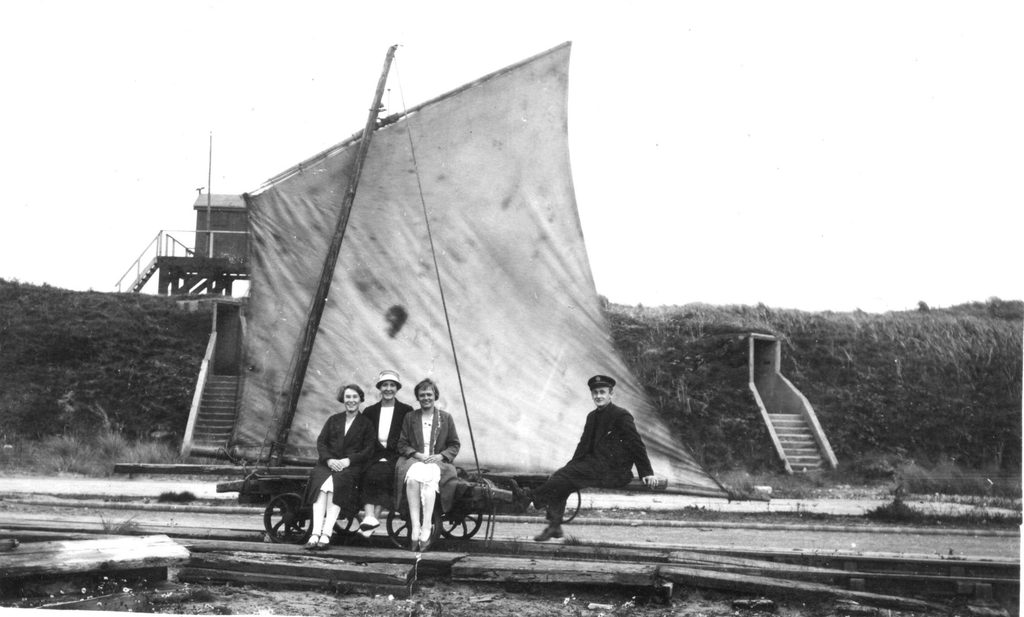
Windtrain Sail bogie on Spurn Point, c 1933

The long-running saga over the proposed electrification of the main rail line in and out of Hull appears to be inching towards a conclusion. For years the stumbling block seemed to be the cost of installing the necessary overhead cables between Hull and Selby. Now the development of battery-electric trains has changed the dynamic.

TransPennine Express recently announced a £1bn investment in a new fleet of battery-electric trains and Hull MPs Diana Johnson and Emma Hardy have now written to the bosses of Hull Trains and Northern Trains asking them to consider doing the same. The MPs said: “Operating without fossil fuels would offer future-proofed long-term benefits for all rail-users and for freight transportation.” If they were still around today, I’m sure Charles Hailes and Edwin Hodgson would agree with them

Back in 1922, the neighbours from Kilnsea invented their own fossil fuel-free train and started running it on East Yorkshire’s most remote railway. Seven years earlier a military line stretching for nearly four miles was opened by the Department of War to supply fortifications and gun batteries between Kilnsea and Spurn Point. Goods and materials would be landed by boat at a jetty on Spurn before being loaded onto small steam locomotives.

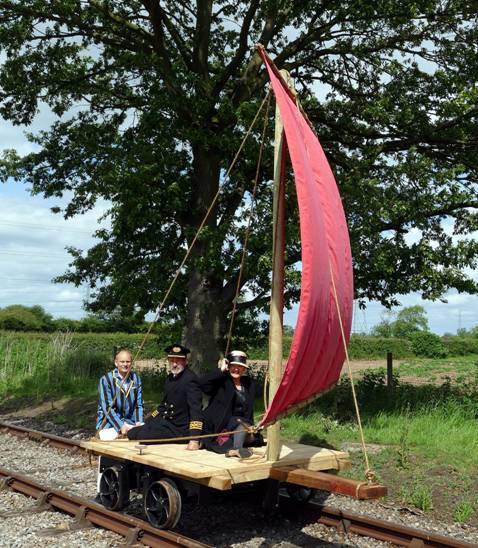
After the war its use as a railway declined and Charles and Edwin spotted an opportunity. Taking advantage of Spurn’s gusty nature and using an old rail bogie, a wooden pole and a sheet previously used as a makeshift cinema screen for a sail, they created their own wind-powered train. A contemporary newspaper report records the train reaching relatively high speeds but without any brakes, stopping was a bit of a problem and it also experienced several near-misses with the locomotives. In one early run in a gale-force wind, Charles was even forced to use his knife to cut the sail loose in a desperate bid to slow the train before it crashed.

Over the next few years several versions of the ‘Spurn bogie’ were built, some by military men still stationed nearby and others by local lifeboatmen and lighthouse keepers with old wheels and axles being acquired from redundant locomotives. Brakes were also fitted.

One model even featured an adapted racing car which had its wheels adapted to run on the rails and was said to reach 60mph on windy days. Ronald Kendall, who lived on the Point in the 1930s as son of a lifeboatman, shared his memories of growing up there with the Spurn Kilnsea Easington Local area Studies project. He said: “On one occasion a gang of us, without notifying anyone, lifted the bogie onto the line and began pushing it along, running and jumping on. As we came up to the bend and went down a slight incline we came face to face with the Kenyon (locomotive). It was a case of all jumping off and collecting a few bruises as the bogie crashed into the train. We were reported to our fathers who read us the riot act.”

When the first road was built along the Point in 1941, the use of the railway line decreased dramatically and it finally closed ten years later. Slowly but surely, it then got washed away.

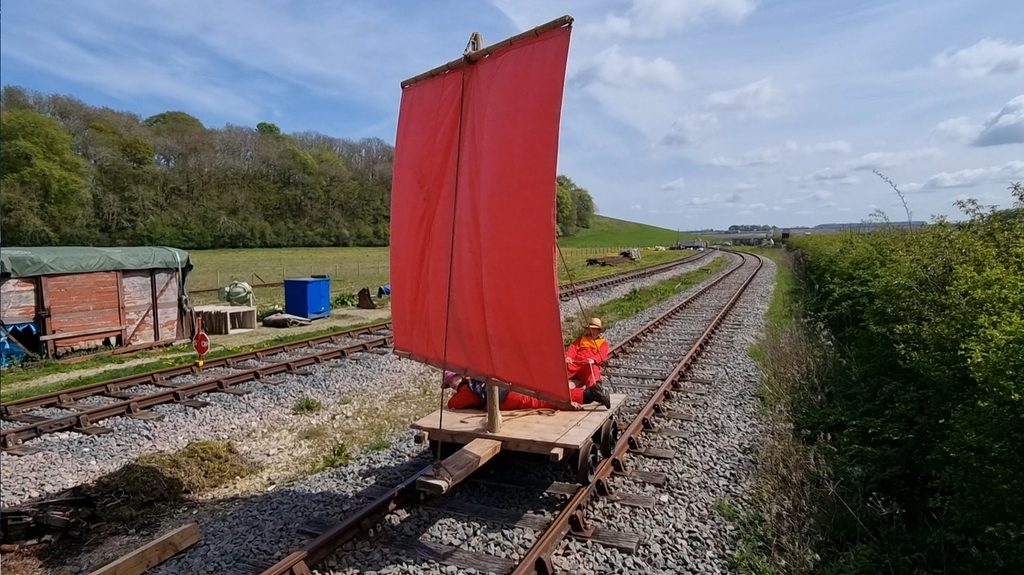
In 2019 local historian and Spurn expert  Phil Mathieson turned the clock back with a small team of volunteers to build a replica of the original bogie train, taking some modern day inspiration from the nearby offshore wind farms. “With the Humber region being at the forefront of wind turbines and green energy, we felt it was appropriate,” he said.

With the old military railway at Spurn no longer intact, the bogie still gets an occasional run-out elsewhere. Most recently, it was one of the star attractions at an event at the Yorkshire Wolds Railway at Fimber Halt.

Angus Young

Which Geordie Artist Is Being Celebrated At Two Pubs In Hull?

Our sober analysis correspondent Angus Young went to the pub (for research purposes) and began contemplating the walls.

You might not have heard the name John Gilroy. However, his most famous artwork is instantly recognisable and it’s currently enjoying a revival in Hull. Gilroy was born in 1898 in Whitley Bay and served with the Royal Field Artillery during the First World War. After the war he became an art teacher but in 1925 he changed career to become an artist and illustrator for London-based advertising agency SH Benson.

Three years later the agency secured a prestigious new account. Guinness didn’t use advertising during the first 170 years of its existence. Instead, the  Dublin-based brewery believed its famous dark Irish stout could speak for itself. That all changed with Gilroy and the agency he worked for being given the task for turning the drink into a brand.

As lead creative on the account, he came up with the Guinness for Strength campaign which featured a range of impressive feats of strength being carried out after downing a glass of the dark stuff. The most famous was the workman using one hand to steady a giant iron girder balanced on his head. The campaign was a huge success but Gilroy was already at work on a second one, having been inspired by a night out at the circus.

His idea was to incorporate exotic animals into his now trademark bold designs, starting with a poster of a cheeky sea-lion running away from a zookeeper with a Guinness perched on its nose. Turtles, ostriches and crocodiles followed but Gilroy’s most popular creature was the toucan, first introduced in late 1935, then revived in  a new series of posters in 1953 and again in the 1980s for a series of TV adverts.

Interviewed in 1952 about the secret of his Guinness campaigns, Gilroy said: “I love poster work and I am conscious of the poster artist’s responsibilities. The hoardings are the Museum of the Masses.. They hoard the art treasures of the man in the street. But the man in the street is usually in a hurry to catch a bus or to avoid being caught by a bus. He has no time for contemplation. My posters are, therefore, a kind of aesthetic-in-a-minute.”

Girlroy died in 1985 but his artwork for Guinness lives on. Recently it’s been incorporated into facelifts at two pubs in Hull by local artist Ezra.

At Molly Mangan’s, Gilroy’s famous toucan looms over Newland Avenue against a backdrop of the Humber Bridge, The Deep and the Maritime Museum. In the pub’s car park, a Gilroy crocodile adorns a wall while prints of some of Gilroy’s Guinness is Strength posters can be seen just inside the main entrance.

Meanwhile, at the St. George’s Hotel in St. George’s Road  the toucan and the crocodile both make an appearance along with a gentleman sporting a toucan-like beak. For purely research purposes, Curiosity can also confirm the Guinness at both establishments is reassuringly good.

Angus Young