
She may have a legacy divisive enough to split atoms but our maligned premiers correspondent Angus Young thinks he might just have found one thing she did right.
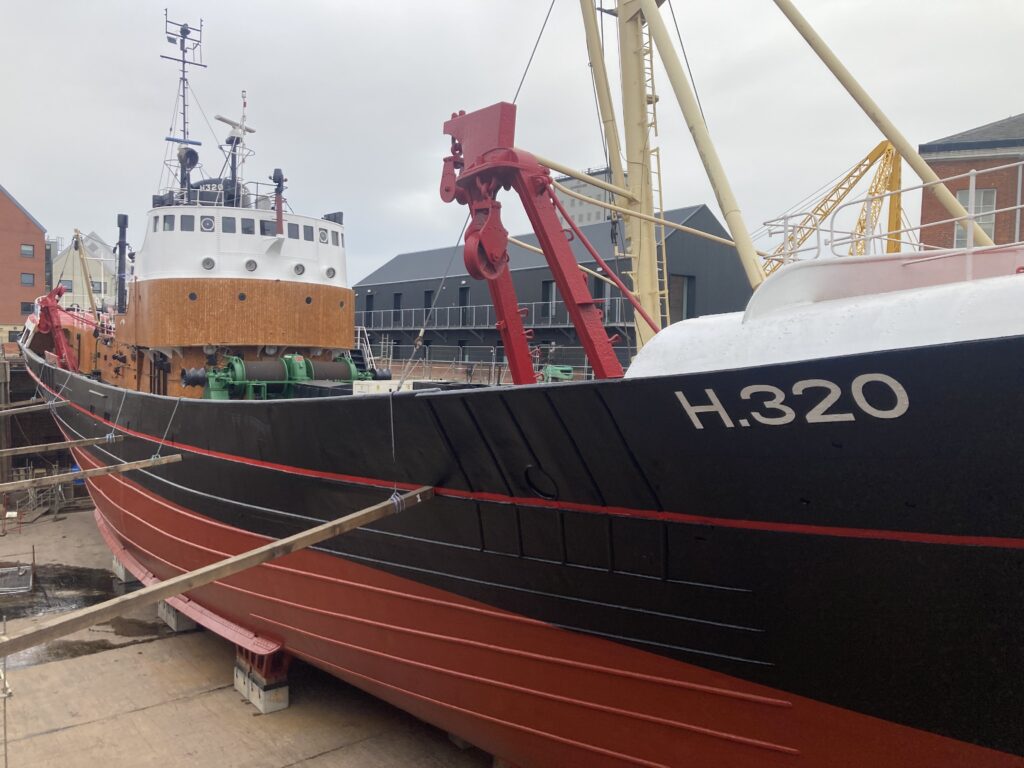
It’s unlikely that Margaret Thatcher will feature prominently in the Arctic Corsair when it re-opens to visitors in its new berth. Yet without her, Hull’s last surviving sidewinder trawler might well have ended up being cut up for scrap.
The Corsair’s long journey from fishing vessel to tourist attraction began in earnest under the then Conservative government’s Inner City Task Force programme. The programme was launched in 1985 in eight of the most deprived areas of the most disadvantaged cities in England as measured in a range of factors including unemployment, education, housing, health and wages. It took its cue from an initial task force set up by Mrs Thatcher after the Toxteth riots in Liverpool in 1982.
Surprisingly, Hull wasn’t among the first wave of eight but was added in 1992 under John Major’s government. At the time, Malcolm Watson was responsible for the national programme and working in the Department of Trade and Industry in London. “I was transferred from Whitehall to Hull to join the Task Force in 1992 because I’d been to university here. I had also worked as a porter at Hull Royal Infirmary on permanent relief shift work for a year and a half after leaving university so I knew the city well” he recalled. “Politically, the impetus came out of the inner city riots in the 1980s. ‘We must do something about these inner cities,’ said Thatcher at the time, handing the baton to Michael Heseltine and later Kenneth Clarke.”
“The primary function of the Task Force was to do something about unemployment and its social repercussions (in which the government had played a very large part, of course) by developing training programmes and helping start-up businesses. Each Task Force had a sponsor minister. Hull’s was the late Ann Widdecombe who visited quite a few times.”
Rescuing the Arctic Corsair was one of around 230 projects overseen by the Task Force. Other notable schemes included helping launch the Goodwin Development Trust, JobLink and IT in the Community as well as numerous numeracy and literacy projects in local schools. “I was the project officer for the Corsair, or the Arctic Cavalier as it was then. I was and still am very glad to have played a part in securing the trawler for the city and the people of Hull,” said Malcolm.
However, it wasn’t easy.
“Nobody in the Task force wanted the job as it was going to be difficult and messy. Funding rules meant you couldn’t spend money on capital projects which this plainly wasn’t so I converted the scheme into a Task Force/City Council training project for unemployed residents living in the Task Force area. The DTI wouldn’t have it and I had to rejig it another couple of times over the next few months before they passed it. Working with the council, training companies, the Department of Education, the Hull Training and Enterprise Council, the fishing heritage group STAND and the European Regional Development Fund, we got it up and running.”
Eventually, the Task Force provided a £400,000 grant to the city council to buy the vessel and fund an initiative for 25 trainees to work on its restoration. Even then, Malcolm recalls it wasn’t straightforward with mountains of paperwork required by the DTI on a regular basis covering monitoring and outputs. “It was a bloody nightmare for four years but it was worth it,” he said. “The Task Force’s efforts have largely been forgotten, which is the way of the world. It was a long time ago now and it was a Thatcher initiative (continuing under the Major years) which doesn’t necessarily endear it to the city fathers these days!”