
There’s about to be a great deal of fuss about Bayeaux and Harold and arrow in eyes but what, our medieval invasion correspondent Angus Young asks, has it all got to do with Hull?
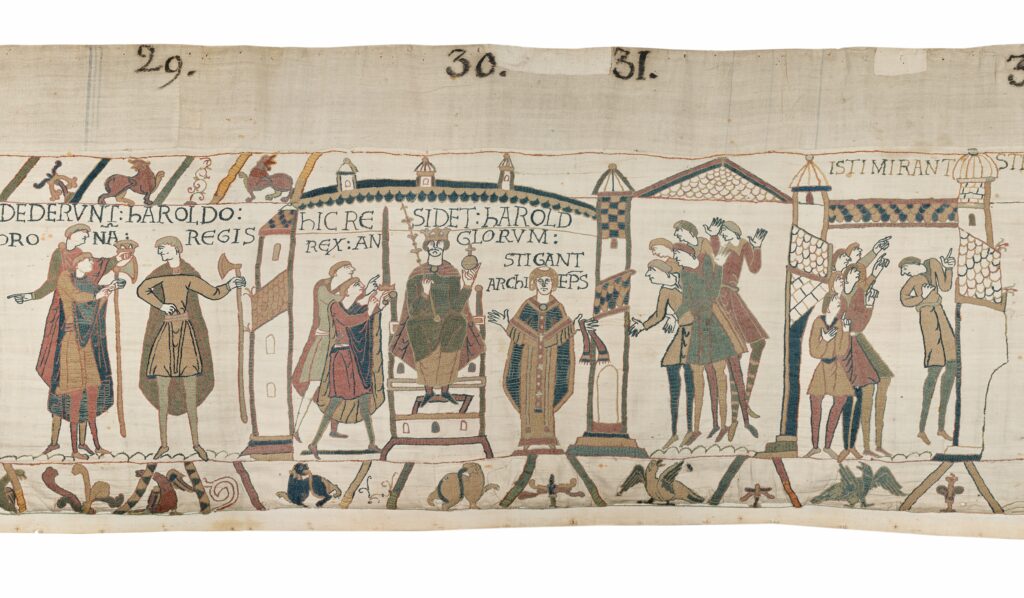
The imminent arrival of the Bayeux Tapestry at the British Museum is expected to trigger renewed interest in all things Norman. The famous 11th century embroidered depiction of the events leading up to Norman Conquest of England in 1066 is thought to have actually been made here rather than France, possibly as a gift to William, the victorious Duke of Normandy. The tapestry has been in France for over 900 years but in September it will go on public display in London as part of a nine-month exhibition at the British Museum.
So what did the Normans do for us here in East Yorkshire?
The village of Stamford Bridge near Pocklington is central to the story of the Conquest as the outcome of a battle there in 1066 heavily influenced the subsequent Norman invasion. In the battle, England’s King Harold defeated a Viking army but his troops were so exhausted that after a long march south they were unable to sustain a fight against William’s Norman forces when they landed in Hastings a month later.
Having killed Harold and conquered England, William divided up the country and put his most trusted men in charge of different parts of it. One of them was Drogo de Beauviiere, an experienced Flemish mercenary soldier who had fought in the Norman invasion force. Drogo’s reward for his service was the granting substantial estates in Lincolnshire, North Yorkshire and a large chunk of land in Holderness, stretching from the Humber estuary to Bridlington.
Bordered by the Humber to the south, the sea to the east, the River Hull flood plain to the west and Earl’s Dyke to the north, the Holderness of Drogo’s day was commonly referred to as being an island. A huge marshland dissected by slow-moving watercourses and hundreds of meres, it was arguably the most remote place in England. A single bridge across the River Hull at Tickton was the only physical connection with the rest of the country until the 18th century.
Drogo built a wooden castle on a raised mound of earth at Skipsea, almost certainly as a strategically-important coastal military staging post. Until recently, it was thought Skipsea was purely a Norman development but archaeologists now believe there was human activity at the site 600 years earlier. Either way, Skipsea remains an important Norman landmark even if only the mound of earth remains.
Much of Drogo’s short history as the first Lord of Holderness is recorded in the Domesday Book, another Norman innovation, and shows how William’s conquest rapidly changed areas like Holderness. Under the overall rule of a lord, the area was divided into three – North, Middle and South Hundreds – with each one responsible for its own system of tax connection, justice and military organisation. In effect, it was the beginnings of local government and Holderness, partly because of its physical remoteness and partly because it was on the frontline of any potential future Viking invasion, became a highly privileged feudal lordship with its own private sheriff and coroner. Drogo and his immediate successors would have spoken Norman-French and this became the language of governance in the region for the next 300 years
The Normans were also keen church builders and St Nicholas Church in North Newbald is said to be the one of the finest complete Norman churches in the country. Built around 1151, the church’s unofficial nickname is The Cathedral of the Wolds. Elsewhere, original Norman features in local churches abound. You can check them out in Wetwang, Flamborough, Beverley (St. Mary’s), Fangfoss and Goodmanham to name but a few.
The Norman-French influence is also reflected in some place names, The famously deserted Medieval village of Wharram Percy was handed to the Norman baron William de Percy in 1086, creating the first chapter of a landowning family dynasty which still continues today with the Duke of Northumberland’s extensive estate which includes Alnwick Castle.
The Bayeux Tapestry itself is another legacy and has inspired two local tapestries made in recent years. Stitched by a team of volunteers using the same techniques as deployed in the Bayeux Tapestry, the Battle of Stanford Bridge Tapestry can be viewed on Tuesdays between 10am and 2pm at the Station Club in Stamford Bridge.
Meanwhile, the Hull Tapestry charting the history of the city is displayed at the Guildhall and can be viewed during working office hours.
Angus Young