

It’s the one you see as you go over Anlaby Road flyover but it’s gone from place of worship to community asset, as our deconsecrated buildings correspondent Angus Young discovered.

Built in 1870, St Matthew’s Church in Anlaby Road still boasts the highest spire in Hull. However, it’s no longer a church.
Back in 2017 Hull-based social housing charity Giroscope bought the derelict building three years after it closed as a place of worship with the help of a European Regional Development Fund grant. The aim was to transform the empty Grade II-listed landmark into a thriving community enterprise centre and now that idea has become a reality. It currently provides some of the most stunning workspaces in Hull for small businesses as well as acting as a venue for events, exhibitions and live music.
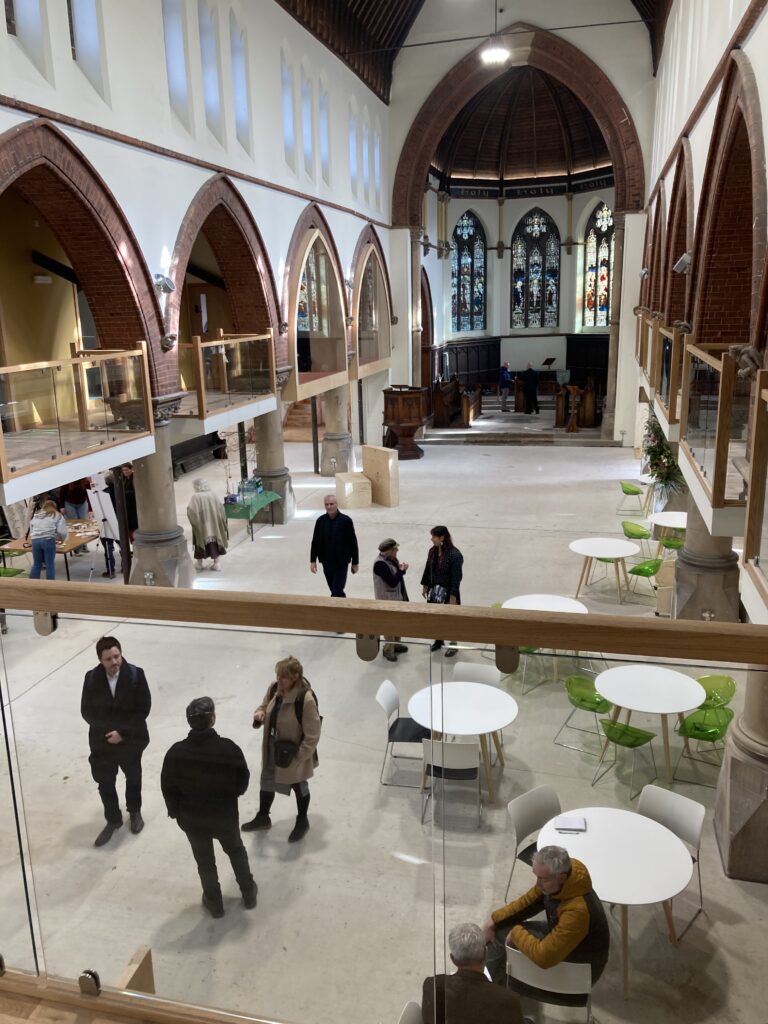
Six small offices and a large meeting room have been created on new mezzanine floors on each side of the building. On the ground floor, there’s a new fully-equipped kitchen which will host Giroscope’s popular training courses for people looking to work in the catering sector. The facelift has also included the installation of a new floor complete with an underfloor heating system, rooftop solar panels and the restoration of the church’s distinctive First World War Memorial stained glass window.
Giroscope founder and coordinator Martin Newman said restoring the window had been an essential part of the wider project to breathe new life into the building. “Some of the glass was broken as a result of vandalism while the place was standing empty,” he said. “We wanted to retain as much of the church’s fabric as we could to reflect its history and its place in the local community so restoring the window was a bit of a priority.”

The inside of St Matthew’s, looking even posher from the other end.
Originally installed in 1922 to commemorate men from the local community who fought and died in the war, it is now flanked by two memorial stones listing their names. Martin said; “There are 138 names on the memorials, many of whom were lost at sea. They really show how much the church has always been rooted in this community. During the build we’ve had lots of people coming in and telling us they got married here, attended funerals here or sang in the choir here. We want to make sure the community continues coming into the building, whether it’s to work or just to enjoy themselves.”
However, there’s one part of the former church which has remained largely untouched – the bell tower and the spire above it. “There is a really narrow set of steps up to the bells but we decided early on to leave them alone because we didn’t really know what condition they were in and didn’t want to risk one coming loose and crashing down on us,” said Martin.
He hopes the new chapter in the building’s history will also revive its profile, having been partially hidden by the construction of the adjacent Anlaby Road flyover in 1964. “The flyover created a real sense of dislocation for the neighbourhood around here. It’s been cut off from the rest of Anlaby Road so we’re hoping this place will help bring local people back together again.”
Angus Young