

Victorian entrepreneurship or cunning financial gerrymandering? Our complementary currency correspondent Angus Young gets all fiscal.
William Cussons was a bit of a visionary. Not only did he lay the foundations for one of Hull’s most successful retail businesses but he also introduced a series of innovations as he did so. The youngest of three brothers, William was born in 1845 and would eventually follow in the footsteps of his maternal grandfather who was a grocer and tea agent.
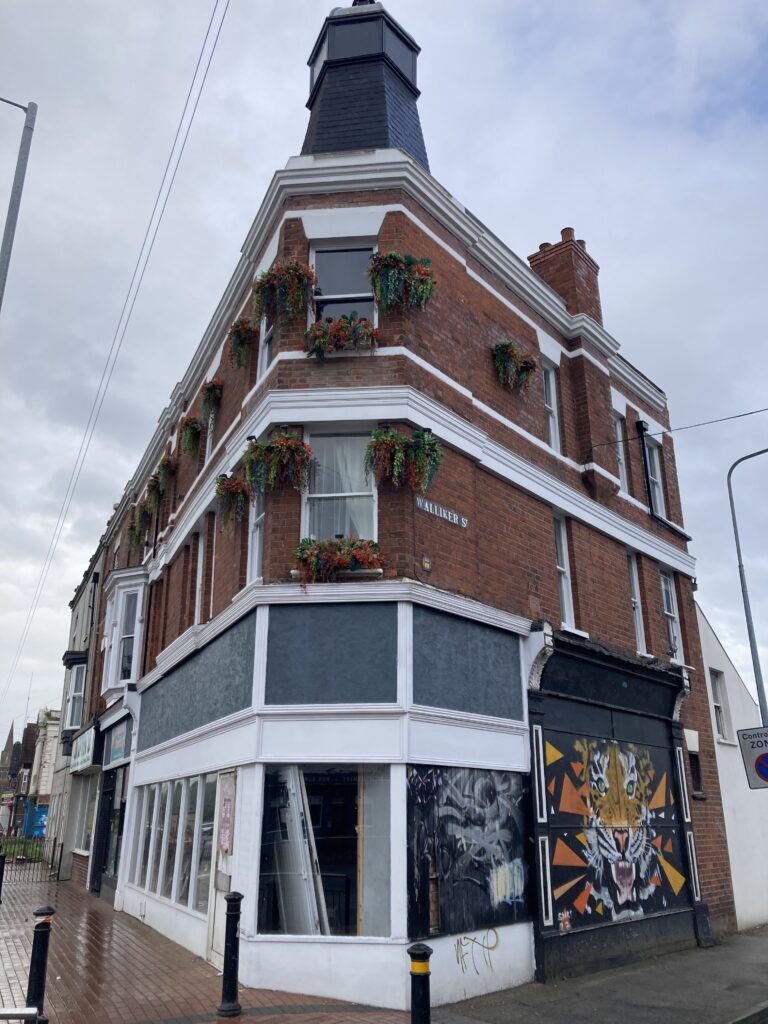
In 1871 the brothers went into the grocery and provisions business together, trading under the name Cussons Brothers, but the partnership didn’t last long. Middle brother John left to run his own grocery business on Holderness Road, leaving William and eldest brother Thomas in charge of their own store in Anlaby Road. The building at the corner of Walliker Street is still there today, best known for its distinctive turret and decorative spire. For a while the Anlaby Road store was a flagship, offering customers demonstrations of new products. One early event involved taste-testing Coronet evaporated milk to judge whether it did actually “whip like cream.”
When Thomas retired in 1882 William took over and started to build an empire, initially taking over John’s Holderness Road store and then opening a large new department store in Beverley Road five years later. Housed in Brunswick Arcade which still survives today, it occupied a whole block and was divided into different departments selling items ranging from groceries and fresh meats to shoes, general drapery and hardware.
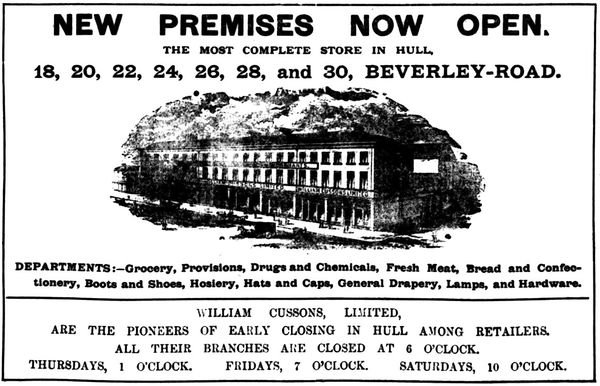
A contemporary advert marking the opening of the store also describes William’s company as the “pioneers of early closing” among retailers in Hull, highlighting the 6pm closing time for all branches in the city between Monday and Wednesday, 1pm on Thursdays, 7pm on Friday and 10pm on Saturday. This probably reflected William’s prominence as a leading member of the Wesleyan Methodist Church in Hull, acting as a Sunday School teacher, a circuit steward at several churches and treasurer of the Hull Methodist Mission.
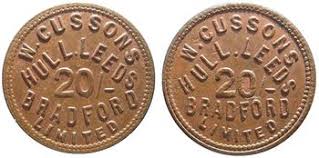
His religious beliefs were also almost certainly the inspiration for launching an innovative profit-sharing scheme for customers at his stores. Under the scheme, tickets were issued to customers and every three months the company’s accounts were audited by two separate accountancy firms. If a profit was declared, a bonus was announced and customers could redeem their tickets for special coupons to the value of the bonus to be spent in the stores. For example, in February 1893, a bonus of one shilling in the pound was declared with each store paying out the bonus on specific days.
The scheme closely mirrored a similar one operated by the Co-operative Society whose stores were in competition with William. In a bid to win footfall, he even produced anti-Co-op posters to persuade customers to join his scheme instead. Shoppers would receive four coupons for a 1lb packet of tea, and two coupons for a half-pound packet. The metal coupons would also be exchanged for free books while, in another first, cut-out coupons were also printed in newspapers. Today, the metal coupons – which came in a variety of shapes and sizes – are collectors’ items.
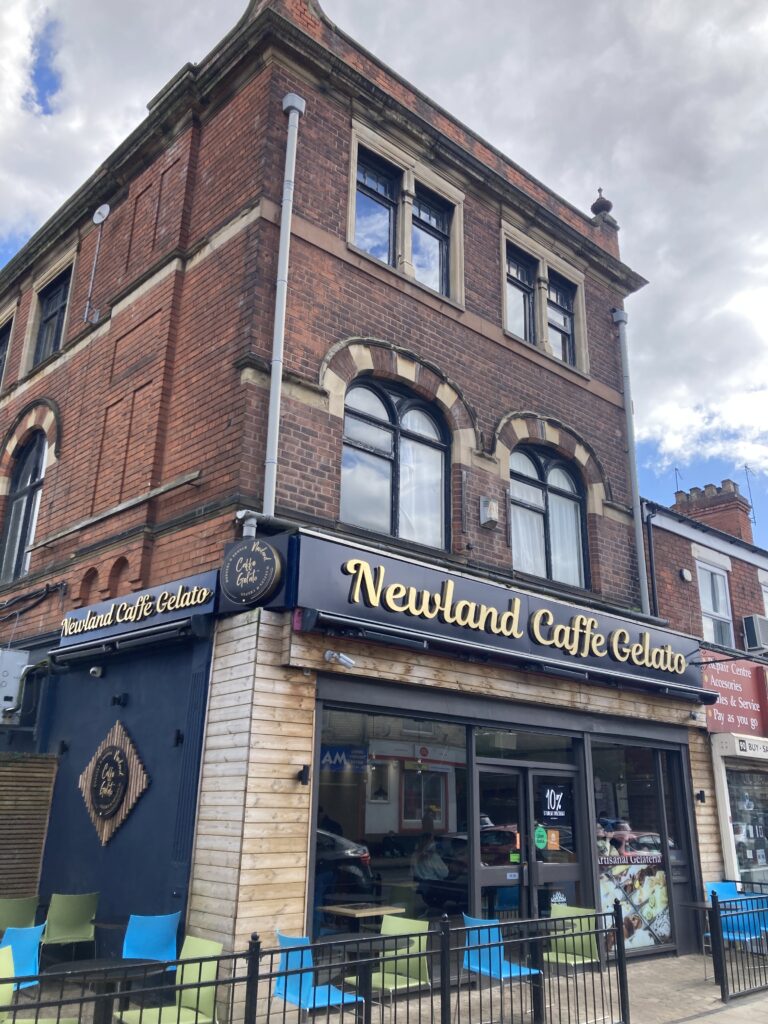
Business boomed and William became a rich man, living with his wife and five children Dorchester House in Beverley Road, a striking town house which now forms the main part of the Dorchester Hotel. At the time of his death in 1907, William Cussons Ltd. operated 23 shops in Hull, Hornsea, Withernsea and Bridlington with other business interests in Leeds and Bradford. Many occupied street corner sites with suitably grand architecture to reflect their location. A former Cussons store at the junction of Newland Avenue and Lambert Street is a good example. It’s now home to Caffe Gelato.
The company continued until 1962 when it was bought by the Great Universal group. By then it had over 50 stores across Hull and East Yorkshire, still trading under the Cussons name. However, by the late 1960s another change of ownership saw them being re-branded as Fine Fare. In 1985, the surviving shops became Somerfield stores after a takeover by the Dee Corporation which was originally founded by Hull grocer Frank Dee.
In an ironic final twist, the Somerfield stores were acquired in 2008 by the Co-op – William’s old competitors.
Angus Young