Why Did Two Hull-Built Steam Ships End Up Sailing More Than Two Miles Above Sea Level?

Our elevated shipping correspondent Angus Young takes a trip to the Andes and beyond.

SS Ollanta

They were constructed next to the Humber in a Hull shipyard standing just a few feet or so above sea level. However, the SS Inca and the SS Ollanta were destined for much higher waters. Both ships were built by Earle’s shipyard at Victoria Dock to operate on Lake Titicaca, the highest navigable lake in the world which lies in the Andes mountains between Peru and Bolivia.

Earle’s made ships for the British, Japanese and Chilean navies, the Hull-based Wilson Line and yachts for the Russian aristocracy. But the orders by the British-owned Peruvian Corporation were undoubtedly its most unusual contracts.

The British takeover of Peru’s state railway company in the late 19th century was part of a deal allowing Peru to pay off crippling debts caused by war and a series of natural disasters. In 1904 with traffic increasing on the 118-mile long lake, Earle’s secured a contract with the company to build the 220 foot-long steamer Inca. The ship was twice the size of the largest vessel sailing on the lake and when it was completed each section was carefully marked before the whole ship was dismantled. All parts of the vessel were then placed in packing crates, including the engines and boilers which had been  manufactured separately.

The crates were shipped from Hull in 1905 and on arriving in Peru they were transported 200 miles by railway to the lake where all the sections were re-assembled before the ship entered service.

Twenty five years later Earle’s won a second contract for an even larger vessel, the 260ft-long Ollanta, to operate on the lake. The ship was built and then dismantled in the same way as the Inca and this time the company sent one of its top engineers to Peru to supervise its re-assembly. William Smale’s task was not easy.  As well as the challenge of piecing the vessel back together, he had to rely on local labourers who not only spoke little English but also possessed few skills related to modern shipbuilding and engineering. Lacking many tools for the job, Smale improvised by adapting existing railway machinery while pressing ahead with the construction of a new slipway from scratch where the ship could be launched.

His original instructions were that he should wait for the arrival of a team from Hull to help with the launch but Smale and his Peruvian workforce cracked on and Ollanta was already in the water when his colleagues finally arrived. The steamer had a deadweight capacity of 950 tons and her four oil-fired engines gave her a top speed of 14.5 knots. Accommodation was also provided for 86 first and second-class passengers.

Smale stayed on in South America for a number of years, taking on a senior engineering job with the Peruvian railway company. He later worked in India before returning to Hull and spent part of the Second World War working on the construction of the famous portable Mulberry harbours used in the D-Day landings.  The Inca survived until the 1990s before being scrapped. Her original Earle’s builders’ plate is displayed in a ticket office at the lake.

Today SS Ollanta is berthed in Puno harbour on the lake. No longer in regular service, she is reportedly used for occasional passenger cruises.

Angus Young

What Is The Columbarium?

Hull Tour Guide Paul Schofield takes a trip down Hedon Road to visit one of the most eerie and intriguing places in the city.

Who Was Hull’s Most Famous Spy?

Our wartime espionage correspondent Angus Young unveils a fascinating tale of deception, misidentification and model ships.

Max Schultz was born in Hull while his emigrant parents were heading to America from their native Germany. Perhaps his arrival changed their plans because they decided to stay in Hull where his father eventually opened a shoe shop. Little is known of his early life but Schultz developed a successful career as a shipbroker and owner, reflected by the fact that, along with his wife Sarah and five children, he lived in a large house in fashionable Coltman Street where several master mariners and other prominent figures of the day also lived.

Through his work, Schultz spent much of his time at ports on the continent and because of this he came to the attention of the newly-formed Secret Service Bureau of the British government. What would become MI6, the bureau was created in 1909 in response to British concerns over the rapid expansion of the German Navy. Schultz’s occupation was a perfect cover for frequent visits to Germany to gather information on vessels being built for the Imperial fleet.

For two years he managed a team of four paid informants working in various shipyards, reputedly obtaining a large collection of drawings which were brought back to London. However in 1911 he was arrested in Hamburg by the German authorities along with two accomplices, convicted of spying and jailed for seven years. While he spent the First World War behind bars, back in Hull his wife Sarah was forced to revert to her maiden name of Hilton as anti-German hostility swept the city as a result of deadly Zeppelin raids. Street riots broke out and shops owned by Germans or with German-sounding names were attacked while stones and abuse were hurled at the family’s house in Coltman Street by attackers unaware of Schultz’s secret spying missions on behalf of Britain. It’s also likely some had confused him with another Max Schultz, a German arrested in Portsmouth for spying on British naval shipping.

On his release from prison after the war the Hull-born Schultz also changed his name to Hilton and resumed working for the Secret Service, returning to Germany after a brief spell back in his home city, Sadly, his marriage collapsed and he died a premature death in 1924 at the age of just 49 reportedly an alcoholic.

His remarkable story was given a new lease of life in 1999 when a model ship was bought at a flea market in Hamburg. The ship in question was the 1912 ocean liner SS Imperator, once the largest passenger ship in the world and flagship of the Hamburg-America shipping company. The man who made it was Max Schultz.

The model’s new owner found a hand-written note hidden beneath one of the ship’s funnels. It said: “Oct 6, 1913, To whom so ever find this may know, that this is placed inside of the model of the Imperator H&A line 828 ft long, 87 ft beam and 48 ft depth.  The model is built to scale by the writer in Fuhlsbuttel Hard Labour prison with very odd & rough tools despite it not on account of roughness, it is a labour of love and helps pass the time. I am here now two and a half years, having been sentenced in Leipzig to seven years for espionage for the dear old English government. I am an English man and a ship owner residing in Coltman Street, Hull, Yorkshire. Wife a Hilton good and true, five children. Max William Schultz.”

Angus Young

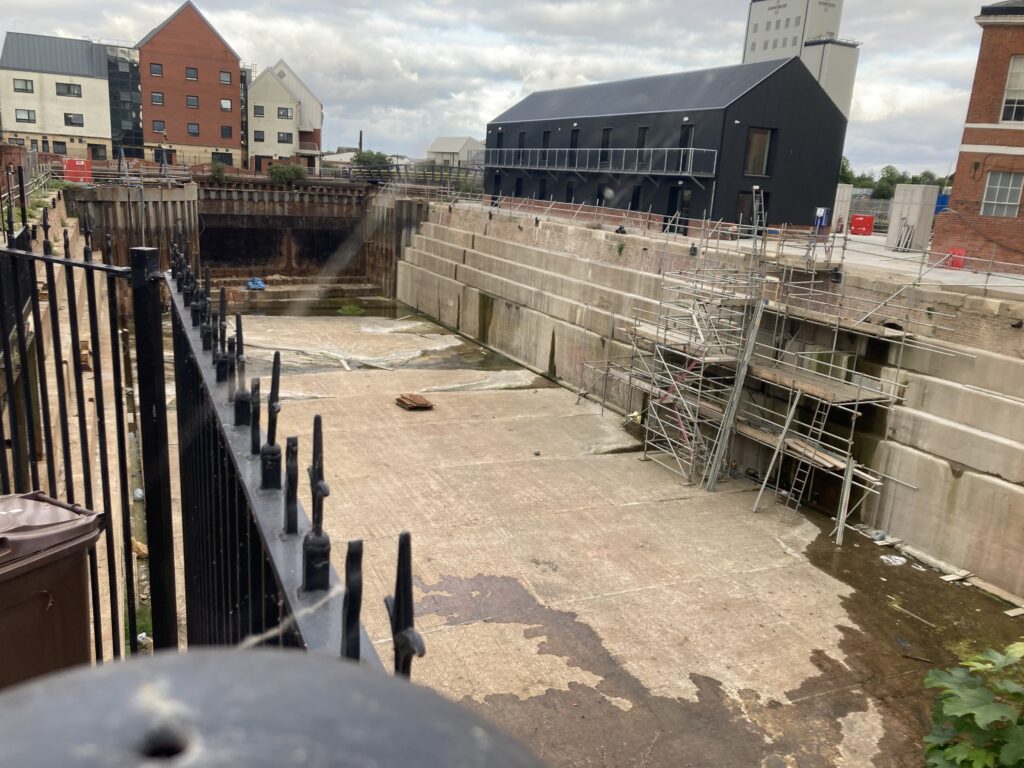
What’s Going On At The North End Shipyard?

Stumped by silt but soon to be expunged to fruition, according to our dry dock progress correspondent Angus Young.

After literally getting stuck in the mud, the ambitious project to create a new permanent berth for the Arctic Corsair is back up and running. Approval for a much-delayed marine licence required to remove silt from the River Hull means the former sidewinder trawler is now scheduled to be dry-docked at the North End shipyard in April 2026.

Around 3,500 cubic metres of silt will be removed from the banks of the river, allowing the installation of a new 50-tonne dock gate and the creation of a sufficiently clear navigational path for the 693-tonne vessel to be manoeuvred into its new berth. Separate licensing approval is still needed from the Environment Agency covering the disposal of the extracted silt. While this is not expected to be a problem, it will involve the design of a temporary silt treatment compound at the site.

Historically, dredged river silt was taken into the Humber where it was dumped but recent legislation now requires land-based disposal for contaminated material. Under the plans, water will be drained from the extracted silt and returned to the river. The remaining material will eventually be sent to landfill.

The potentially tricky task of slotting the trawler into the dry dock has been pencilled in for next April because that’s when the next ideal tide for the job is forecast. As the vessel’s engines no longer work, it will have to be towed into place by tugs. Two practice runs using other similar-sized ships are also being planned beforehand to test whether all the calculations and angles required for the last leg of the Corsair’s final journey are correct.

As well as the new gates, the dry dock will also house a series of supporting blocks which the trawler will eventually stand on. Both the gate and the blocks have already been constructed and are currently in storage awaiting installation.

Once safely in the dock, the remaining fit-out works onboard the Corsair will take place. When they are completed, the first visitors are expected to be welcomed in late 2026. As well as the ship, a new visitor centre has been built at the shipyard while three new large concrete support columns at the site await the return of a restored 18-ton Scotch Derrick Crane which once stood next to the dock.

Gillian Osgerby, interim assistant director for major projects and infrastructure at Hull City Council, said: “Water infiltration was a big issue on the vessel when it was previously berthed on the river but that won’t be a problem here. Being berthed in a dry dock will allow people to see the full size of the Corsair for the first time as well as helping conserve it for at least another 100 years. I am confident it is going to be something very special, not just for Hull but the whole region.”

Angus Young

How Does The Tidal Barrier Work?

It stops the Old Town from flooding, but how? Our marine impediment correspondent Angus Young dives in.

Hull’s Tidal Barrier, yesterday. Pic: Dr Stuart McLelland

After the one on the Thames, Hull’s Tidal Barrier is the largest flood barrier in the UK. It’s not a surprising fact because after London, Hull is also the second largest UK city most at risk from being inundated by flooding.

Completed in 1980 at a cost of £4.3m, the barrier has certainly proved to be value for money having protected the city from flooding ever since. The giant structure’s finest hour to date came in December 2013 when it stood firm during a record storm surge on the Humber and kept everyone dry.

When a high tide is predicted, the barrier’s 212-tonne steel gate is lowered into the River Hull to prevent water from the estuary entering the low-lying River Hull Valley. Steel plays an important part in the  structure because each of its two distinctive concrete towers also feature steel support columns. At the time, the 34 metre-long steel used for the columns was the longest ever rolled by British Steel.

The gate is powered by motors and is typically deployed using a hydraulics system 30 minutes before an expected high tide. In the event of a mechanical failure, it can actually be hand-cranked in position although this is never thought to have happened during a real-life incident.

Hull’s Tidal Barrier, yesterday. Pic: Dr Stuart McLelland

When required to thwart a high tide, the gate moves from its normal stationary horizontal position and rotates 90 degrees before being lowered and locking into a sill built into the river bed. This movement has been likened to an up-and-over garage door. When locked into place, five sluice gates in the barrier control water flows into the river.

As with any machine of a certain age, the barrier needs regular maintenance. Last year specialist civil engineers carried out a major structural survey, inspecting 92 separate locations on the steel gate for signs of corrosion along with 260 welds and bolts. They also took concrete samples from 12 different parts of the two main towers for further examination. The results from tests on both the steelwork and concrete will be used to plan future maintenance work.

When it was built, the barrier was typically lowered around once a year but more recently that frequency has significantly increased reflecting rising tides on the Humber. Sometimes it is lowered once a month. Another recent change has seen the barrier being used to reduce the risk of flooding upriver in the River Hull Valley. This has seen it lowered at low tide to keep water from the estuary out of the River Hull to ease flood-inundated land north of the city.

As you would expect, Professor Stuart McLelland, of the Energy and Environment Institute at the University of Hull, is a big fan. He said: “The tidal surge barrier is an impressive structure and an elegant engineering achievement to help the city and the wide region  live with the water that surrounds us. If it wasn’t there, those of use living and working in Hull would regularly get wet, or worse.”

Angus Young