
Andy Train, of Pride In Hull, picks a unexpected but undeniably amazing view.

Andy Train, of Pride In Hull, picks a unexpected but undeniably amazing view.

Author and illustrator Ramzee takes a shot at our Big Malarkey quiz, while Ally-mai holds sway.

The difference between the rest of us and our muck garths correspondent Angus Young is that we see an owld doorway and he sees a social history of Hull.

It’s another one of those blink-and-you-will-miss-it moments. Take a stroll across North Bridge, dodge the traffic on Great Union Street and head for the southern side of Witham. Just before reaching Malton Street, it’s there on your right.
Framed in an archway set into an old brick wall is a wooden door covered by a rusting metal grille. Above it, there’s an overgrown bush. The archway itself is well below head height while the door looks as if it hasn’t been opened in decades. Viewed from the side across an open patch of fenced-off land, the door doesn’t appear to lead anywhere.
However, in the mid-19th century the archway was the entrance to 23 cramped properties lying either side of a narrow alley housing over 200 people. Holderness Court was one of five alleys lying between the Ship Inn (more recently known as the PlimsollShip Inn) and Malton Street. The others were the strangely-named Quickyfalls Court, Clean Alley, Chaffer’s Alley and Dunn’s Court.
Needless to say, conditions in the alleys back in the day were pretty grim. They had all been built on land previously used to store night spoil (human waste) removed from the town centre before taken out into the countryside where it was used as fertiliser. As a result, the area was known as ‘Muck Garths’. The houses were built back to back and didn’t have any running water or toilets. Instead, residents had to share a communal privy.

A picture of life in Chaffer’s Alley is provided by Mike and Sheena Young in an absorbing online blog called Young Family History. In it, they trace a branch of their ancestry back to three-year-old Jane Cotter listed in the 1841 Census as living with his parents and three older siblings in a house they shared with another family in Chaffer’s Alley. Jane’s labourer father James was born in Ireland while her mother Margaret originally hailed from Middlesex, suggesting the Muck Garths alleys were mainly home to migrant workers who had settled in Hull.
James Cotter died of a diseased bladder in 1845 aged 56. His burial entry records his residence as Chaffer’s Alley. His death almost certainly plunged the family into deeper poverty.
Six years later in the 1851 Census his widow Margaret is registered as living in the Sculcoates Union Workhouse with two children who had been born after Jane who by now, at the age of 12, was working as a servant in a lodging house in Sykes Street.
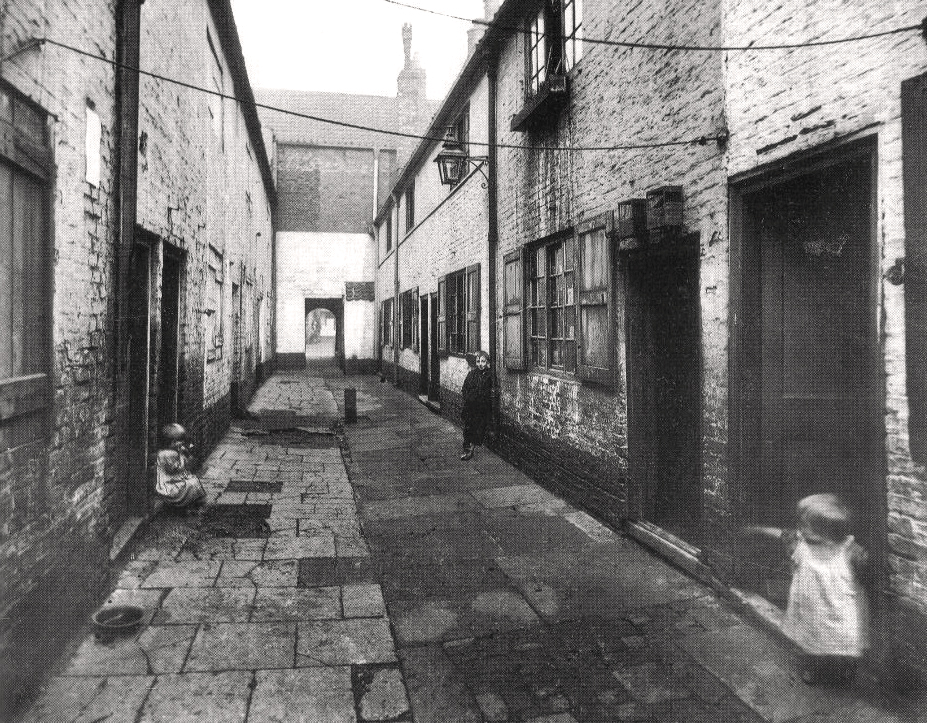
The cholera and typhus epidemics experienced in Hull in 1847 would eventually lead to the clearance of the kind of slum housing found in narrow alleys and passages. Between 1890 and 1910 Hull Corporation condemned and demolished 779 properties and a 1892 map showing the new tramway along Witham confirms that by then, Holderness Court and the other alleys were no more.
However, why the alley’s original archway entrance was retained remains one of life’s wonderful mysteries. The fact that it’s still with us nearly 200 years later certainly deserves a wave the next time you’re passing.

Hull Tour Guide Paul Schofield visits a memorial to the brave volunteers who fought fascism in the 1930s.

While appearing at a recent Hull Noir event, top author Jake Arnott was kind enough to tell us about his love for our local litterateurs.

In a podcast so fascinating Burnsy is stunned (almost) to silence, Stewart Baxter talks about everything from childhood trauma to improvised music to Spotify to the Nuremberg Trials combine in his new project.
This is a two-part podcast. Both episodes are available on this page.

Our police history correspondent Angus Young is a proud and enthusiastic graveyard rambler and often finds fascinating tales of local folk long past.

Graveyards are a treasure trove when it comes to researching local history. The one at St. Mary’s Church in Cottingham is no exception with a singular very striking tomb standing out. Surrounded by high iron railings on four sides, it features a prominent stone obelisk standing in the shade of a nearby tree. Closer inspection reveals it’s a grave for the Wray family.
There’s an engraved stone commemorating Anne Wray, who died in 1854 aged 66 and another in memory of what appears to be her three children – Eliza, John and Fanny. However, the reason for the striking monument lies in the contemporary importance of Anne’s husband John who, according to his own commemoration stone attached to the base of the obelisk, died in 1869. Still clearly visible and etched in stone, it reads: “In memory of John Wray Esquire, late Receiver General of the Metropolitan Police. Founder and for 43 years chairman of the University Life Assurance.”
Unlike Sir Robert Peel who, as Home Secretary, was responsible for the introduction of the Metropolitan Police force in London in 1829, little is known of the man who played a major role in getting it off the ground. That man was John Wray.

Born in Hull in 1782, Wray was appointed as the Met’s first Receiver Governor, or chief financial officer. It was his responsibility to organise and oversee the collection of money from London’s parishes to fund the new-look force, working from an office in Whitehall Place with a rear entrance in Scotland Yard. Wray was the son of Lieutenant Colonel John Wray, commander of the Hull-based Fourth Battalion of the East Yorkshire Militia and a member of Hull Corporation who was best known for initiating a national relief fund for children and widows of men who had died during the Battle of Waterloo. Wray junior studied at Trinity College in Cambridge and worked as a barrister before joining the Met on an annual salary of £700. He served with the force until 1860 when he retired, aged 78

An official history of Scotland Yard describes him as “completely honest but far from organised by today’s standards”. Apparently, most of his dealings were verbal while his “interest in accurate account keeping was remote”. Even so, by the time he retired Wray had seen the Met grow to a force of 10,000 officers.
He also managed to juggle his role controlling the Met’s purse strings with founding and chairing the University Life Assurance Society, which was later acquired by Equitable Life group several years after his death. On retirement, Wray returned to live in East Yorkshire as a widower.
Today his name lives on in a block of flats built by the Metropolitan Police in Chelsea in the 1930s to provide accommodation for 114 police officers and their families. Wray House was sold in 1986 and converted into private residential accommodation but retains a link with the police as its original architect Gilbert Mackenzie Trench was also responsible for designing the iconic blue police call box later made famous as Dr Who’s Tardis.

Theatre type Andy Pearson picks a distinctly unglamorous yet very meaningful site known to lots of Hull City fans.

Collin, from Hull nature enthusiasts Rewilding Youth, takes on our Big Malarkey quiz with quizmaster Ally-mai.

With the rides now safely away from Walton Street for another year, our environmental carnival correspondent Angus Young looks at how sustainable the event is.

We all know it’s colourful, noisy and designed to empty your wallet faster than a gang of pickpockets in Dickensian London. But how environmentally-friendly is Hull Fair?
Well, the latest terms and conditions for operators produced by Hull City Council covering this year’s event are big on recycling and reducing waste. Catering stalls are not allowed to use plastic, trays and cutlery; dry refuse such as glass, metals and plastics must be recycled separately from general waste while anyone spotted pouring waste fat and oil down a drain risks a £300 fine.
However, there is no monitoring or enforcement in place to curb any potentially harmful emissions being thrown into the night air above Walton Street.

Travelling fairs rely heavily on diesel-powered generators to power rides and stalls and Hull Fair traditionally billed as Europe’s biggest travelling funfair – is no exception. In 2019 an in-depth report on the environmental impact of diesel use at outdoor events in the UK painted a grim picture. Describing it as a “public health emergency”, the report estimated the annual emissions from generators at events was the equivalent of adding 220,000 diesel-powered cars to the roads every day.
Putting it another way, the report suggesting offsetting the annual emission of 1.2 million tonnes from generators would require the planting of a forest four times the size of Birmingham every year.
Of course, change can happen if you put your mind to it as the organisers of the Humber Street Sesh proved two years ago when they switched from using diesel to hydro-treated vegetable oil, supplied at a discounted rate by local firm J.R. Rix & Sons. They oil powered all the stages, bars and lighting and reduced the Sesh’s carbon footprint by 90 per cent.
What Hull Fair’s carbon footprint is anyone’s guess without any specific quality monitoring in place. The only recorded measurement is taken 500 metres away along Anlaby Road by a nitrogen dioxide monitoring unit which is part of a citywide network designed to keep tabs of vehicle emissions. Even then, it only provides monthly data which is eventually published.

In a statement, the council said: “Air quality is rigorously monitored throughout Hull, via more than 150 monitoring stations around the city, which provide a monthly update on levels of Oxides of Nitrogen. Every year, we use this data to create a publicly available report which is robustly reviewed by DEFRA, to assess whether there is more the council can do to improve air quality. We also have our own Air Quality Strategy; another public document setting out our plans to continue making improvements.
“Generally, air quality in Hull is good, with only one area of the city exceeding the nationally set Air Quality Standards. That’s an area around the A63, and the current works by Highways England include a requirement for them to reduce concentrations to below the set levels. Base measurements are not carried out before or during Hull Fair, due to the continuous monitoring already ongoing.”