
Liam and Jack from Hull KR Foundation give us a rundown of their best of the current season.

Liam and Jack from Hull KR Foundation give us a rundown of their best of the current season.

We sent Burnsy to Prinny Ave to learn what goes on in the Avenues own art gallery.

Hull Tour Guide is back on his beloved Holderness Road to talk about a significant designer.

Sounds like a bit of a conspiracy theory, but our fortified waterways correspondent Angus Young thinks the truth is literally beneath us.

For most of its 33-mile length, the River Hull gently winds its way through East Yorkshire and the northern suburbs of Hull. Like any natural watercourse, it twists and meanders according to the local terrain and the speed of the flowing water. But the river’s final stretch from High Flags where Scott Street bridge once stood to the Humber is very different. Apart from a hardly noticeable kink near Drypool Bridge, it’s uncannily straight.
The river’s last leg could be encased in plaster such is the curve-free line it follows all the way to The Deep. However, the river once took a very different route. Historians think severe flooding in the River Hull valley in 1253 not only inundated much of the marshland north of the Humber but also diverted the course of the river into another watercourse called Sayer Creek.
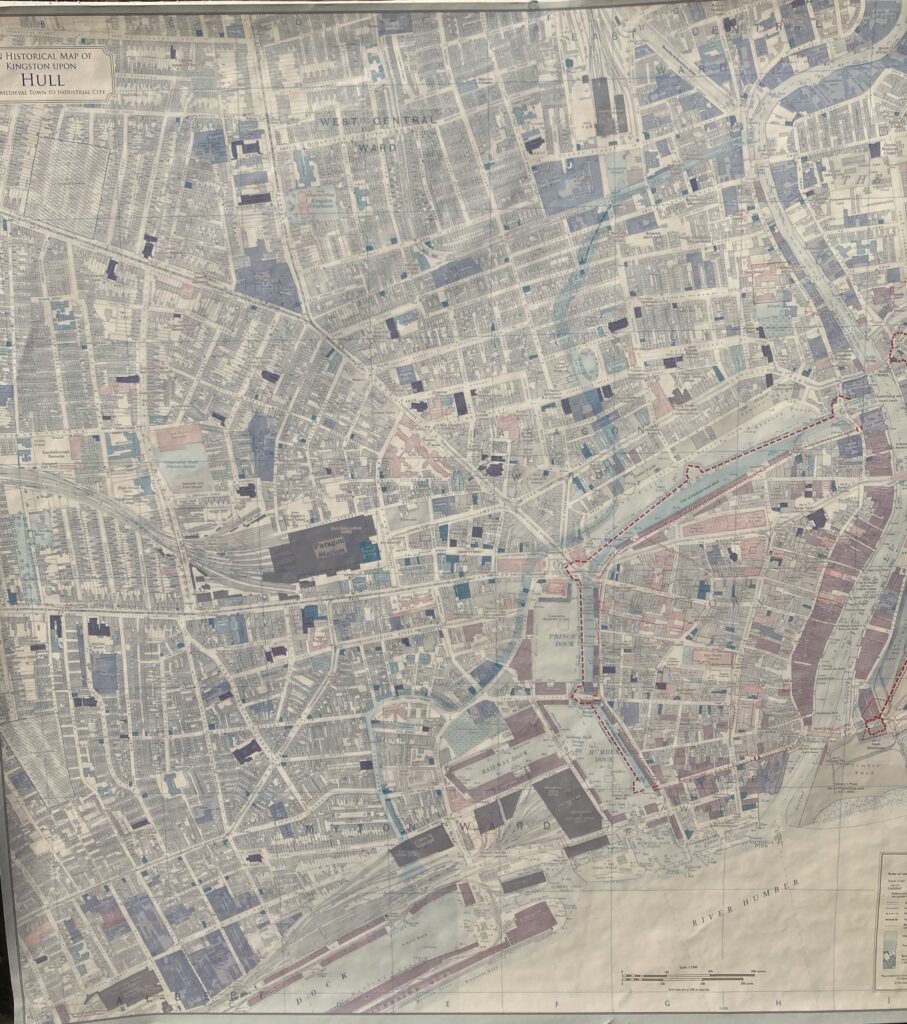
The creek was a man-made channel originally dug to drain land to the east but thanks to the flood became the new course of the river from High Flags that we know today. So where did the river flow before that?
The ancient route can be traced on a recently-published map of Hull showing locations of buildings and landmarks in 1928 with the river’s final winding stretch superimposed on top. You can find a copy in the map section of the Hull History Centre. However, you can also walk along the route through various city centre streets imagining that you’re actually taking a stroll on an ancient riverbank. In fact, once you realise the old riverbed is actually somewhere deep under your feet you begin to recognise the faint but tell-tale low-lying nature of the ground around you.
Starting just north of Scott Street, the old river headed south at what is now Caroline Street before crossing Freetown Way and flowing through the area currently occupied by Kingston Square. From there it flowed south under where the Maltings Business Park stands today and across George Street before meandering close to the Hull Maritime Museum, going under Hull City Hall and running along the route of Waterhouse Lane.
A significant bend in the old river then occurs roughly where the Mytongate junction on the A63 at Castle Street is today, close to the spot where the new road tunnel is being constructed. Interestingly, the 1928 map shows the bend in the river corresponding almost exactly to the crescent-shaped Great Passage Street which no longer exists. The street was an ancient highway which is recorded as far back as the 12th century. As such, it was almost certainly originally adjacent to the river and is thought to have been the location of the hamlet of Myton.

In the 17th and 18th centuries it reverted back to being little more than a track to a couple of scattered properties as the town of Hull developed to the east but in the 19th century a neighbourhood was re-established as Hull expanded to the west. The street itself disappeared when the Mytongate roundabout was built in the late 1970s.
The final stretch of the old river runs south adjoining what is now the Kingston Retail Park before reaching Albert Dock and joining the estuary. Had the great flood of 1253 not happened, the confluence of the River Hull might still be there along with The Deep and the Tidal Barrier and not where it eventually ended up half a mile away.
Angus Young

Not content with one sculpture, boss of Humber Street Gallery Marianne Lewsley-Stier selects an entire trail.

John from Hull Minster tells us the nearest pubs you could nip to at lunchtime (if you also worked there.)

We all know ‘For Those in Peril On The Sea’ but, as Dr Robb Robinson of the University of Hull explains, we don’t all know who wrote it.

Pubs that defeat their own purpose are explored by our abstinence hostelry correspondent Angus Young.

Back in late Victorian era Hull there were no shortage of places to go for a booze-free night out. The Hull Peoples’ Public House Company operated no fewer than 20 hotels and two cafes where no alcohol was served. Ironically, one of the cafes – the De La Pole in Silver Street – is now occupied by a supermarket with an off-licence for selling booze.
The company was formed at the height of the Temperance movement and advertised its venues as alternatives to traditional pubs and the liquid dangers that lurked within them. Instead, the company promised “Viands of the Best Quality at Moderate Prices”. Printed adverts for the company show it sold tea, coffee and cocoa for one penny a cup as well as ‘aerated waters’ for one penny a bottle. As well as its venues, it also made its own brand of aerated water in two factories in Leicester Street and Marlborough Terrace which also produced crockery for the business. Some of the company’s premises offered overnight accommodation costing between sixpence and one shilling.
The production of fizzy or carbonated water was big business in Hull at the time. Companies such as Hindle’s in Chapel Lane and Hawkshaw’s in Spencer Street, made and distributed a variety of drinks, including lemonade, soda, ginger beer and orangeade as well as aerated water. Another firm, Julius Peters, made ‘Kola Champagne’ from its premises in High Street while Murden’s has outlasted them all and still trades today as a family-owned wholesale soft drinks and confectionery business based in Spyvee Street.

The abstinence movement was heavily influenced by the Methodist Church and first gained traction in Hull in the late 1830s with the formation of the Hull Temperance Society. The first edition the society’s newspaper, The Hull Temperance Pioneer, carried the following declaration on its front page: “I do hereby declare that I shall abstain from all intoxicating drinks; such as Rum, Brandy, Gin, Whiskey, Ale, Porter, Wine, Cider and Spirit Cordials, except for Medical and Sacramental purposes, and discountenance the causes and practices of drinking them.”
In a letter published in the same edition, a correspondent noted: “On reading a history of the French retreat from Moscow, I find that during the inclemencies of the Russian winter, and the horrors of the climate, all those who took brandy perished almost without exception, whilst all those who refused it and drank coffee alone survived, were never frost-bitten and reached Paris in safety.”
As well as the Public House company, two other organisations were also prominent in Hull’s attempts to bin the booze. Formed in 1874, the Band of Hope was spearheaded by the Methodist Church and aimed to educate children about the evils of alcohol. Members could join from the age of six and at its peak there were an estimated 10,000 members who took part in regular musical concerts and marches.
The Good Templars were formed in the same year, taking their name from the medieval religious order of knights who guarded holy sites in Jerusalem, The Hull version sought to lead their own crusade against the corruption of alcohol.
One of the group’s founders was Guy Hayler, who ran his own temperance hotel in Albion Street. A lifelong temperance campaigner, Hayler seems to have been a charismatic figure. On one Sunday he was said to have delivered a record-breaking 127 separate sermons and Sunday School addresses across Hull on the perils of drinking alcohol. He also founded an annual May day event celebrating teetotalism. In 1882 he gathered a petition of more than 500,000 signatures calling for a parliamentary bill to close all alehouses in Yorkshire on Sundays and also played a leading role in lobbying magistrates to refuse applications to sell beer and spirits at Hull Fair.
Individual churches and chapels also formed their own temperance groups, supported by a number of prominent public figures such as Thomas Ferens and Frederick Needler, both staunch Methodists.
The UK temperance movement started to run out of steam after the First World War, partly because of increased licensing regulation over the sale of alcohol as well as advances in health and education and a decline in church membership. Together, they combined to change the way society viewed the issue. As a result, the Hull pub chain with no booze closed its doors for good.
Angus Young

Some brotherly love from Hull Tour Guide Paul Schofield as he tells the tale of the monks of Meaux.

On the day Abbie Rial hosts our manga drawing event at Western Library, she offers up her all-time great manga books.