
Tutorial number four finds manga artist Abbie Rial back in the Makerspace and looking at faces.

Tutorial number four finds manga artist Abbie Rial back in the Makerspace and looking at faces.

Burnsy attempts to unpick the important details of the upcoming election to decide who will be the new mayor of Hull and East Riding, with help from Angus Young.

Forget Grok, this is the type of AI we want! Our anthropomorphic technology correspondent Angus Young has the details.
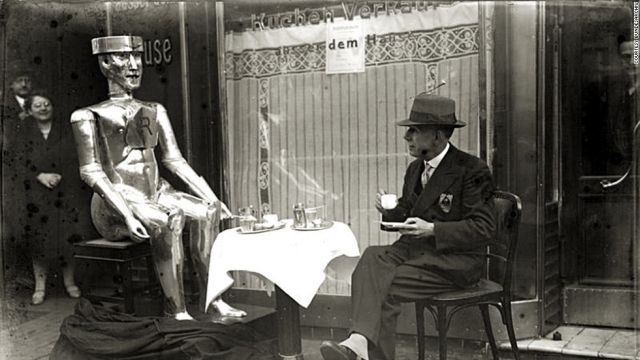
It was billed as Hull’s Great Exhibition. Staged over ten days in March 1935, the City of Hull Trades Exhibition in the City Hall featured 23 stands ranging from the Hull Corporation Electricity Department to Swissaire Refrigerators of Hessle Road. Additional attractions included music by the band and pipers of the King’s Own Scottish Borderers, fashion parades and a display showcasing a fully-electric house.
However, the star of the show was a robot called George. “Come and see the great super electro-mechanical man,” said the official programme. “He moves and talks – is almost human. The world’s great electrical wonder, a moving, walking man. A man without soul. Come and see how he will help you to solve the problems of the future. First time in Hull.”

George was the handiwork of Captain William Henry Richards, a journalist, war correspondent and an amateur engineer. He is credited with building Britain’s first mechanical man in 1928. His invention called Eric performed the opening ceremony of the Society of Model Engineers’ annual exhibition that year. Weighing just over 45 kilograms, Eric was made of aluminium and stood in a box which housed a 12-volt electric motor. Inside Eric’s armour-plated chest was another motor with 11 electromagnets and wiring to different parts of his body. Eric could take a bow, look right and left, sit down and deliver a short recorded speech.
Naturally, he caused a sensation and Richards took Eric on promotional tours in both America and the UK before deciding to concentrate on developing a second robot who would become known as George. Boasting a more rounded physique, he made his debut at a Parisian theatre and subsequently toured Europe and the UK appearing in department stores and trade exhibitions such as the one in Hull.

Standing on his own two feet rather than in a box, George moved in the same way as his predecessor and was said to be able to answer a number of pre-prepared questions. Richards used primitive voice-activated technology to trigger the robot’s movements. He would speak into a microphone built into its body which then transmitted electrical currents to a series of moving mechanical parts. Asked what it looked like inside, he said: “Most disappointing, nothing but gears and cranks. Just like a watch on a large scale.”
Even so, the official Hull exhibition programme promoted George as a technological wonder. “There is no doubt Britain’s great super-electro-mechanical man will arouse keen interest in Hull. What this extraordinary invention means to the human race only time can tell,” it said. As it turned out, George barely survived the Second World War after being badly damaged when a Surrey garage where he was stored suffered a direct hit during a bombing raid.
It’s not clear what happened to the robot when his inventor died in 1948 but four years later George’s story took an unexpected twist when he started to appear in publicity photographs for the actress Diana Dors and her then husband Denis Hamilton. At the time, Hamilton claimed he had built the robot – which he called Robert – from spare parts he had found in the basement of their new home.
However, the robot was clearly George and the publicity shots led to a bitter row between Hamilton and members of the Richards family after which George was never seen in public again.

Amy Thompson pops along to Bransholme Library to knit together a story of fabric and friendship.

Playwright Maureen Lennon chooses a very popular landmark in the city, and for very good reasons.

A slightly creep discovery may have a simple solution, as our aged cist correspondent Angus Young reports.

During a recent renovation project at St. Mary’s Church in Hull’s Old Town, archaeologist John Buglass made an unusual discovery. He had been hired to keep a watching brief as work was carried out to replace the church’s crumbing Victorian tiled floor and corroded heating pipes underneath which no longer worked. The removal of the floor exposed a number of brick-built burial vaults. The vaults were originally constructed to provide the last resting place for some of the wealthiest members of the church’s congregation who could afford them.
Although unable to physically inspect them, John did manage to record five lead coffins still surviving in their original locations in three different areas. However, to his surprise, the lids of four of the coffins had been cut open while a fifth remained intact with stone slabs placed on it. He believes the remains of the bodies were probably removed when the tiled floor was laid in the 1860s.

He said: “The exposed coffins had all been opened by having the lids cut around the edges and then pulled off. In addition to the obviously opened coffins, all the other voids did not appear to contain coffins and were simply filled with loose backfill material. Although it is not entirely certain why both the vaults and coffins appear to have been emptied, the most likely time this happened would seem to have been during the 1860s restoration work. At this time we know various ledger stones within the church were lifted and moved into the adjacent churchyard. It would seem quite possible that any living descendants may have taken the opportunity to relocate the remains of any forebears, possibly along with their monuments, to a new location. The fact that there are a significant number of vaults reflects the location of St. Mary’s in the heart of the Old Town of Hull with its associated wealthy merchants. This would have led to a large number of burials in various parts of the church with location depending on the wealth and status of the individual.”

The discovery led to speculation that one of the empty coffins might once have been occupied by the remains of Sir Samuel Standidge, a former Mayor of Hull and five times Warden of Trinity House, who as a successful shipowner was one of the richest men in 18th century Hull. Records show he bought his own vault for five guineas in 1778 some 13 years before his death. However, it’s unlikely Standidge and his fellow vault-dwellers fell victim to Burke and Hare-style bodysnatchers.
John’s theory that relatives simply took the opportunity of relocating the bodies to the churchyard seems more plausible, particularly considering the ever-present risk of flooding from the nearby River Hull. The churchyard was at least on higher ground than the vaults sunk deep under the church.
Today, visual evidence of where Standidge and the others might have ended up is hard to find. Most of the churchyard’s stone ledgers have faded with the passing of time and the inscriptions are difficult to make out let alone read.
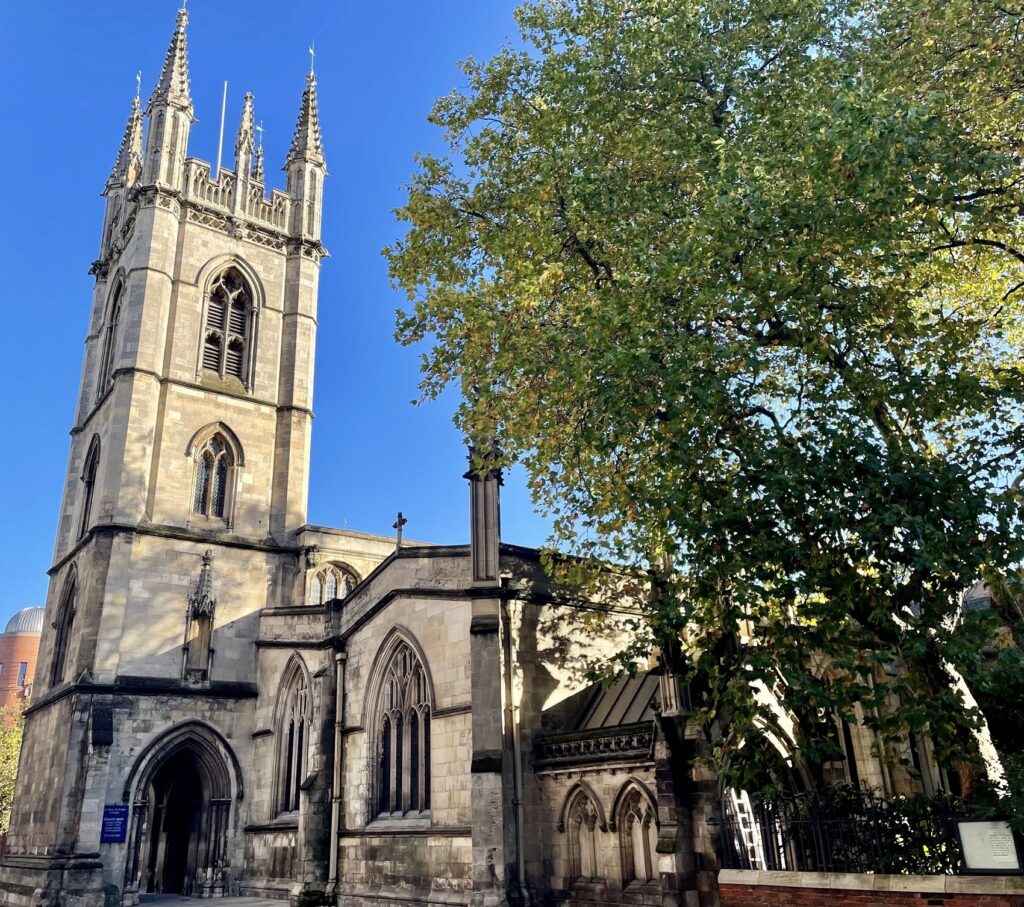
As well as the vaults, John’s other most significant discovery was the remains of walls which once formed part of the earlier phases of the medieval church. Elsewhere, a small part of an earlier brick floor was also uncovered with some of the oldest identified bricks re-used in later building projects thought to date back to 1423. As well as the new stone flooring, the church now has new heating and electrical systems, indoor toilets and a new refreshment space.
Amanda Habergham, chair of the Friends of St. Mary’s. said: “Any visit to the church used to usually require the wearing of at least five layers of clothes just to keep warm. Thankfully, the new heating – which includes underfloor heating and some renovated radiators from the 1930s – has changed all that although it’s also a bit of a double-edged sword because we now have to keep a close eye on our energy costs.
“As a church, we get no capital funding from the Church of England or the local authority so everything we raise is either from the congregation or through grants.”

In the third of her tutorials, top manga artist Abbie Rial is concentrating on the human figure.

A volunteer at Bransholme Library, John not only knows a lot about art, he also knowns what he likes.

Journeyman player, Spanish superstar, penniless alcoholic – our vintage football correspondent Angus Young uncovers a remarkable sporting life.
When Rubén Sellés was appointed by Hull City last December he made history by becoming the club’s first Spanish head coach. However, The Tigers’ first connection with Spain goes back over a century.
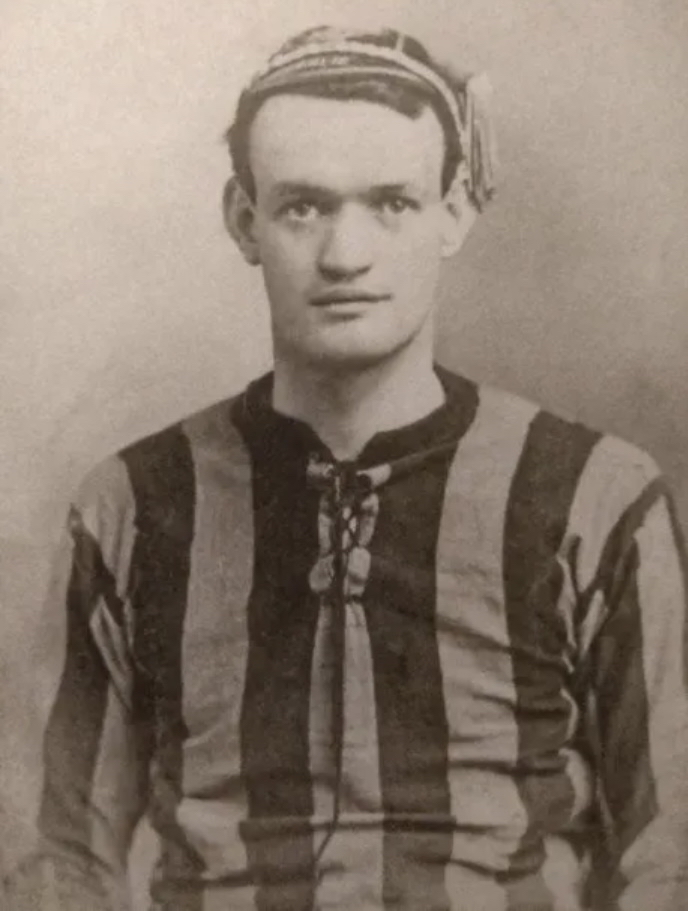
In March 1912 an Irishman called Patrick O’Connell joined City from Sheffield Wednesday for a transfer fee of £350 and went on to play 58 times for the club over the next two seasons, some of them as team captain. As it turned out, it was the most games he played for the same club in his career.
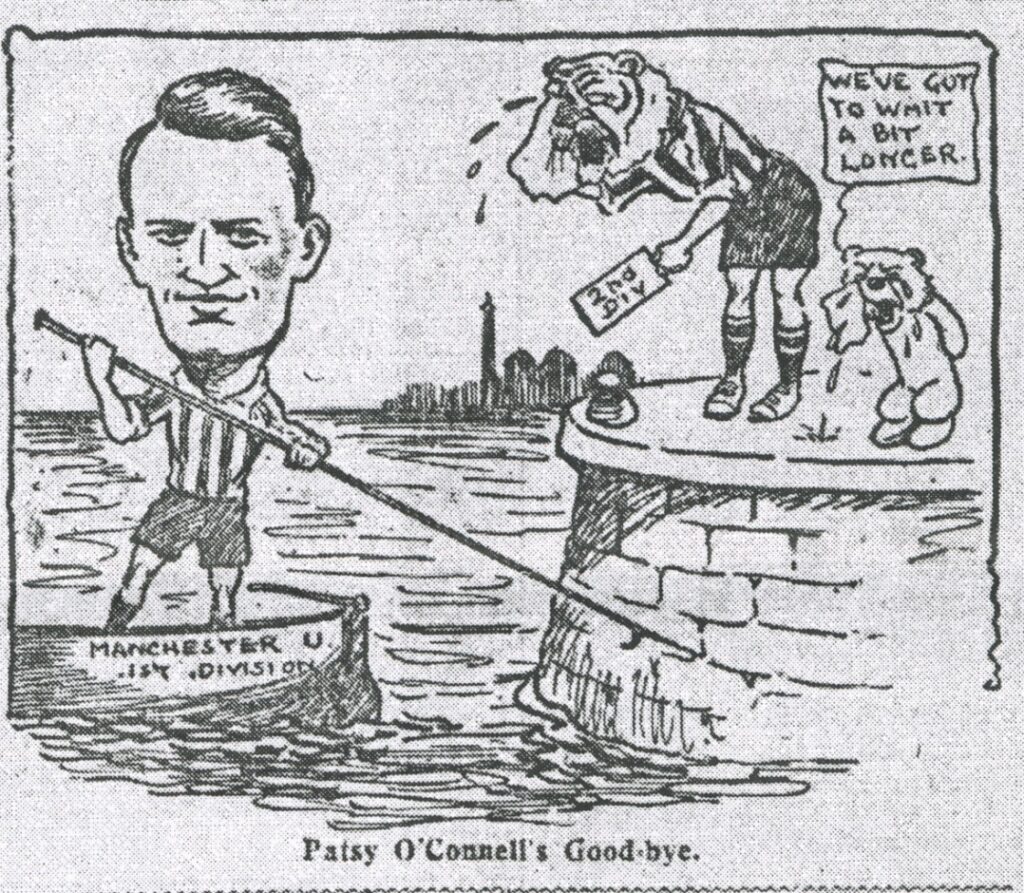
When he left City to join Manchester United his departure appears to have been less than amicable. O’Connell had enjoyed his time in Hull and wanted to stay, requesting a new three-year contract. He also suggested an unusual clause allowing him to live 20 miles away in Hornsea owing to his wife Ellen’s “delicate health”. Ultimately, hopes of a new deal and a seaside home were dashed by City’s board of directors who had more urgent matters on their hands.The club was in serious financial trouble made worse by a large fire on Easter Monday in 1914 which damaged large parts of the Anlaby Road ground. The club took out a £1,000 loan to carry out the repairs. Two weeks later O-Connell was sold to Manchester United for the same amount.
O’Connell ended his playing days in 1922 at non-league Ashington in Northumberland. After briefly taking over as the club’s manager, he successfully applied for the manager’s job at Spanish club Santander. Professionally, his life in Spain blossomed. Further managerial appointments followed at Seville and Betis where he guided the club to their one and only La Liga championship in 1935. His success would see him next move to Barcelona as head coach just as Spain was lurching towards civil war.
During the conflict Spain’s national league was suspended and the Catalan club, which opposed General Franco’s regime, had its stadium bombed and saw its president shot dead by troops. Nonetheless, O’Connell was credited with helping save the club from oblivion by leading the team on a lucrative tour of Mexico and America to stave off financial collapse. When the war was over, he resumed head coaching roles once more at Santander, Seville and Betis before taking up scouting.
Privately, his life was a mess having abandoned his wife and four children in Manchester when he first moved to Spain without telling them where he was. He later married an Irish nanny only for her to eventually seek a divorce when she belatedly discovered he was still married. Neither of his two families knew the other existed.
Eventually, he returned to England and ended his days as a penniless alcoholic, begging on the streets of Kings Cross in London where he lived in a ramshackle boarding house. Such was the family turmoil he helped create, only his brother attended his funeral following his death in 1959. He was buried in an unmarked grave.
Despite his fall from grace, O’Connell’s remarkable footballing journey across Europe has recently been re-discovered and celebrated in his native Ireland via a book by a relative, an Irish TV documentary and the re-dedication of a wall mural in Belfast commemorating his links with Barcelona originally painted in 2015. Meanwhile, a bronze bust of the man known as ‘Don Patricio’ also now takes pride of place in Betis’ club museum.

Musician Lou recalls her first visit to Hull Ice Arena and how it started a lifelong love of all things sub-zero.