What’s Going On With King Billy?

He’s been looked well shabby for too long now, but our council pestering correspondent Angus Young has got the latest news on Hull’s oldest statue.
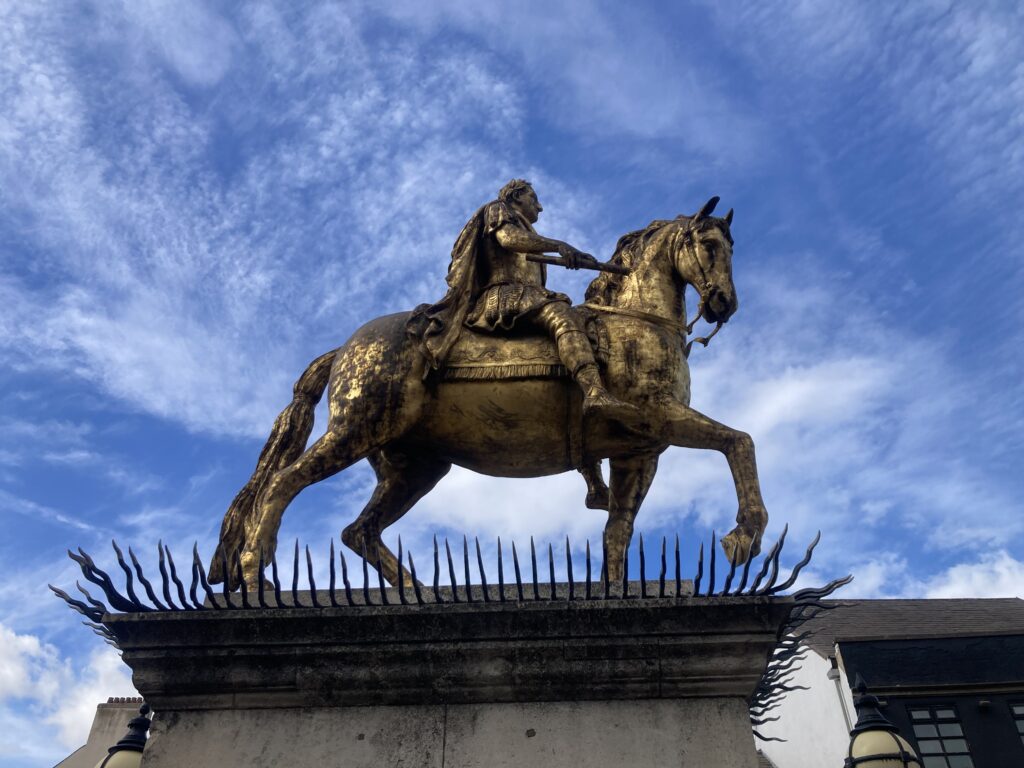
Mucky Billy, yesterday.

The statue of King William III is undoubtedly a Hull landmark. It’s the oldest public statue in the city having originally been installed in Market Place in 1734. It’s also famous for depicting the 17th century king as a Roman senator sat astride his horse. There’s the equally famous absence of any foot stirrups in the design by Flemish sculptor Peter Sheemakers. And no story about the statue would be complete without the tale of its removal for safekeeping during the Second World War when it was taken on the back of an open lorry to Sancton near Market Weighton to avoid enemy bombing. Ghosthunters will also happily recount the spooky legend surrounding the statue which involves the old king dismounting for a stroll around the Old Town when the bells at nearby Hull Minster strike midnight.

Perhaps it’s best to gloss over the violent sectarian suppression (good idea – Ed.) which the statue originally celebrated and instead reflect on the here and now as the current story about the Grade I listed structure revolves around its crusty condition.

Anyone who has seen it recently will have noticed both William and his horse are looking rather grubby to say the least. Both should be glowing gold but the last time a coat of gilt was applied is now a distant memory with large patches of grey and black clearly visible. Responsibility for the statue rests with Hull City Council and it seems a long overdue makeover is in the pipeline now that all the prolonged dusty work on the nearby A63 is finally over.

In July last year the council hired specialist historic restoration company Lost Art to carry out a detailed condition survey of both the statue, its supporting plinth and the four cast-iron lamps added in the late 19th century. If the company’s name is familiar, it carried out the recent full restoration of Pearson Park’s entrance gates.

Now, 14 months later, the restoration project is continuing  to move slowly through the gears. A council spokesperson told us: “‘Restoration of the King William III statue is part of the council’s five-year infrastructure plan, which will see many of the city’s valued monuments restored. The council is aware of its importance to the city and our residents and, just like the recently cleaned Cenotaph, we intend to undertake a thorough job to restore it to its former glory. We are currently in the process of appointing a heritage architect to advise of what works are required and how these can be undertaken in a way that is sensitive to the historic nature of the statue.”

As the five-year plan was signed off last year, we can confidently say King Billy and his horse will be back to their gleaming golden best by 2030 at the latest. Hopefully, it might even be a bit earlier than that.

Angus Young

Which Prime Minister was from Hull?

Northern PMs are nothing new, as our political premier correspondent Angus Young reports, but few were top dog as long ago or far away as this one.

Sir John Hall 1824 – 1907

In case you have noticed it, we’ve now got a Northern Prime Minister. Andy Burnham was born in Aintree in Liverpool and, until his recent elevation, was best known for being Mayor of Greater Manchester for the last nine years. Not since Harold Wilson has the Westminster lobby made so many jokes about flat caps and whippets.

Of course, Hull’s own John Prescott came close to being Prime Minister when he served as Tony Blair’s deputy. However, despite often being portrayed as a non-nonsense straight-talking Northerner, Prezza actually hailed from Prestatyn in Wales.

So who was the son of Hull who made it all the way up the political ladder to become a Prime Minister?

The answer to this very good pub quiz question is Sir John Hall. Never heard of him? There are probably two good reasons for that. For a start, Hall was born in Hull just over 200 years ago so he’s not exactly still on the tips of everyone‘s tongues in the city. Secondly, his political career took off on the other side of the world.

Hall was born in St. Mary’s parish of Hull in 1824 , the third son of a Navy captain called George Hall who had become a prominent shipowner. His father would later become Warden at Trinity House. Young John was initially sent to a boys’ boarding school in North Ferriby run by Presbyterians who refused to conform to the Church of England It seems the Hall family weren’t short of a bob or two because he was later sent to school in Switzerland at the age of ten and then continued his education in Hamburg and Paris.

He returned to England to work in London for a German shipping agent before joining the General Post Office but later decided to emigrate to New Zealand at the age of 27. The move was said to be triggered by a book he had read on sheep farming and job opportunities offered by officials in the Canterbury region, which encouraged immigration from Britain and Ireland. John persuaded two of his brothers to join him and they eventually established a large sheep farming business.

In his new home, he also became active in local politics in Christchurch, becoming a local councillor before being elected as a Member of Parliament in 1850. He found time to return to Hull in 1860 for a couple of years, marrying the sister-in-law of one of his brothers at Holy Trinity Church. The bride’s father was an attorney who also owned the Duke of Cumberland pub in Cottingham.

In 1879 he became New Zealand’s Prime Minister, holding the position for three years. He was knighted at the end of his time in office and briefly retired from politics only to return as an MP in 1887.

In New Zealand, he remains best known as a champion for the women’ s suffrage movement, personally presenting a petition to the country’s parliament in 1893. Sir John made a great spectacle of it, bringing the petition written on a continuous sheet of paper in a wheelbarrow into the main chamber before theatrically unrolling it down a central aisle until it thumped into a wall. He later steered the bill through parliament, making New Zealand the first country in the world to give women the vote.

Angus Young

What Is Baby Brain?

You may have seen the show at Freedom Festival last week. Here are Ruby and Lottie of The Herd explaining what it is.

What’s Going On At Priory Meadows?

It may appear to be just some fields of grass, but the meadows are essential ecological spaces which need protection, as our greenbelt governance correspondent Angus Young reports.

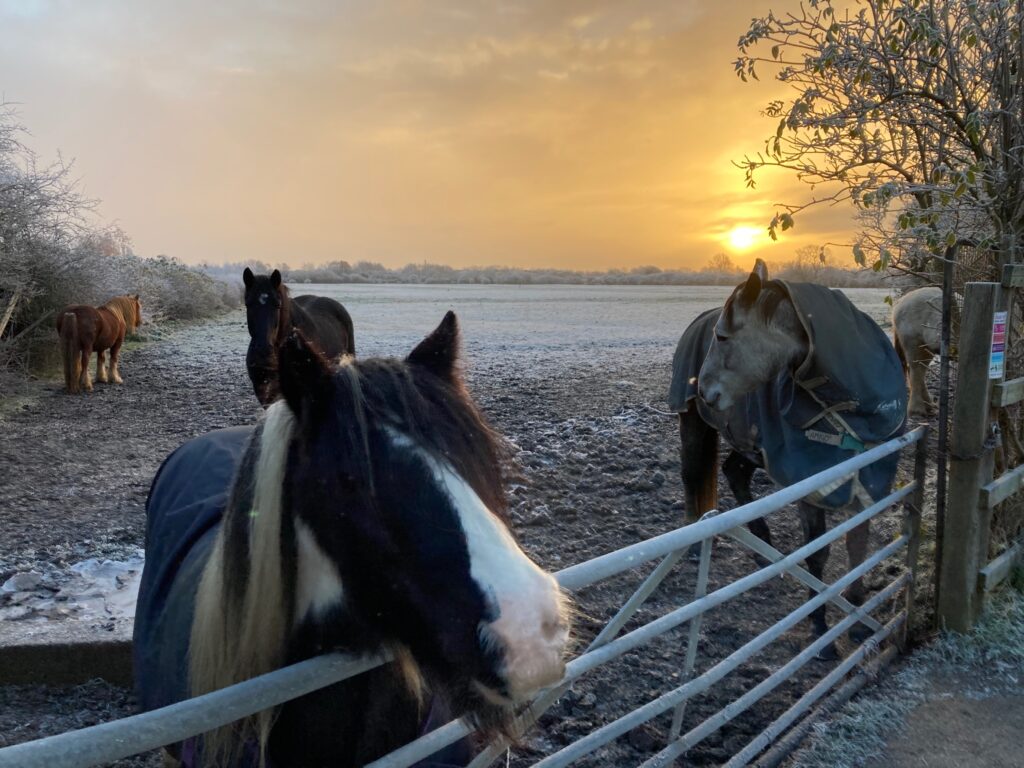
Some horses at sunset on Priory Meadow.

The fields lying either side of Priory Road act as a green boundary between Hull and Cottingham. They also happen to be almost the only surviving relic of the neutral grasslands that once covered the River Hull valley before the arrival of 20th century chemicals-based intensive agriculture. If you are wondering what a neutral grassland is then read on. (Also read on if you’re not – Ed)

According to the Hull Biodiversity Action Plan, the qualifying criteria appears to be somewhere that has not been treated with herbicides or artificial fertilisers. The Plan notes such unimproved semi-natural grasslands in Hull are rare and the best ones can be found on the pastures at Priory Meadows and Snuff Mill fields which have been traditionally maintained for over a century. In that period, the only incursions have been the construction of the Humberside Police HQ, two semi-detached houses standing opposite in splendid isolation and, more recently, the Priory Woods cemetery.

Despite the recent prolonged dry spell, it’s mainly a wet grassland peppered with hollows, ponds and ditches that provide important breeding grounds for frogs and newts and feeding grounds for kestrels and barn owls. They also support a rich variety of flowering plants and plant species typically found in unimproved grassland, such as Adder’s Tongue, Cowslip and Pepper Saxifrage.

Rohan Lewis, who carries out local plant surveys for the Botanical Society, visited Priory Meadows earlier this summer. He said: “I was astounded not only by the colours – the purple of the Knapweed, the blue of Devil’s-Bit, the yellows of Cinquefoil and Meadow Buttercup – but also by the presence of plants like Meadow-Rue, Pepper-Saxifrage and Betony, whose nearest sites otherwise are mostly in the floodplain of the River Derwent.”

However, he was less impressed by the impact of grazing horses which are kept on the grasslands. “All this land is owned by Hull City Council and though not technically greenbelt land, it has been preserved from development and leased out for grazing, mainly by horses. Unfortunately some tenants have shown little regard for anything but the opportunity to graze as many horses as possible. Some of the fields are now nibbled almost bare and Green-Winged Orchids, which used to occur there, have not been seen for years.”

Happily, there’s a new push to manage some of the Meadows in a more eco-friendly way. A new community interest company has recently taken on a new lease from the city council covering 11 fields. It hopes to restore hedges and clear encroaching scrub from some of the fields as well as creating more public access and reducing  grazing on three fields to the west of Priory Road.

Rohan added: “Members of Hull Natural History Society have been out this month performing an in-depth botanical survey on the fields  covered by the lease. This data is being fed back to Natural England and will hopefully lead to the award of grant money to Priory Meadows CIC so that the improved management can get underway.”

Angus Young