
As a name, it seems entirely inappropriate, but – as Hull Tour Guide Paul Schofield explains – it used to be an accurate description of the area.

As a name, it seems entirely inappropriate, but – as Hull Tour Guide Paul Schofield explains – it used to be an accurate description of the area.

Ruth works at the Western Library on Boulevard and is a bit of an audiobook addict. Here are her favourites of the year and how to get them in your lug’oles.

Enjoy a contemplative moment with crime author Nick Quantrill as he picks his preferred spot to sit and ponder.

The fascinating tale of an undervalued figure in the British art world, Leslie Cole. Another cracker from our cub reporter Angus Young.

Photographs of bomb-damaged buildings overlooking Queen Victoria Square have become the defining images of Hull during the Second World War. But the paintings of Leslie Cole also probably also deserve to be seen in the same light as his work as an artist both in the city and abroad reveal a rare talent for capturing the human experience in what had become industrial-scale warfare. However, it was only in 1985 – nine years after his death – that he was finally recognised as one the UK’s foremost wartime artists when a posthumous solo exhibition was staged at the Imperial War Museum in London.
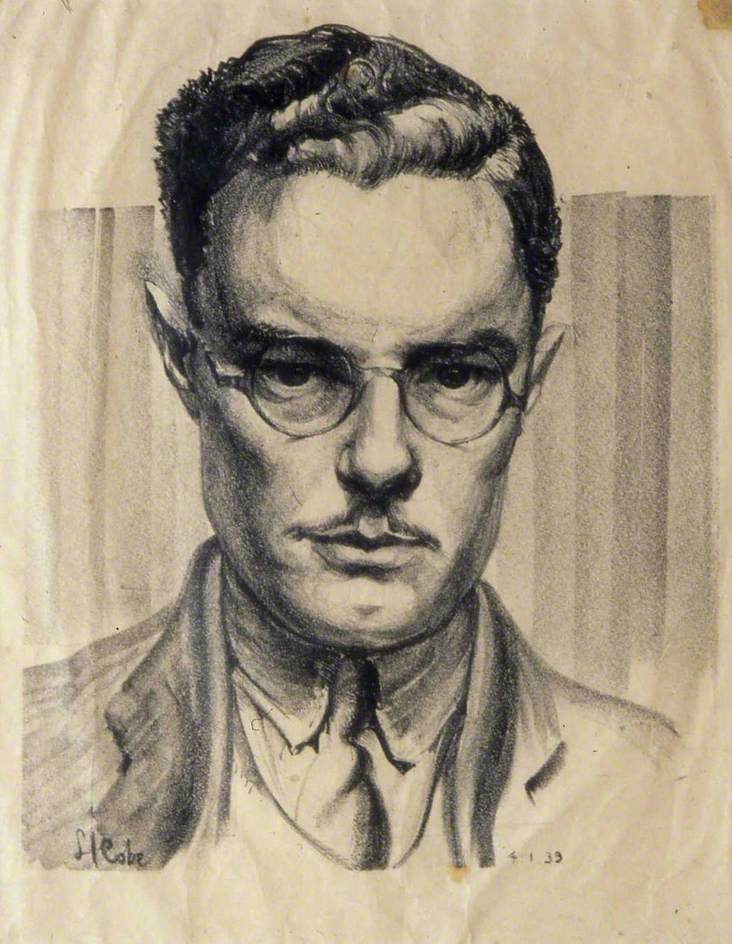
Originally from Swindon, Cole moved to Hull in 1937 to take up a teaching job at the Hull College of Art in Anlaby Road where he became an assistant lecturer in charge of lithography. A year later he married his wife Brenda and the couple lived in Victoria Avenue. When war broke out, Cole joined the Royal Air Force but was discharged on medical grounds.
Instead of being able to serve, he carried on teaching while attempting to secure a contract with the War Artists Advisory Committee (WAAC), set up by the government to compile a comprehensive artistic record of Britain throughout the war. Initially rejected, Cole decided to gain the committee’s attention by personally arranging trips on a Hull trawler involved in minesweeping and coastal defence duties. His stark dimly-lit lithographic print of life below decks from one of those trips reflects the crew’s cramped living space. He also spent some time painting scenes of the war effort in Hull, presumably organising access himself.

One striking work, The Kitchen of the First British Restaurant in Hull, dates from 1942 and features a busy bakery with workers preparing food. It is one of two of his works now in the Ferens Art Gallery collection. British Restaurants was the name given to communal feeding stations for those bombed out of their homes. In Hull, the council operated 92 stations after the 1941 Blitz using schools, church halls and even mobile units. At the busiest, two-course meals were served every three hours. Food was prepared in four large kitchens located in different parts of the city and although it’s not known which one Cole painted, one kitchen still survives today in Gillett Street off Hessle Road. It’s now a vehicle repair garage.
Cole also visited King George Dock to watch tanks being loaded onto a ship bound for Russia resulting in two paintings now in the collection of the Imperial War Museum. One features a busy crane-filled dockside view, the other takes us inside the bowels of the ship itself as workers pack the cargo ahead of their journey. His Night Scene in a Watch Office was also painted around this time, Cloaked in grey and dark blue, it shows a group of RAF personnel scanning a moonlit night sky through a large window for enemy aircraft.

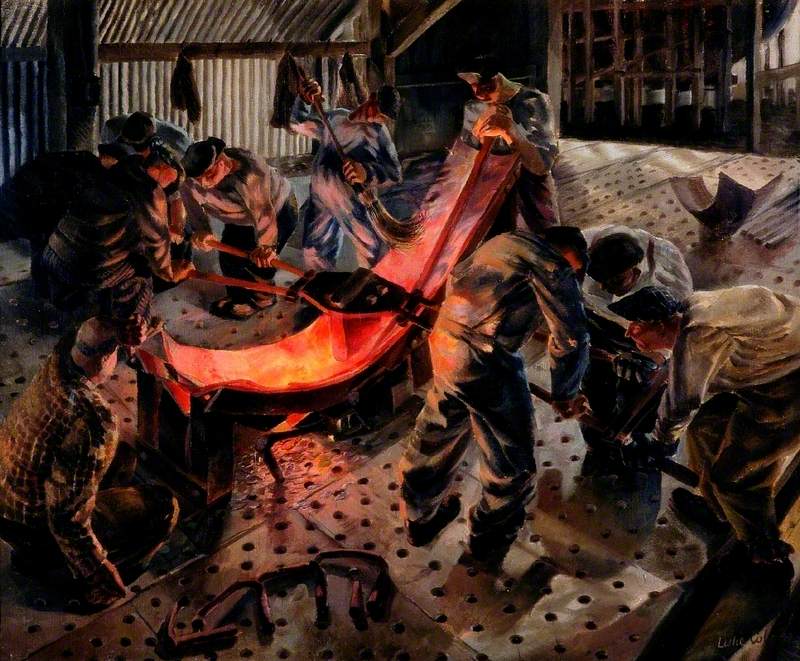
In contrast, The Shaping of a Keel Plate of a Corvette, is a fiery shipyard scene with men illuminated by the red-hot metal they are working on. As the Royal Navy Corvette HMS Azalea was built at the Cook Welton and Gemmell shipyard in Beverley in 1941, it’s likely Cole paid a visit there too. Eventually, the quality of his work in Hull led to his first full-time WAAC commission. In 1943 he went to Malta to witness the end of a German siege and then took part in an operation to recover the island of Pantelleria off the Siciallian coast.
Cole returned to Hull in late 1943 and resumed teaching at the College of Art until July 1944 when a second commission saw him join the Royal Marines in Normandy before taking on further WAAC work in Cairo and Greece. Juggling his teaching duties now became increasingly difficult and later that year he resigned from the college to become a fully salaried war artist. He was then sent with three other artists to record the British liberation of the Belsen-Bergen concentration camp in Germany, producing some of his best-known and most moving works – three large panoramic oil paintings of survivors, British troops and captured German guards.
In a commentary on one of the paintings, he wrote “The camp is large – 12 square miles and divided into compounds like chicken runs, with huts bare of any furniture or conveniences. The huts normally accommodate 50 but as many as 400 were put in. The women’s compounds were the most tragic and horrible, and the worst cases of disease were located here, both in number and intensity. During my visit, the victims were still dying in the open and the woman in the centre of the picture collapsed while I was drawing. There are many bodies lying about, clothed and unclothed, and these were left as the British medical officers had not enough personnel to check if death had set in. If the body disappeared at night, it was alive.”
Cole did not return to Britain until 1946 having spent time in Singapore, Burma and Borneo, completing several more paintings of liberated prisoners of war. When he did return, he and Brenda left Hull and moved to London where he established a studio and then took a teaching job at Brighton College of Art. He was still working there when he died in 1976.
As well as The Kitchen, a painting from Cole’s time in Malta is also in the Ferens Art Gallery collection, although neither are currently on display. Overall, 20 of Cole’s works are in the Imperial War Museum while over 70 others are in public collections across Britain.
Angus Young

With Autumn well upon us, we thought it might be time to answer this question, which was asked by an anonymous person at this year’s Freedom Festival.

A seriously fascinating chat between Burnsy and geophysicist, glaciologist, former leader of the British Antarctic Expedition and ex-vice chancellor of the University of Hull, David Drewry.

Lou reckons O’Rileys music venue on Beverley Road is an underrated gem in the city. And who are we to argue?

All libraries are special, but Burnsy went to the Boulevard to find out what makes the Western a bit more exceptional.

Some would more readily claim it’s the colour of chocolate, but our cub reporter Angus Young is rather more prosaic than poetic.
In my early days as a cub reporter (last week, then? ed) in East Yorkshire I would go out on assignments with a veteran Scottish photographer called Rab McKenzie. One day as we drove through the countryside, Rab gestured at the surrounding landscape. “See all that?” he said with a flourish. “It’s all glacial shit!”

At the time, I didn’t have Rab down as a geology expert and I wasn’t expecting a lesson on the subject but, of course, he was right. Beneath us was a 20-metre thick layer of boulder clay stretching all the way to the coast having been deposited by melting glaciers during the Ice Age. Best viewed on a visit to the crumbling cliffs of Holderness, this chunky slab of mud contains gravel, sand, stones and the occasional well-preserved fossil and derives its colour from some of the minerals within it, notably iron oxide.
The sediment created by North Sea tides crashing into the cliffs washes down the coast, sweeps around Spurn Point and ends up in the Humber to create what we can see today – an expanse of gravy-coloured muddy water sat on a bed of sticky clay rather than Barbados-style blue.
Despite their appearance at low tide, the mudbanks of the Humber – and the River Hull for that matter – are constantly changing. Each tide carries over 1,500 tonnes of sediment with it. Overall, it’s estimated that up to 1.2 million tonnes of sediment may be present in the estuary at any one time. Today, they provide rich feeding grounds for birds with the Humber now supports an internationally important number of breeding bittern, marsh harrier, avocet and little tern.
Historically, this readily accessible supply of clay also helped establish brick-making as one of the region’s earliest industries. Approximately five million bricks were used to build Hull’s town walls which were said to be the largest brick-built construction in the country in medieval times. Similarly, Hull Minister lays claim to being one of the earliest examples of a largely brick-built church in England and was originally constructed on a raft of oak logs because of Hull’s notoriously sponge-like ground conditions.
Rab’s rather fruity description of Ice Age debris would have probably been appreciated by the founder members of the Hull Geological Society who quickly formed their own Boulder Committee. Between 1894 and 1905, committee members embarked on regular field trips to record the locations of thousands of so-called “erratic” glacial boulders left scattered across East Yorkshire by melting glaciers. Reports were made to meetings of the British Association for the Advancement of Science and other regional boulder committees set up by nearby societies. In each case, the type and age of each rock was identified in an attempt to retrace the paths of the glaciers as they changed the landscape around them.
Hull has no natural outcrops of rock. Instead, the nearest solid exposed rock is chalk which is best seen on the Yorkshire Wolds and, in particular, at Flamborough Head. The clear water in the Gypsey Race, Europe’s most northerly chalk stream running from Wharram-le-Street to Bridlington, provides a striking contrast to the brown stuff flowing further south.

Florence of HU7 asks a perfectly reasonable question, here. But the answer is slightly more complicated than you may have thought.