
Hull’s Big Malarkey has been around for a few years now and is hugely loved. We though we’d find out why so many people enjoy it.

Hull’s Big Malarkey has been around for a few years now and is hugely loved. We though we’d find out why so many people enjoy it.

Hull has had a tidal barrier for over 40 years now, but what does it actually do? We dispatched Hull Tour Guide Paul Schofield to find the answers.

All them big blocks of concrete in East Park? What they about, then? Our cub reporter Angus Young did so well with his first assignment, we let him off the lease again to investigate.

Travel writer and author Travis Elborough got it just about right, reflecting on a visit to Hull while researching the history of parks for his 2016 book A Walk In The Park. “There are few sights in England that can quite equal the absurd charm of the imitation Khyber Pass in Hull’s East Park,” he wrote.
Thought to be the largest ornamental rock feature in any public park in the country, its design is said to have been inspired by the British Army’s capture of the famous mountainous pass in 1878. Constructed just over two decades later as part of the new public park, it actually owes more to Carry On Up The Khyber – famously filmed in Snowdonia in North Wales – than the actual North West Frontier.
The central section of the Hull version is made up of large blocks of sandstone, reputedly having once been part of The Citadel, a 17th century defensive fortification overlooking the spot where the River Hull and Humber. Other sections are made from brick covered in cement render while others are topped with mis-shapen clinker bricks because of their water-resistant qualities. Today they still resemble the ruins of a military fort.
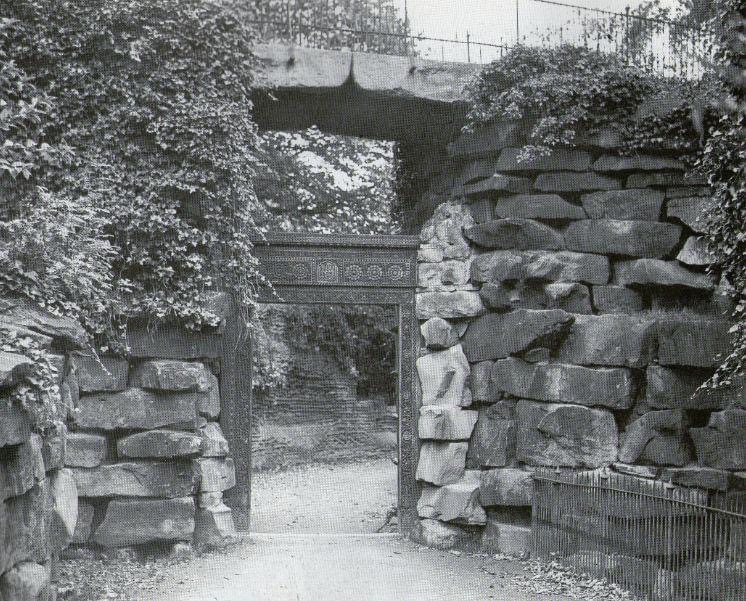
The original design also had recesses for fountains and a mini-waterfall and a bridge for people to walk over during their promenade around the park. Some early postcards also show extensive planting on the rocks. From the start, it appears to have been historical mish-mash with a series of decorative stone roundels being set into walls of the main entrance to the Pass. These had been rescued from Suffolk Palace, the family home of the De La Pole family which had once stood in Lowgate in Hull’s Old Town.
Another re-used historical feature from elsewhere was part of the dungeon of the former town jail, presumably added to enhance the idea of it being an old fort. The dungeon was carefully re-built on site and was later used as a store and a dog kennel by park staff. Then, in 1912, a surviving watchtower from the old Citadel was added. It had previously been acquired by a shipbuilder who had preserved it by constructing his new premises around it.
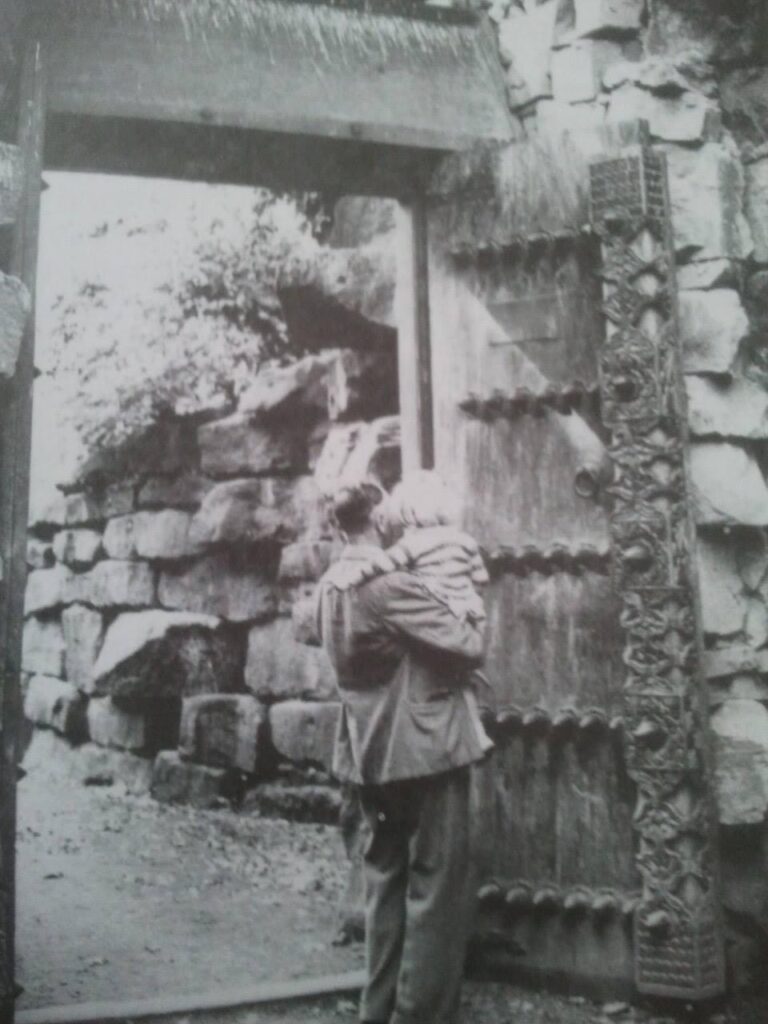
So far so Hull but the pattern of bolting on extra features to the Pass took a more exotic twist via the British Empire Exhibition held next to the new Wembley Stadium in 1924. Staged as a huge trade show, a total of 56 British territories exhibited at the event in specially-built displays and pavilions. The main entrance to the East Africa Pavilion was an ornately-carved wooden door made in Zanzibar where they were traditionally used to show an occupant’s special status and religion.
Part of the cost of the pavilion was met by Hull Corporation who, like other councils around the country, used the exhibition to develop potential new trade links with exhibiting territories. A civic delegation from Hull attended and hosted a meeting with agricultural officials from Uganda, East Africa and South African with the aim of encouraging the growth of caster seed in Africa. The idea was to create a cheaper alternative to importing caster oil from America and within a year the Union Castle shipping line had started a regular service from Mombassa in Kenya to Hull with caster seed, maize and groundnuts among the regular cargo. Meanwhile, as a result of Hull’s sponsorship, the impressive mahogany door set in a archway also ended up in the city and was duly attached to the Khyber Pass at its narrowest point.
Over the decades, this eclectic mix of local and African history named after a mountain pass between Pakistan and Afghanistan became an unofficial children’s playground rather than accurate homage to the past. As memories of the British Empire faded, younger generations would refer to it as ‘The Rockies’ while various features were either removed or, in the case of the waterfall, simply stopped working.

At some point the decorative Zanzibar door and its frame were taken down and in 1998 the watchtower was relocated to become a landmark in the new housing estate on Victoria Dock. However, as part of a £10m National Lottery-funded £10m refurbishment of the park in 2000 the Pass was also given a facelift with the restoration of a water feature and a new replacement bridge over the main walkway.
Today the place really does retain an absurd charm, underlined by the recent addition of a plaque commemorating Hull-born Tom Longstaff who was awarded a gold medal in the 1924 Winter Olympics for being part of an unsuccessful British expedition to climb Mount Everest two years earlier. What Longstaff would make of the various signs currently fixed to the walls of the Pass saying ‘ No Climbing Allowed’ is anyone’s guess.

Not us. We didn’t want to know. This question has come in from an anonymous pupil at Griffin Primary School. And you know our policy – you ask, we answer. We can only apologise to Mr Wolf.

In our very first podcast episode, your host Dave ‘Burnsy’ Burns is joined by Hull University History professor Dr Robb Robinson to answer your questions about history and Hull and the history of Hull.

We asked crime writer Nick Quantrill to tell us about some of his favourite places in Hull

On the 2nd floor of Hull’s Central Library is a space for makers, a makerspace, if you will.
So, we thought we’d send our new signing – midfield maestro Dave ‘Burnsy’ Burns – to do his his first match report. He is ably assisted by his glamorous assistant Librarian Matt as they give us an overview of what’s happening at the top of the library.

A question asked by an anonymous pupil from Oldfleet Primary School. The answer may not be as simple as you think.

We bumped into boss of the legendary Beats Bus, Steve ‘Redeye’ Arnott, at the Big Malarkey and took the opportunity to ask him who he considers his favourite rappers.
Find out more about Beats Bus here: https://beats-bus.co.uk

Every town and city, it seems, has their own word for the alleys that run behind houses. But why do people in Hull call them Tenfoots?
Hull’s tenfoots formed part of a huge house-building boom which started in the late 19th century with new terraced housing being constructed in what had been largely open countryside beyond the historic city centre.

Designed to address chronic overcrowding and associated infectious diseases such as cholera in rapidly-expanding industrial towns, the 1875 Public Health Act had not only set out legal requirements for drainage and public sanitation but also new buildings, such as minimum window sizes and specifications for foundations, and legal standards for new streets.
Under the legislation, streets not intended for use by horse and carriage and less than 100 feet long could be 24 feet wide. These ‘backroads’ were generally designed to allow ash and privy waste to be removed from houses without the need to carry it out through the front door. However, subsequent byelaws allowed local authorities leeway to introduce their own rules on dimension and many opted for a much narrower width.
Hull’s oldest surviving tenfoots suggest they were built to the absolute minimum local width possible, presumably allowing developers to still squeeze as much new housing in as they could.

These early tenfoots were also paved with double hexagon-shaped bricks known as Scoria – an ancient Greek word meaning excrement or dung while the Romans used it as a name for hot lava bursting out of a volcano.
The latter no doubt inspired Victorian recycling pioneer Joseph Woodward who used the name for his brick-making company in Darlington. He used molten iron ore waste – known as slag – from the bottom of local blast furnaces to create the distinctive silvery blue bricks which were laid in back alleys across the North of England.
Hull’s remaining Scoria tenfoots – to be found off Hessle Road and Beverley Road Road – are now included in Hull City Council’s Local List of important heritage assets.

It’s clear that while tenfoots became common in Hull, other slightly wider ‘backroads’ were also built. Land Registry records for conveyances dated 1905 for two new properties in Salisbury Street in the Avenues include details of the construction and maintenance of a “backroad or way of twelve feet in width” for the use of all the owners and occupiers of other plots on the “Park Avenue estate”.
Deeds for other properties in nearby Victoria Avenue also refer to twelve feet wide backroads with many stipulating their use for servants and workmen who could not possibly be seen entering by the front door.
Over a century later in 2018 these same passages were the subject of a public inquiry into proposals to restrict public access to them via a new bylaw. Despite measuring twelve feet, they are all referred to as ‘tenfoots’ in the independent planning inspector’s final report. This adoption of the phrase as the colloquial name in Hull for most backroads seems to have happened shortly after the First World War.
The first reference to a tenfoot in local newspapers was in a 1919 advertisement for a property up for sale. From then onwards, tenfoots would feature in a range of stories, from reports of flooding and poor maintenance to terrible accidents and even brutal murders.
By Angus Young