What Happened To Hull’s Trams?

We see the remains of the city’s most elegant transport system all over the shop, but why did the trams disappear?

As we are the UK’s flattest city with not a hill in sight, you might think that having a tram system here would make perfect sense. However, while Manchester, Sheffield and Nottingham have all revived theirs in recent years, we sadly retired ours in 1945 and have never seriously thought about bringing it back ever since. Instead, all that remains of what was probably the most elegant form of public transport ever to grace Hull’s streets are a few museum exhibits, a couple of old tram depots now converted into new uses and a short stretch of track disappearing from view down an alleyway off Anlaby Road.

Tram lines still visible off Anlaby Road

Hull’s first all-electric trams made their debut on 5 July 1899, running on two routes to and from the city centre along Hessle Road and Anlaby Road. Until then, people got around the city using horse-drawn transport with the exception of a steam-powered tram service which ran on Hedon Road. Tram lines were first laid in the mid-1870s. The nine miles of single-line tracks and passing loops were used by horse-drawn trams until 1889 when the short-lived Drypool and Marfleet Steam Tram Company opened a 1.3m tramway for steam-powered trams to ferry workers to and from Alexandra Dock.

Both the steam tram company and a separate firm operating the horse-drawn trams were eventually acquired by Hull Corporation ahead of the launch of its ambitious municipally-owned electric tram service. Parliamentary consent and £300,000 in loans to fund construction work were also secured by the Corporation before its first trams went into service. Within a year, lines along Holderness Road, Beverley Road and Spring Bank with an extension along Princes Avenue had been added.

The former Hull tram depot on Jesmond Street

The rails were supplied by a Belgian company while the electrical equipment was made by German firm Siemens who, more than a century later, would return to Hull to develop an offshore wind turbine blade manufacturing facility in Alexandra Dock. The design of the Belgian rails differed from those used in many other cities and were said to give a smoother ride, particularly over Hull’s many railway level crossings.

A specially-built power station in Osborne Street initially provided electricity for the network and although it closed in 1930 the building still stands today and is used as a warehouse. After its closure, electricity was supplied by the Corporation’s huge coal-fired power station in Sculcoates.

At its peak, Hull’s tram service featured 180 vehicles and 21 miles of line but by the mid-1930s trams began to be replaced by trolley buses and motor buses and the final tram – illuminated by 800 lightbulbs to mark the occasion –  completed its last journey on 30 June 1945. Beyond the Streetlife Museum and a couple of buildings, the legacy of the network can still be seen on some sections of Hull’s main roads where the trams once ran down the middle of what are now long grassed central reservations.

Significantly, the trams also marked a shift in attitudes towards working women. Until the start of the First World War in 1914, the workforce at Hull Corporation Tramways was all-male. However, once the war started women were recruited to replace men who had joined the armed forces. Initially, women worked as conductresses but were later also employed as drivers and inspectors.

by Angus Young

What Is The Oldest House In Hull?

Among others, Mike Young on Facebook asked us what the oldest house in Hull is. There’s only man fit to answer this question, Hull Tour Guide Paul Schofield is on the case…

What Came First, The Chicken Or The Egg?

Just to show that, here at Curiosity, we’re not afraid to tackle the BIG questions. This is a query from Kayleigh in HU7 who clearly needs a definitive answer.

Why Does Hull Have A Tidal Barrier?

Hull has had a tidal barrier for over 40 years now, but what does it actually do? We dispatched Hull Tour Guide Paul Schofield to find the answers.

Why Is The Khyber Pass In Hull?

All them big blocks of concrete in East Park? What they about, then? Our cub reporter Angus Young did so well with his first assignment, we let him off the lease again to investigate.

Travel writer and author Travis Elborough got it just about right, reflecting on a visit to Hull while researching the history of parks for his 2016 book A Walk In The Park. “There are few sights in England that can quite equal the absurd charm of the imitation Khyber Pass in Hull’s East Park,” he wrote.

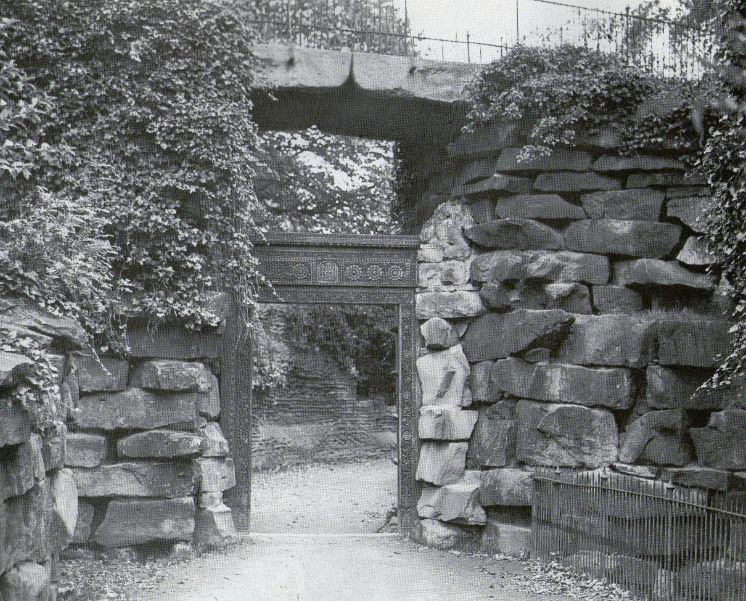
Thought to be the largest ornamental rock feature in any public park in the country, its design is said to have been inspired by the British Army’s capture of the famous mountainous pass in 1878. Constructed just over two decades later as part of the new public park, it actually owes more to Carry On Up The Khyber – famously filmed in Snowdonia in North Wales – than the actual North West Frontier.

The central section of the Hull version is made up of large blocks of sandstone, reputedly having once been part of The Citadel, a 17th century defensive fortification overlooking the spot where the River Hull and Humber. Other sections are made from brick covered in cement render while others are topped with mis-shapen clinker bricks because of their water-resistant qualities. Today they still resemble the ruins of a military fort.

The original design also had recesses for fountains and a mini-waterfall and a bridge for people to walk over during their promenade around the park. Some early postcards also show extensive planting on the rocks. From the start, it appears to have been  historical mish-mash with a series of decorative stone roundels being set into walls of the main entrance to the Pass. These had been rescued from Suffolk Palace, the  family home of the De La Pole family which had once stood in Lowgate in Hull’s Old Town.

Another re-used historical feature from elsewhere was part of the dungeon of the former town jail, presumably added to enhance the idea of it being an old fort. The dungeon was carefully re-built on site and was later used as a store and a dog kennel by park staff. Then, in 1912, a surviving watchtower from the old Citadel was added. It had previously been acquired by a shipbuilder who had preserved it by constructing his new premises around it.

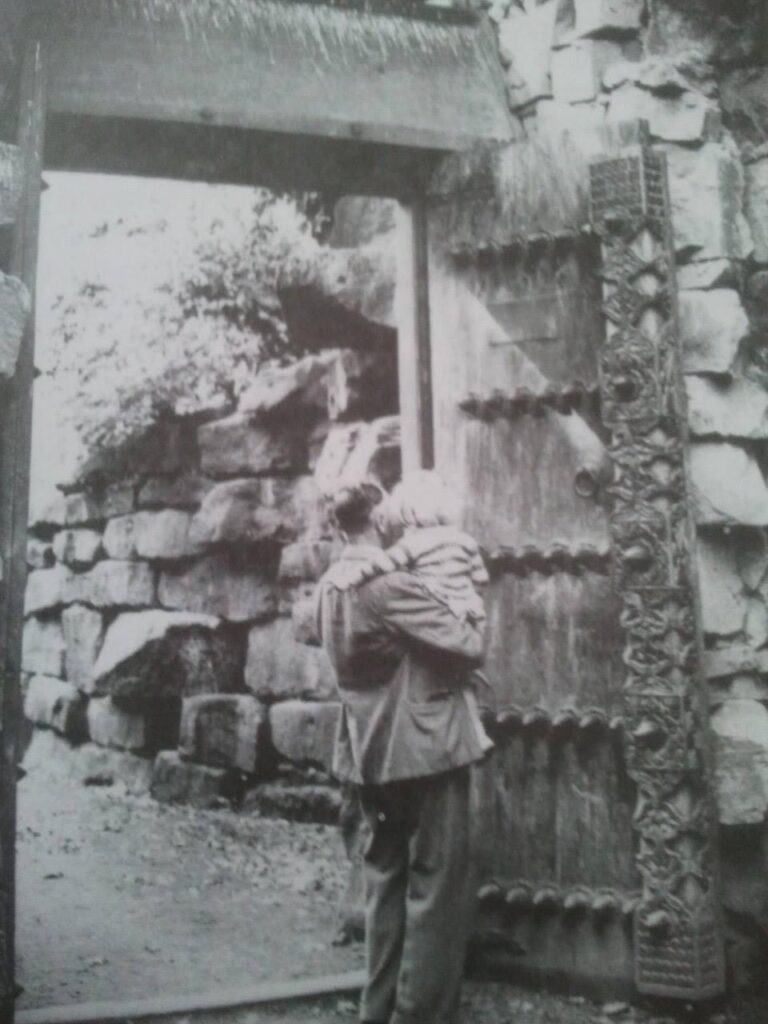
So far so Hull but the pattern of bolting on extra features to the Pass took a more exotic twist via the British Empire Exhibition held next to the new Wembley Stadium in 1924. Staged as a huge trade show, a total of 56 British territories exhibited at the event in specially-built displays and pavilions. The main entrance to the East Africa Pavilion was an ornately-carved wooden door made in Zanzibar where they were traditionally used to show an occupant’s special status and religion.

Part of the cost of the pavilion was met by Hull Corporation who, like other councils around the country, used the exhibition to develop potential new trade links with exhibiting territories. A civic delegation from Hull attended and hosted a meeting with agricultural officials from Uganda, East Africa and South African with the aim of encouraging the growth of caster seed in Africa. The idea was to create a cheaper alternative to importing caster oil from America and within a year the Union Castle shipping line had started a regular service from Mombassa in Kenya to Hull with caster seed, maize and groundnuts among the regular cargo. Meanwhile, as a result of Hull’s sponsorship, the impressive mahogany door set in a archway also ended up in the city and was duly attached to the Khyber Pass at its narrowest point.

Over the decades, this eclectic mix of local and African history named after a mountain pass between Pakistan and Afghanistan became an unofficial children’s playground rather than accurate homage to the past. As memories of the British Empire faded, younger generations would refer to it as ‘The Rockies’ while various features were either removed or, in the case of the waterfall, simply stopped working.

At some point the decorative Zanzibar door and its frame were taken down and in 1998 the watchtower was relocated to become a landmark in the new housing estate on Victoria Dock. However, as part of a £10m National Lottery-funded £10m refurbishment of the park in 2000 the Pass was also given a facelift with the restoration of a water feature and a new replacement bridge over the main walkway.

Today the place really does retain an absurd charm, underlined by the recent addition of a plaque commemorating Hull-born Tom Longstaff who was awarded a gold medal in the 1924 Winter Olympics for being part of an unsuccessful British expedition to climb Mount Everest two years earlier. What Longstaff would make of the various signs currently fixed to the walls of the Pass saying ‘ No Climbing Allowed’ is anyone’s guess.

By Angus Young