
Now this is meta! One of the beautiful minds behind Curiosity, Graham Chesters, comes up with questions about curiosity. We need a lie down.

Now this is meta! One of the beautiful minds behind Curiosity, Graham Chesters, comes up with questions about curiosity. We need a lie down.

With Wes Anderson spotted location scouting in Hull lately, our unlikely hotspot correspondent Angus Young looks back at an odd film set in the city from years ago.
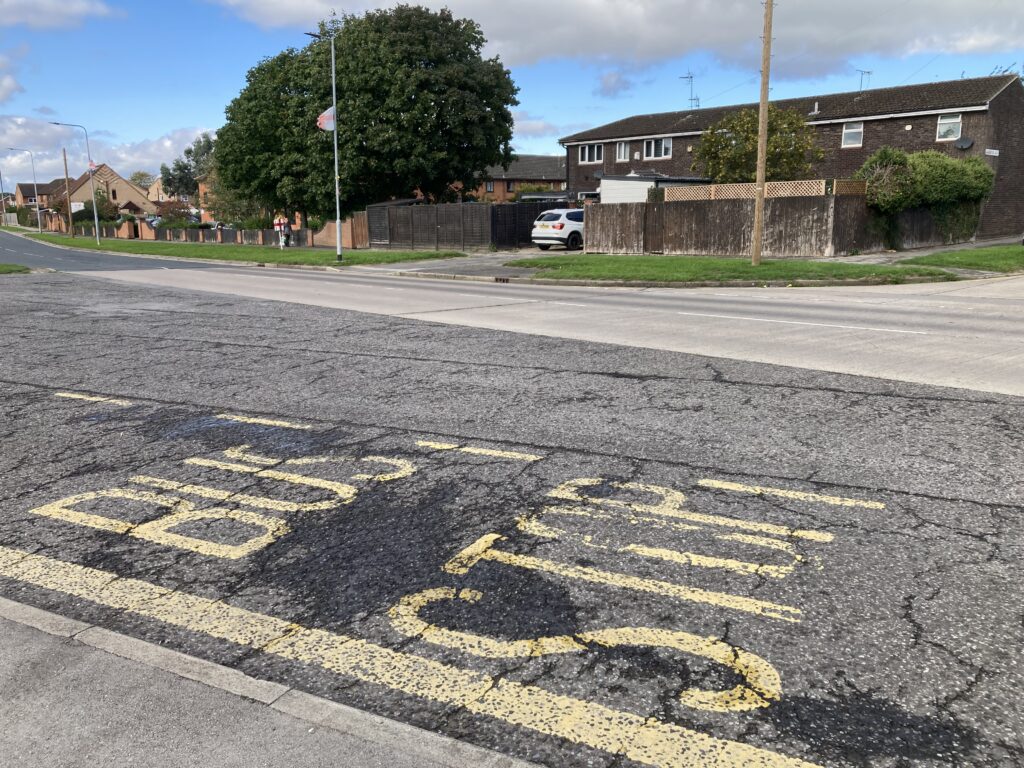
Far be it from us here at Curiosity Towers to be picky but we think the Hullywood Walking Trail is missing a trick. For those unfamiliar with it, the official trail takes participants around various locations in Hull used in TV and films. Available online and in printed form, it includes familiar spots in the city centre used for scenes in the likes of Victoria, Enola Holmes 2 and The Personal History of David Copperfield. However, there’s one location missing – a bus stop in Bransholme.
Back in 1990 it wasn’t a stopping place for buses. Instead, it was a roundabout on Kesteven Way. It was also the location for the filming of a now largely-forgotten hour-long drama screened on Channel 4 the following year starring Alexei Sayle, the late Stratford Johns and a very young Johnny Lee Miller. The play was part of the channel’s ‘4 Play’ series of original dramas which kicked off with Chains of Love, the story of an all-girl sex toy party written by Hull Truck founder Mike Bradwell and starring Cleethorpes-born actress Julie Peasgood.
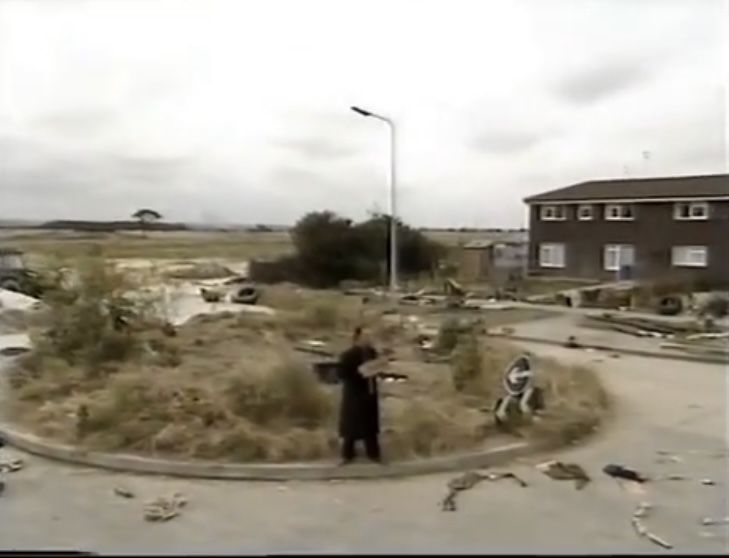
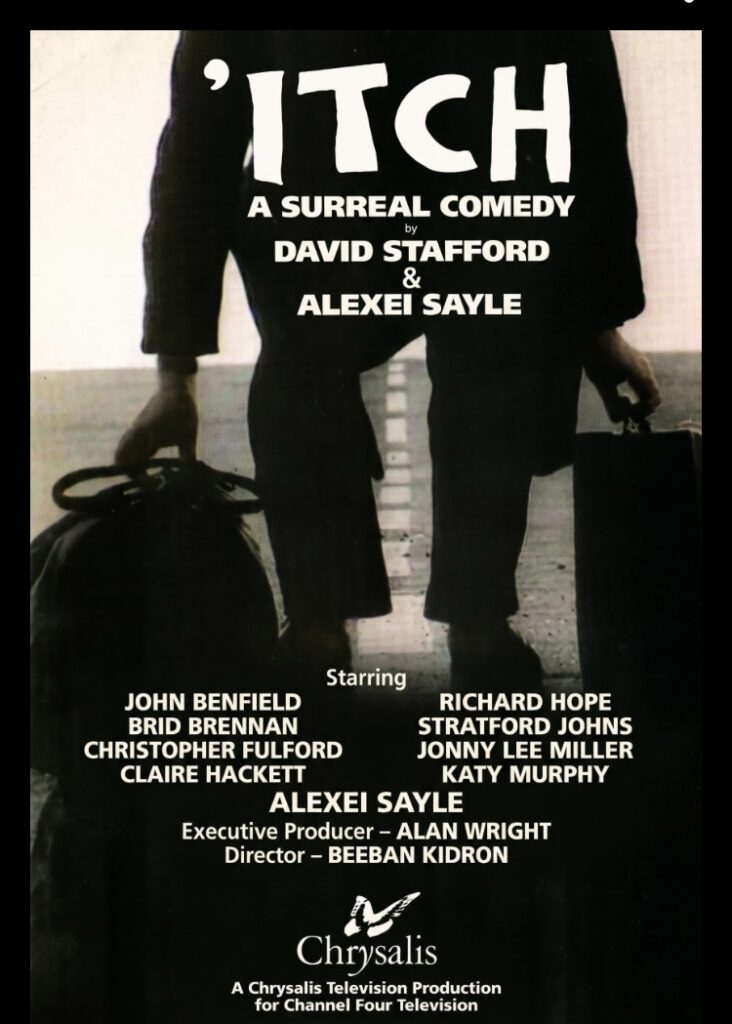
Luckily for fans of surreal, bleak and largely incomprehensible TV, the Bransholme-set play co-written by Sayle and David Stafford is still available to watch in full on YouTube. ‘Itch’ tells the tale of a semi-mute hitch hiker (Sayle) trying to get to Colchester who finds himself marooned on a roundabout on the edge of an unidentified run-down town (Bransholme) unable to persuade anyone to give him a lift. Across the road lives a family (including Miller) who sometimes visit their local pub (run by Johns) to mull over their impending eviction by a development corporation planning to build a vast new upmarket housing estate, retail park and a marina on the surrounding open countryside. “Do you know much about the Yukon during the Gold Rush up there in Alaska? “says Millar’s father with a sigh. “Well, it will be like round here, only a bit warmer.”
Sayle’s hitchhiker spends the next year living on the roundabout amid a landscape of abandoned cars, dumped sofas and upturned dustbins. Eventually, he joins forces with the family to turn their grim surroundings into something more colourful. There are also some local cameos, including a Willingham’s breakdown lorry and a fleet of Dennis Taylor rental vans.
The storyline, such as it is, veers from the bizarre to the ridiculous. In one scene, one of the corporation’s executives is flattened and killed by a goat dropped from a helicopter. However, apart from the goat, the play actually mirrors what was looming on the horizon in real life in that particular neck of the woods.
Within a few years, the open fields beyond Kesteven Way would be re-developed as Kingswood in much the same way as the proposed new town being mapped out in the play. As such, watching it 35 years on provides a fascinating glimpse of a world which has largely disappeared except for the row of council houses where Millar’s family lived. As for the roundabout, it’s been removed and replaced with a layby and a bus stop. [Alexie Sayle has returned to Hull several times since and likes our egg custards. Fact – Ed.)
‘Itch’ might not have the appeal of a Victorian costume drama and there’s far too much of Sayle’s self-indulgent nonsense on display but the play is Bransholme’s big claim to TV and film fame and, as such, should be celebrated as such. Get those Hullywood walking Trail leaflets back to the printers pronto!
Angus Young

Artist Amy Precious discusses her current project, which is exhibiting in Hull’s Fruit Market.

Sophie from Generation Hull explains what apprenticeships are available with them and introduces some beneficiaries.

The Hull Deaf Centre is 100 years old so, to celebrate, we asked some of their regulars about their favourite hand signal.

She may have a legacy divisive enough to split atoms but our maligned premiers correspondent Angus Young thinks he might just have found one thing she did right.
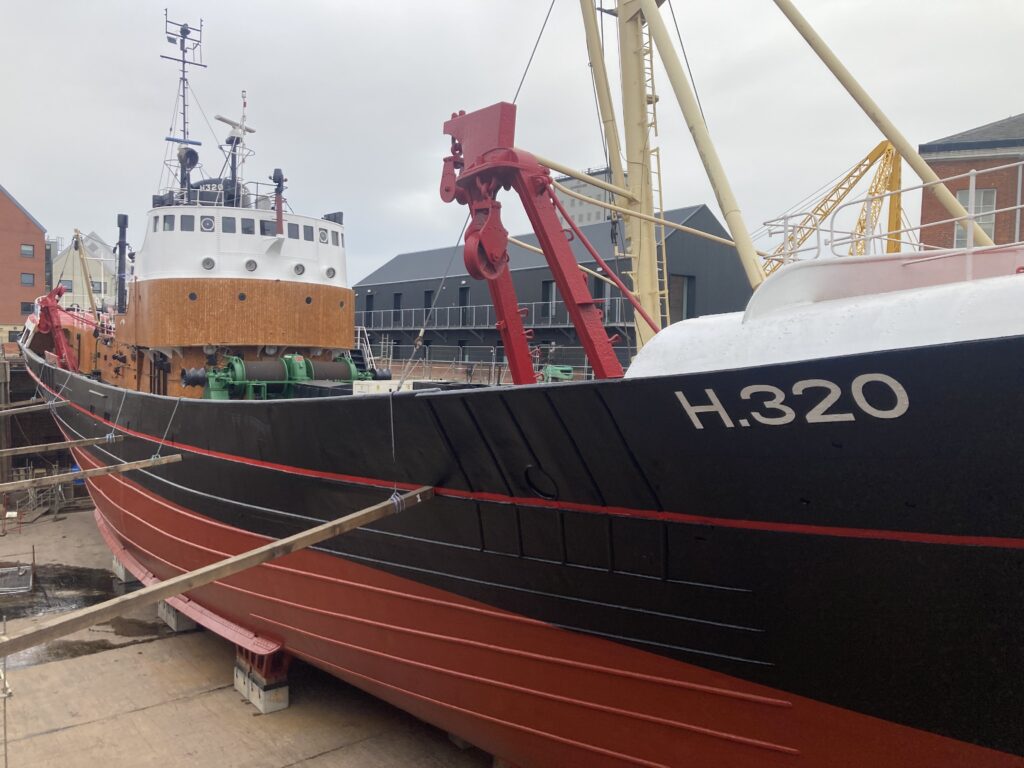
It’s unlikely that Margaret Thatcher will feature prominently in the Arctic Corsair when it re-opens to visitors in its new berth. Yet without her, Hull’s last surviving sidewinder trawler might well have ended up being cut up for scrap.
The Corsair’s long journey from fishing vessel to tourist attraction began in earnest under the then Conservative government’s Inner City Task Force programme. The programme was launched in 1985 in eight of the most deprived areas of the most disadvantaged cities in England as measured in a range of factors including unemployment, education, housing, health and wages. It took its cue from an initial task force set up by Mrs Thatcher after the Toxteth riots in Liverpool in 1982.
Surprisingly, Hull wasn’t among the first wave of eight but was added in 1992 under John Major’s government. At the time, Malcolm Watson was responsible for the national programme and working in the Department of Trade and Industry in London. “I was transferred from Whitehall to Hull to join the Task Force in 1992 because I’d been to university here. I had also worked as a porter at Hull Royal Infirmary on permanent relief shift work for a year and a half after leaving university so I knew the city well” he recalled. “Politically, the impetus came out of the inner city riots in the 1980s. ‘We must do something about these inner cities,’ said Thatcher at the time, handing the baton to Michael Heseltine and later Kenneth Clarke.”
“The primary function of the Task Force was to do something about unemployment and its social repercussions (in which the government had played a very large part, of course) by developing training programmes and helping start-up businesses. Each Task Force had a sponsor minister. Hull’s was the late Ann Widdecombe who visited quite a few times.”
Rescuing the Arctic Corsair was one of around 230 projects overseen by the Task Force. Other notable schemes included helping launch the Goodwin Development Trust, JobLink and IT in the Community as well as numerous numeracy and literacy projects in local schools. “I was the project officer for the Corsair, or the Arctic Cavalier as it was then. I was and still am very glad to have played a part in securing the trawler for the city and the people of Hull,” said Malcolm.
However, it wasn’t easy.
“Nobody in the Task force wanted the job as it was going to be difficult and messy. Funding rules meant you couldn’t spend money on capital projects which this plainly wasn’t so I converted the scheme into a Task Force/City Council training project for unemployed residents living in the Task Force area. The DTI wouldn’t have it and I had to rejig it another couple of times over the next few months before they passed it. Working with the council, training companies, the Department of Education, the Hull Training and Enterprise Council, the fishing heritage group STAND and the European Regional Development Fund, we got it up and running.”
Eventually, the Task Force provided a £400,000 grant to the city council to buy the vessel and fund an initiative for 25 trainees to work on its restoration. Even then, Malcolm recalls it wasn’t straightforward with mountains of paperwork required by the DTI on a regular basis covering monitoring and outputs. “It was a bloody nightmare for four years but it was worth it,” he said. “The Task Force’s efforts have largely been forgotten, which is the way of the world. It was a long time ago now and it was a Thatcher initiative (continuing under the Major years) which doesn’t necessarily endear it to the city fathers these days!”

You may have seen this show at the recent Freedom Festival. Here’s Alex from producers Silent Uproar to explain what goes on.

Tilly from HU7 asked this perfectly reasonable question at The Big Malarkey and we’d be delinquent in our duty if we didn’t get her an answer.

It’s been over 6½ years since the mysterious graffiti legend left his mark in our city. But what, asks our illicit artwork correspondent Angus Young, is it up to?
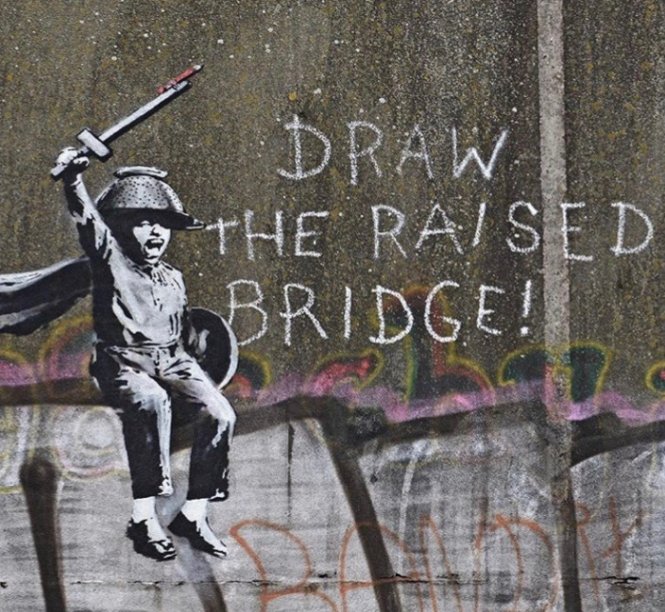
What were you up to in January 2018? You might have been still scratching your head wondering why Hull’s year as the UK City of Culture ended with a whimper rather than a bang. But arty types didn’t have long to ponder what was going to happen next. After a clandestine overnight operation, Britain’s most famous anonymous street artist left his latest work on the deck of a redundant road bridge spanning the River Hull.
Banksy’s Draw The Raised Bridge featured a small child wielding a toy sword above his head and prompted crowds to flock to Scott Street Bridge. I particularly liked the colander the kid was wearing as a makeshift helmet. When the initial excitement had died down, the question of what happens next started to be asked.
The bridge belonged to the city council but it had been closed to traffic since 1994 because of its deteriorating condition. Since then, it has been left in a raised position as if forever allowing boats to pass underneath. However by the time Banksy popped up, the council was slowly going through the decision-making process to dismantle the Grade II-listed bridge amid concerns it was now in imminent risk of collapse.
There was early drama when vandals struck and defaced part of the artwork, covering it with white paint. Luckily, window cleaner Jason Fanthorpe quickly stepped forward to clean it up before the paint fully dried and the council subsequently installed a protective plastic screen over it.
Nine months later the artwork was carefully cut into three pieces and removed by the council before being placed into storage with a promise that it would be placed on public display. Speaking at the time, the council’s portfolio holder for regeneration Daren Hale said: “We are absolutely delighted that we have managed to save our very own Banksy and we look forward to having it back for public viewing as soon as practically possible.”
Eight years later, we’re still waiting for a glimpse of the lad with his colander helmet. So what’s going on?
In 2023 the council confirmed it intended to move Banksy’s artwork into a new permanent home in Trinity Market. A year later the authority said surveys and reports were being carried out on the proposed move. Since then, not a lot.
As such, here at Curiosity Towers we regularly get asked the big question – when is the Hull Banksy actually going to be put back on public display?
A very helpful council spokesperson couldn’t give us a date but did provide us with the following statement. “The Banksy is currently held in secure storage ahead of being placed in Trinity Market. Specialist casing is required in order to safely and securely display an object of this size and nature. The council is therefore working with specialist contractors to undertake this work as soon as possible and will provide further updates when available.”
Angus Young

Artist Lucy Brooke (of the Feminine Urge Collective) chooses a pair of reliefs either side of the same building.